
Learn about non-placental mammals and understand the three different types of mammals. Explore their characteristics and see marsupials and monotremes examples.
Non-Placental Mammals | Definition, Types & Examples
Table of Contents
- What are Non-Placental Mammals?
- What are Mammals?
- Non-Placental Mammals
- Non-Placental Mammals Examples
- Lesson Summary
- FAQs
- Activities
Non-Placental Mammals: Discussion Questions
This activity will check your knowledge regarding the physical features and examples of non-placental mammals.
Directions
For this activity, print or copy this page on a blank piece of paper. Then, carefully read the given narrative and provide a written response to the questions that follow. You may use the web to search for ideas in answering the questions.
The Platypus
Mammals are animals with backbones, characterized by hair or fur for insulation, and mammary glands to nurse their young. There are three types of mammals: eutherians, marsupials, and monotremes, respectively. Among the three, only monotremes lay eggs. It consists of three species, including the platypus. The platypus is a fascinating animal; it was initially thought to be an animal whose body parts came from other animals and fused to create an unusual creature. The platypus has a paddle-shaped tail like a beaver, a furry exterior like an otter, and a flat bill with webbed feet like a duck. Males of the species have venomous spurs on their hind feet. Females typically lay their eggs in an underground burrow near the water. Offsprings hatch after ten days and will depend on their mother's milk for up to four months. Once they mature, they swim off and forage on their own.
Questions
- Are monotremes placental or non-placental animals?
- If a platypus resembles a duck and lays eggs, why is it classified as a mammal and not a bird?
- What are the similarities and differences between marsupials and monotremes?
- Which distinctive feature confirms that a platypus is indeed a monotreme?
- Give another example of an egg-laying mammal.
Sample Answers
- Monotromes are classified as non-placental mammals.
- A platypus is a mammal because it has a furry body and mammary glands to nurse its young.
- Masupials and monotremes are both non-placental animals. Their main difference lies in how they reproduce their young. Marsupials give birth to premature live young. On the contrary, monotremes lay their eggs that hatch after ten days.
- A platypus has a single hole, which serves as the entry to its reproductive region, and the exit of its urinary tract.
- Spiny ant-eaters are mammals that also lay eggs.
Do all mammals have placenta?
No. Instead, most mammals have placentas. However, there are a few non-placental mammals, which are divided into two groups: marsupials (mammals with an external pouch, e.g. kangaroos and wombats) and monotremes (mammals that lay eggs, e.g. echidnas and platypuses).
Are kangaroos monotremes?
No. Kangaroos are marsupials. Though both monotremes and marsupials are both non-placental mammals, they are not identical. Monotremes are mammals that lay eggs. In contrast, kangaroos and other marsupials give birth to live, under-developed offspring with continue to develop in an external pouch.
What type of animals are monotremes?
Monotremes are non-placental mammals. Because they are mammals, they have hair/fur and produce milk. However monotremes lay eggs instead of giving birth to live young. The only two living monotremes are Duck-billed Platypus and Spiny Anteater (also called Echidnas).
Table of Contents
- What are Non-Placental Mammals?
- What are Mammals?
- Non-Placental Mammals
- Non-Placental Mammals Examples
- Lesson Summary
The science of taxonomy focuses on classifying living organisms, which means grouping them by their characteristics and evolutionary history. ALL living things are grouped taxonomically. For example, humans are classified at Eukaryotic (our cells have nuclei) Chordates (we have backbones), Class Mammalia (warm-blooded animals that have fur and make milk), Order Primates (large-brain animals with specialized social behaviors), and Species Homo sapiens. Specifically, humans are a type of mammal called a placental mammal — mammals that have long pregnancies and give birth to well-developed offspring. Most, but not all, mammals are placental mammals. However, there is a significant number of non-placental mammals. These animals do not have a placenta and have very short pregnancies. Their offspring either hatch out of eggs (monotremes) or are birthed very prematurely and develop in external pouches (marsupials). This lesson will provide an in-depth comparison of these various mammalian reproductive strategies.
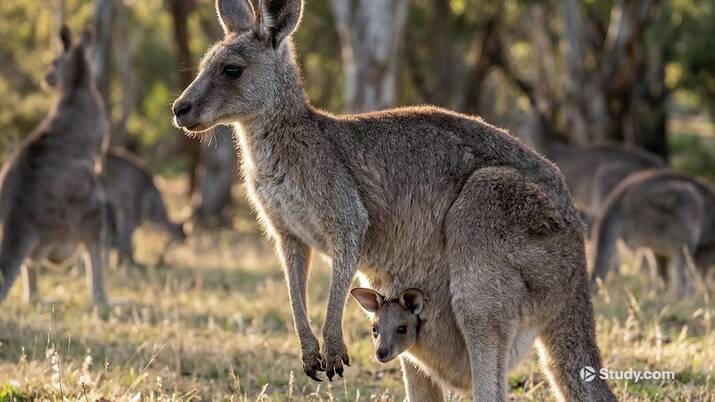
Your next lesson will play in
10 seconds
All members of Kingdom Animalia (multicellular heterotrophs, organisms that eat other organisms to obtain energy) are divided into two groups — the vertebrates, or animals with a backbone, and the invertebrates, animals without a backbone. Vertebrates are then subdivided into five different categories: fish, amphibians, reptiles, birds, and mammals. Mammals have specific traits that separate them from the other vertebrates, including:
- Endothermic (warm-blooded)
- All mammals (and birds) are endothermic, meaning they regulate their internal body temperature.
- Fur
- All mammals have hair or fur covering all or part of their bodies. This helps preserve body heat.
- Mammary glands
- All mammals nurse, or make milk for their young
- Three inner ear bones
- In humans, these bones are named the hammer, stirrup, and anvil.
- A diaphragm
- This strong muscle separates the thoracic cavity (chest region) from the abdominal cavity (belly region)
- Enucleated red blood cells
- Mammalian red blood cells do not have a nucleus; all other vertebrate red blood cells do
Even though all mammals share the above characteristics, there is still amazing diversity in the class — from the towering giraffe to the incredibly odd duck-billed platypus.
Different Types of Mammals
 |
Class Mammalia is sub-divided into three groups based on how they produce offspring, which is also known as their reproductive strategies:
- Prototheria (Egg-laying mammals)
- This group is more commonly known as the monotremes
- Theria (Viviparous mammals, or mammals the birth live young)
- Metatheria(also called Marsupials)
- Mammals that give birth to very underdeveloped young and nurture them in an external pouch
- Eutheria (also called Placental mammals)
- Mammals with a long gestations period (pregnancy) who nurture their developing young with a specialized organ called a placenta
- Metatheria(also called Marsupials)
(Note: The root of these various sub-categories of mammals, "-theria comes from the Greek for wild-animal.)
Only one of these groups, Eutheria, contains placental mammals. However, this is by far the largest of the three groups; most animals alive today are Eutherians, or placental mammals. The other two groups — Prototheria (monotremes) and Metatheria (marsupials) — make up the non-placental mammals. In contrast, both of these groups are quite small - there are only two known living Prototherian species and just a handful of Metatherian species.
Most mammals alive today are placental mammals; they have a specialized organ called a placenta that develops during pregnancy to provide oxygen and nutrition to the developing fetus. Because of this, placental mammals can have relatively long gestations (long pregnancies) and give birth to more fully developed offspring.
In contrast, non-placental mammals do not have a placenta and have much shorter pregnancies. Their offspring are usually born less developed than placental mammals. There are two distinct types of non-placental mammals:
- Monotremes (protherians) — egg-laying mammals that do not give birth to live young
- There is only one order of monotremes alive today, Order Monotremata
- Marsupials (metatherians) — mammals that give birth to immature fetuses and nurture them in an external pouch
- There are two orders of marsupials alive today
- Order Australidelphia (Australian marsupials)
- Order Ameridelphia (American marsupials)
Monotremes
Monotremes are egg-laying mammals. They are the only mammals that do not give birth to live young. Because their young do not develop long-term inside the mother, there is no need for a placenta. However, monotremes do still make milk and nurse their young after they hatch, but even this is done in a unique way. Monotremes do not have nipples; instead, their mammary glands lie under their skin and are very similar to sweat glands. The developing offspring lick the milk from their mother's skin. Monotremes get their name from the fact that their urinary, digestive, and reproductive systems share a single-opening (mono-" means one, -treme means opening). The internal duct where all three systems combine is called the cloaca, which acts as the animal's anus, exit for the urinary tract, and reproductive opening. Monotremes are the only mammals to have all three of these organ systems converge internally.
There are only two species of monotremes alive today, though a few others appear in the fossil record. The only two extant monotremes are:
- Duck-billed Platypus — These medium-sized, furry, web-footed animals caused an uproar when specimens were first sent to Europe in 1798. Scientists debated whether they should be classified as mammals (because they had fur) or a bird (because of the bill and the fact that it had no nipples). Some scientists believed the platypus was a hoax constructed by a taxidermist! Platypuses have large, duck-shaped beaks that are good at digging up small invertebrates (insect larvae, worms, shrimp, etc) to eat. Male platypuses have venomous spurs on their hind legs. Platypuses lay eggs about a month after mating, and the small, ~1 cm-wide eggs hatch after 10 days. Newly hatched platypus pups are blind and hairless. Duck-billed platypuses are native only to Australia.
- Echidna (also known as Spiny Anteaters) — small, web-footed, insect-eating animals found in Australia and New Guinea. Their backs are covered in spines made of keratin, the same protein in hair, fingernails, and hooves. (In contrast, non-spiny-anteaters, which are placental mammals found in South and Central America, are covered in long fur). Like platypuses, male echidnas have spurs on their hind feet, but the spurs are non-venomous. Echidna lay eggs approximately 16-28 days after mating, and the eggs are carried around by the mother in a pouch. The eggs hatch after approximately 10 days, when the infant is approximately the size of a raisin.
Marsupials
Marsupials are a type of therian meaning they are mammals that give birth to live young. However, marsupials have very short gestation periods - often only about a month. The offspring are born as premature fetuses, which then continue to develop in a pouch attached to the mother's body. Marsupial offspring will stay in the mother's pouch for several months to a year, depending on the species. The name "marsupial" comes from marsupium, which is Latin for "purse," a reference to the pouch that defines the group.
Marsupials are divided into two main "super-orders" based on geography:
- Magnorder Australidelphia — Marsupials living in Australia and New Guinea. This category includes 75% of all known marsupials, including koalas, kangaroos, wallabies, bandicoots, and wombats, among others.
- Magnorder Ameridelphia — Marsupials living in North and South America. Most of these marsupials are various types of opossums.
Though in modern times most marsupials are found in Australia, there is significant fossil evidence that the group first evolved millions of years ago in what is now South America and migrated to Australia via (a much warmer) Antarctica.
There are several different types of non-placental mammals alive today, and most are found in various parts of Australia and New Guinea. Even more species can be found in the fossil record.
Marsupial Examples
The most common type of marsupial in North and South America are the various species of opossums (scientifically, opossums are found in the Americas and possums are found in Australia. However, colloquially the two names are used interchangeably).
 |
Australian marsupials include
- kangaroos
- wallabies
- koalas
- bandicoots
- wombats
 |
Monotreme Examples
Monotremes are only found in Australia and New Guinea. There are only two different species of living monotremes alive today:
- Duck-billed Platypus (Australia only)
 |
- Echidna (Spiny Anteaters) (Australia and New Guinea)
 |
Mammals are types of animals with the following characteristics:
- Endothermic (warm-blooded)
- Body covered in hair/fur
- Make milk to feed young
- Have three inner ear bones
- Have a diaphragm (muscle between chest and belly)
Mammals are divided into two main types:
- Plancental mammals (also called Eutheria), which have long pregnancies and give birth to highly-developed offspring. The offspring are nourished during pregnancy by the placenta, an organ that transfers oxygen and nutrients to the growing fetus.
- Non-placental mammals, which have very short pregnancies (usually only a week or two) and whose offspring develop outside of the mother's bodies.
Non-placental mammals are further divided into two main groups:
- Monotremes (also called Prototheria), which are egg-laying mammals
- Examples of monotremes are duck-billed platypuses and echidnas
- Marsupials (also called Metatheria), which are mammals with pouches
- Examples of marsupials include kangaroos, wombats, koalas, bandicoots, and possums.
Most (98%) mammals are placental mammals. There are only two types of monotremes alive today, and they are only found in Australia and New Guinea. There are several different types of marsupials, but almost all are only found in Australia (except for the possum, which is found in both the Americas and Australia).
Video Transcript
Kingdom Animalia
A kingdom is a classification level that includes many different types of organisms. For instance, snakes, bears, and insects are all in the same kingdom! All living things are classified into six kingdoms. Mammals are included in Kingdom Animalia, which itself includes a number of different classifications. In this lesson, you will learn about the two categories of non-placental mammals: the marsupials and the monotremes.
What are Mammals?
Mammals share four main characteristics. An important characteristic of mammals is that they are warm-blooded. The body temperature of a warm-blooded animal can be kept higher than the surrounding environment. Another characteristic that mammals have in common is that they are vertebrates, which means they have a backbone. Mammals also all have hair or fur, and they produce milk to feed their young.
Let's talk about three different types of mammals: eutherians, marsupials, and monotremes. Eutheria are mammals that are attached to a placenta early on during their development. Eutheria are placental mammals. The focus of this lesson, however, is non-placental mammals, which are the other two categories of mammals: marsupials and monotremes. Non-placental mammals are not attached to the mother via a placenta.
Non-Placental Mammals
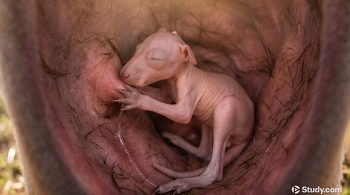
Marsupials are mammals that carry their young in a pouch early on during their development. The young of marsupials are born very underdeveloped. Once a marsupial is born, it locates its mother's nipple and stays in her pouch until it is more developed. Examples of marsupials are possums, koalas, and kangaroos.
 |
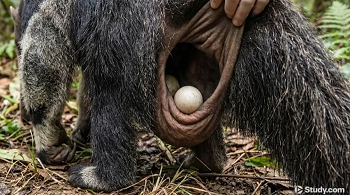
Monotremes are the most primitive type of mammal, and their young hatch from eggs. There are only three species of monotremes. They are the duck-billed platypus and two different types of spiny anteaters. The anteater carries its eggs in a pouch on the female's body until they hatch. The young, underdeveloped anteaters then find their mother's mammary gland and latch on for nourishment.
 |
Monotremes only live in two locations in the world: Australia and New Guinea. The word ''monotreme'' means ''one-holed.'' The name refers to the monotreme's cloaca, which is the animal's anus, the entry to its reproductive tract, and the exit of its urinary tract.
Lesson Summary
Mammals are animals that are warm-blooded, have fur or hair, produce milk for their young, and are vertebrates. Warm-blooded animals are those whose body temperature is not affected by the environment. Vertebrates are animals that have a backbone. Mammals are further broken down into three groups: eutherians, marsupials, and monotremes.
Eutheria are mammals whose young are nourished for an extended period of time by an organ called a placenta during their early development in the womb. Monotremes and marsupials are non-placental mammals, meaning the young are not attached to the mother via a placenta. Marsupials are mammals that carry their young in a pouch early on during their development. Monotremes are the most primitive type of mammal; their young hatch from eggs. Monotremes have cloacas, holes in their bodies that serve as the animal's anus, the entry to its reproductive tract, and the exit of its urinary tract. Examples of non-placental mammals are koalas, possums, kangaroos, the duck-billed platypus, and the spiny anteater.
Register to view this lesson
Are you a student or a teacher?
Unlock Your Education
See for yourself why 30 million people use Study.com
Become a Study.com member and start learning now.
Become a MemberAlready a member? Log In
BackResources created by teachers for teachers
Over 30,000 video lessons
& teaching resources‐all
in one place.


I would definitely recommend Study.com to my colleagues. It’s like a teacher waved a magic wand and did the work for me. I feel like it’s a lifeline.
Jennifer B.
Teacher

Back

Non-Placental Mammals | Definition, Types & Examples Related Study Materials
Explore our library of over 88,000 lessons
Browse by subject