
By The Study.com Editorial Team, Last Updated 08/25/2026
Key Takeaways
- As of January 2026, the TOEFL® iBT is shorter, adaptive, and more personalized, with updated tasks and a smoother overall test experience.
- The total test time drops from 116 minutes to about 90 minutes, thanks to shorter stimuli and redesigned section formats.
- Reading and Listening are multi-stage adaptive, adjusting question difficulty based on performance and using more modern academic and real-life scenarios.
- Scoring shifts from 0-120 to a 1-6 band scale, with 0.5-point increments.
- During 2026-2028, score reports will show both scales, giving schools time to compare systems before the 1-6 band becomes the only standard.
What Are the Major Changes to the TOEFL® iBT in 2026?
| Change | What's New |
|---|---|
| Adaptive Testing | Reading and Listening now use multi-stage adaptive format adjusting to student ability |
| Test Duration | Total time drops from ~116 to ~90 minutes; Speaking cut from 29 to 8 minutes |
| Scoring | New 1-6 band scale aligned with CEFR; results within 72 hours |
| At-Home Testing | Dedicated proctors, AI identity checks, streamlined workflows (from May 2025) |
| Accessibility | Stereophones at test centers; large print, Braille, audio, extended breaks available |
| Registration | Redesigned booking process for both test center and at-home options |
What's Changing in the TOEFL® Exam Format?
The 2026 TOEFL® iBT now features updated task types across Reading, Listening, Speaking, and Writing.
| Section | Old TOEFL® Duration | New TOEFL® Duration |
|---|---|---|
| Reading | 35 minutes | 30 minutes |
| Listening | 36 minutes | 29 minutes |
| Writing | 16 minutes | 23 minutes |
| Speaking | 29 minutes | 8 minutes |
| TOTAL | ~2 hours | ~1 hour and 30 minutes |
What Are The New TOEFL® Reading Task Types?
The TOEFL® now includes three new Reading task types, each testing a different level of English reading ability.
| Skill | Prompt Type | Task |
|---|---|---|
| Complete the Words | Short passages with missing letters | Complete the spelling so the passage makes sense |
| Read in Daily Life | Announcements, emails, or online articles | Locate facts and make inferences from context |
| Read an Academic Passage | University-level textbook passage | Answer questions on main ideas, vocab, details, and inferences |
What Are The New TOEFL® Listening Tasks?
The new TOEFL® Listening section will now feature four diverse task types that revolve around both academic and daily life situations.
| Skill | Prompt Type | Task |
|---|---|---|
| Listen and Choose a Response | Single spoken sentence | Pick the most appropriate response from four options |
| Listen to a Conversation | Short conversation with idiomatic expressions and colloquialisms | Answer questions on speakers' tone, intentions, and details |
| Listen to an Announcement | Brief announcement in a school or campus setting | Make inferences about the announcement |
| Listen to an Academic Talk | Short academic lecture | Answer questions on main ideas, discussion structure, or arguments |
What Are The New TOEFL® Speaking Task Types?
The Speaking section now includes just two task types, both focused on natural spoken communication.
| Skill | Format | Task | Scoring/Notes |
|---|---|---|---|
| Listen and Repeat | 7 short sentences, each with a visual cue (picture or map) | Listen once, then repeat the sentence as accurately as possible | Based on pronunciation, rhythm, and accuracy |
| Take an Interview | 3-4 interview-style questions on familiar topics | Respond to each question with no preparation time | 45 seconds per question; focus on fluency and clear communication |
What Are The Task Types in the New TOEFL® Writing Section?
The Writing section tests how well you can construct, respond, and argue in written English across three real-world and academic contexts.
| Skill | Prompt | Task |
|---|---|---|
| Build a Sentence | Scrambled sentences from a casual conversation | Put the words in correct order to make them grammatically correct |
| Write an Email | A set of premises (an event, a problem, or a solution) | Write an email responding to a realistic situation |
| Write for an Academic Discussion | Short online classroom discussion | Write a response to share an opinion, support a position, or introduce a new idea |
How are the TOEFL® Scores Changing in 2026?
In 2026, ETS replaced the 0-120 TOEFL® scoring scale with a new 1-6 band scale aligned to the Common European Framework of Reference (CEFR). Each of the four sections (Reading, Listening, Speaking, and Writing) receives a band score from 1.0 to 6.0 in 0.5-point increments. The overall score is the average of the four section scores, not their sum.
During the transition period (2026-2028), score reports will show both the old 0-120 score and the new 1-6 band. After 2028, only the 1-6 band will remain.
| New Band (1-6) | CEFR Level | Proficiency | Old Score (0-120) |
|---|---|---|---|
| 6.0 | C2 | Mastery | ~114-120 |
| 5.0-5.5 | C1 | Advanced | ~94-113 |
| 4.0-4.5 | B2 | Upper Intermediate | ~72-93 |
| 3.0-3.5 | B1 | Intermediate | ~42-71 |
| 2.0-2.5 | A2 | Elementary | ~18-41 |
| 1.0-1.5 | A1 | Beginner | ~0-17 |
How to Prepare for the 2026 TOEFL® Changes?
To prepare for the 2026 TOEFL®, focus on the adaptive format, updated task types, and the new 1-6 band scoring scale so you can walk into the exam knowing exactly what to expect.
1. How do you get familiar with the adaptive format?
- The 2026 TOEFL® uses a multi-stage adaptive format, so question difficulty changes based on your performance as you move through the test.
- Practice with materials that reflect this structure so the format feels familiar on test day.
- Work through questions at varied difficulty levels instead of practicing at one fixed level.
2. How should you practice the new task types?
- The 2026 TOEFL® includes updated Speaking and Writing tasks that differ from the previous exam format.
- Use ETS-aligned prep materials that include the new question types.
- Spend extra practice time on Speaking and Writing because those sections have changed the most.
3. What should you know about the 1-6 band scale before test day?
- The 2026 TOEFL® reports scores on a 1-6 band scale aligned to CEFR, replacing the previous 0-120 score.
- Check what band score your target school requires before you build your study plan, since admissions benchmarks will shift from the old scale.
- Use the band scale as a progress benchmark during practice, not just as a score to interpret after the exam.
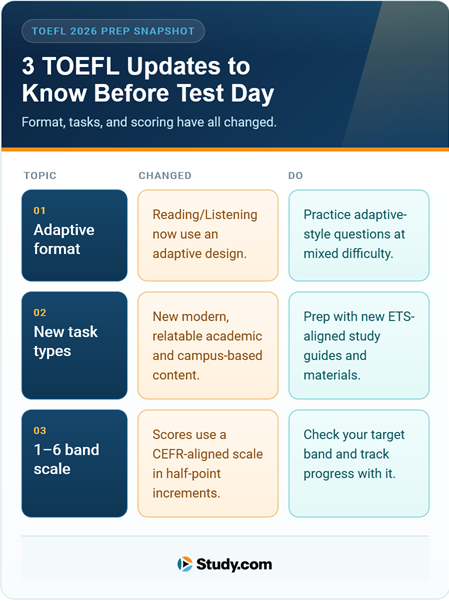 |
Infographic created and reviewed by Study.com's TOEFL® Test Prep team.
How to Get Ready for the Brand New 2026 TOEFL® Changes?
To get ready for the brand new 2026 TOEFL® changes, students should prepare early, use updated practice materials, and build confidence with the new format, task types, and scoring system. Because the 2026 exam is shorter and adaptive, ETS recommends using updated prep materials that reflect the new structure, not older versions of the test.
Frequently Asked Questions About the Changes in the New TOEFL® iBT
Will the new TOEFL® be easier than the current version?
Not necessarily. The 2026 TOEFL® is designed to be more efficient and realistic, not automatically easier. While the shorter format may reduce fatigue, students will still need strong reading, listening, speaking, and writing skills. The adaptive structure may also make the experience feel different depending on individual performance.
Are the 2026 TOEFL® changes more important for first-time test takers or repeat test takers?
These tips for mastering the 2026 TOEFL® Reading section matter whether you're a first-timer or a repeat test taker. Repeat test takers may notice the differences from the older format more clearly since they can compare firsthand. First-time test takers, on the other hand, should focus less on what changed and more on building comfort with the current Reading structure. That's the fastest path to a strong score.
Can students still use older TOEFL® prep materials for the 2026 exam?
Older TOEFL® prep materials can still help build general English skills, but they may not fully reflect the new exam's task types, timing, or adaptive structure. Students should use updated resources whenever possible so their practice matches the format, expectations, and pacing of the version they will actually take.
What should you do if your target school hasn't updated its TOEFL® reading requirements yet?
While you work to master the 2026 TOEFL® Reading section, it's also smart to reach out to your target school's admissions office and ask how they plan to interpret the new TOEFL® scores during the transition period. This is especially important for schools that haven't published clear guidance yet, since score policies may vary across institutions, programs, and application cycles.