
Written by Farooq Alvi and Nupur Bharadwaj
As higher education transforms year by year, students' perspectives offer crucial insights into the road ahead. From financial pressures to technological shifts and mental health concerns, college students face significant challenges.
Study.com surveyed 200 undergraduate students to hear their unique perspectives and gain firsthand insights into their predictions for college education, what they anticipate their biggest challenges to be, how they see technology shaping their college experience, and more.
Key Takeaways
- Students predict that their top three challenges will be: finances and student debt (50%), anxiety and stress (45%), balancing school and work (33%)
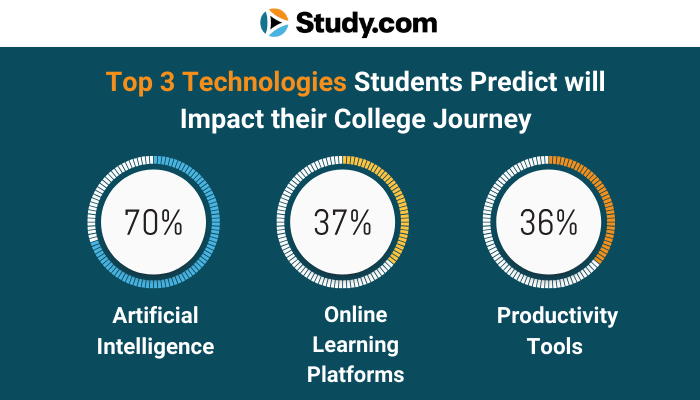
- 70% of students predict that Artificial Intelligence (AI) tools like ChatGPT will make the biggest impact on their college experience
- 47% of current college students said they anticipate using alternative course platforms like Study.com, Coursera, Khan Academy, etc. to help them learn, retain, or understand academic material often (1-2 times per week) or all the time (3-4 times per week)
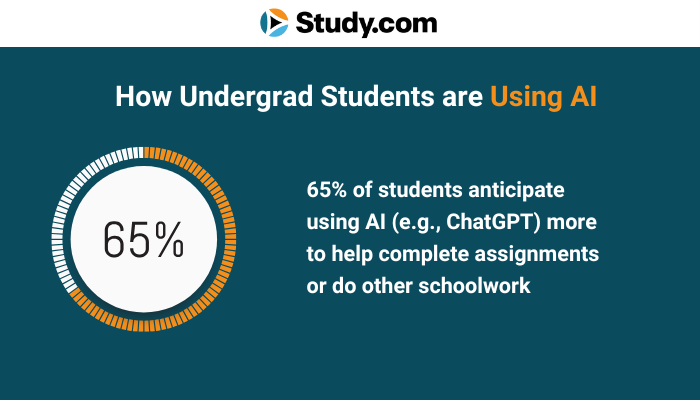
- 65% of students anticipate using AI (e.g., ChatGPT) more to help complete assignments or do other schoolwork
- 50% of students believe that colleges should prioritize stress and time management support services for student well-being
Students' Top 3 Predicted Challenges
Financial Struggles
When asked what they thought their biggest challenges would be, 50% of undergraduate students surveyed responded with finances and student debt. This is not shocking, as according to the Education Data Initiative, as of 2025, student loan in the United States totals $1.8 trillion. What's more, the average federal student loan debt balance is $38,375 and the average public university student borrows $31,960 to attain a bachelor's degree.
Mental Health Struggles
Stress, burnout, and emotional well-being also remain significant concerns, especially as students juggle multiple priorities, with 45% of students saying that anxiety/stress was their predicted top challenge. One student said, "I feel I might have to stop attending school due to being overwhelmed."
Balancing Work and Academics
Juggling jobs alongside coursework is another major challenge, with many struggling to find enough hours in the day for both. 33% of students said that balancing schoolwork with work/career was their predicted top challenge. One student shared, "I expect to be very stressed balancing work and school."
It is also notable that 26% of students cited time management as their top predicted challenge, further highlighting this struggle.
 |
Support Services Students Think Colleges Should Prioritize
Students have clear opinions on what support they need from their colleges. The top three priorities they identified are:
- Stress and time management workshops - 50%
- Mental health counseling - 44%
- More flexibility in deadlines and coursework - 43%
Additional needs include financial literacy support (39%), increased access to academic advising (33%), and career or financial counseling (29%).
These priorities align closely with students' biggest concerns. Workshops on stress and time management directly address the anxiety and burnout many students anticipate, while financial literacy support could help students navigate tuition costs, student loans, and budgeting challenges.
National surveys demonstrate a rising prevalence of anxiety and stress among young people as well, impacting learning outcomes and retention rates. For example, recent data from Inside Higher Ed's 2024 Student Voice survey found that two in five students say their mental health is impacting their ability to focus, learn, and perform academically "a great deal," and one in ten students rate their mental health as "poor".
 |
Technology Predictions
Technology continues to shape education, influencing how students learn, study, and complete coursework. Colleges are adapting to these changes, with some implementing AI-specific policies, such as banning AI-generated work without citation or integrating AI literacy courses into the curriculum.
Students predict the top technologies that will impact their college experience:
- Artificial intelligence tools like ChatGPT - 70%
- Online learning platforms (e.g., Study.com, Coursera) - 37%
- Productivity tools (e.g., Grammarly, Canva) - 36%
 |
A Word About AI
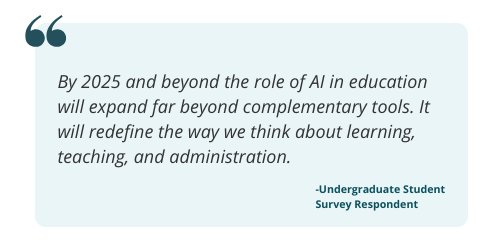
AI is becoming a key part of students' academic experience, assisting with studying, understanding college coursework in topics ranging from chemistry to statistics.
 |
With AI's expanding role, 65% of students anticipate using AI more to complete assignments and schoolwork.
How students are using AI today:
- Studying for exams - 47%
- Understanding course material - 44%
- Brainstorming assignments - 42%
The Cengage Group's 2024 GenAI Report reveals a surge in AI adoption, with 79% of students anticipating a positive learning impact and 69% of educators already integrating AI tools. AI's rapid adoption is pushing universities to prioritize literacy programs and address ethical concerns.
 |
AI and Academic Integrity
Students recognize the challenges AI presents to academic integrity. Some worry about over-reliance, with one student stating:
"I believe the use of AI is going to be detrimental to student learning because students are relying too much on it and aren't actually learning."
 |
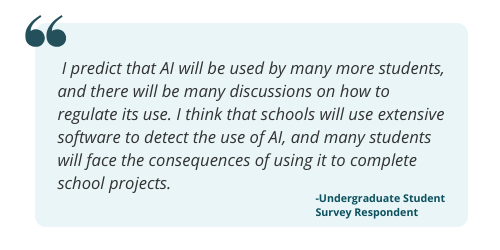
Inside Higher Ed's 2024 Student Voice survey found that three in ten students are unclear about when they are permitted to use AI in coursework, highlighting the need for clearer academic policies.
Although there are concerns surrounding AI use and academic integrity, our survey found that most students use AI to enhance learning.
 |
Online Learning
Online learning platforms, as seen by the results above, are also prevalent, with 47% of respondents saying they anticipate using alternative course platforms often (1-2 times per week) or all the time (3-4 times per week). Whether this be for credit transfer or helping understand coursework, it's safe to say online learning is among the top technologies for students.
Voice of the Student - Recurring Themes
Our survey concluded with the open-ended question: "Please share one prediction you have about the upcoming school year." Students' responses revealed recurring themes about the challenges and changes they expect to see.
- AI's growing role in education - Many believe AI will become even more integrated into learning, with some embracing its benefits and others concerned about academic integrity.
- Financial uncertainty - Rising tuition and limited financial aid continue to be major worries, with students fearing that affording college will only get harder.
- Mental health struggles - Increased workloads, financial stress, and balancing multiple responsibilities have students anticipating higher anxiety levels.
- A shift toward alternative learning - Some expect online platforms and non-traditional education paths to become even more essential for academic success.
Conclusion - College Students and Their Outlook on Education's Future
College students remind us that they foresee the upcoming school year to bringing continued financial strain, mental health challenges, and the ongoing struggle to balance academics with other responsibilities. And while it's true that these challenges will impact students, so will technology solutions like online learning platforms, productivity tools, and AI tools as they continue to broaden the possible ways students can learn.
Methodology
This survey, conducted in February 2025, gathered responses from 200 current undergraduate students across the U.S. Our primary goal was to understand what students predicted their education would look like in the future, understand the challenges they foresee, and highlight the voice of college students across the US.
About Study.com
Study.com empowers over 34 million learners and educators each month through its award-winning online platform for K-12 curriculum, college courses, and test prep. Serving educators in 11,000+ school districts nationwide, Study.com meets Level IV evidence standards under the Every Student Succeeds Act (ESSA). Headquartered in Mountain View, CA, it has been recognized by Fast Company as one of the world's most innovative companies and included in the GSV150 for four consecutive years.
Study.com offers a comprehensive guide to preparing for teacher certification exams like Praxis, TExES, and GACE.