
Key Takeaways:
- AI disruption is hitting entry-level Gen Z jobs first because it automates many "starter tasks" (basic admin, first drafts, simple analysis).
- More future-proof careers share the same core: hands-on work, high stakes, licensing, or human trust (healthcare, trades, clean energy, security/compliance, education).
- Your advantage is a skill stack. Pair human skills (communication, leadership, critical thinking) with AI literacy (use tools well, verify outputs).
- Future-proofing is actionable now: audit your tasks, upskill in AI/data basics, build proof through projects or a small portfolio.
Nearly two-thirds of young workers today say they worry AI will eliminate jobs, according to a 2025 Deloitte survey.
This fear is founded, considering that a recent study from Stanford reports a 16% drop in employment for workers ages 22 to 25 in occupations most exposed to AI. This is in contrast to older workers in those same roles gaining ground.
The result is a shakier entry point into careers that once served as reliable launchpads for the so-called tech-savvy generation.
With the Gen Z job market in transition, are there Gen Z jobs that are future-proof against AI disruption?
Read on to find out.
How is AI Disruption Redefining the Gen Z Job Market?
AI disruption is hitting Gen Z jobs first because it targets the exact work many entry-level roles were built around: repeatable, screen-based tasks that are easy to review. Think first-pass research, basic analysis, meeting notes, simple customer replies, scheduling, and template-driven content.
AI may not replace the entire role, but it can absorb enough "starter tasks" that companies need fewer junior hires to get the same output.
That shift shows up in research:
| McKinsey estimates that, at current capability levels, AI agents could perform tasks that occupy 44% of US work hours (with robots adding more potential). That does not mean those jobs vanish, but that many job descriptions change. |
At the same time, demand is growing in jobs that are harder to automate, especially roles that require hands-on work, safety judgment, licensing, or direct human care.
 |
What are the Best Jobs for Gen Z That Can Survive AI Disruption?
Among the best jobs for Gen Z in 2026 are careers in healthcare, renewable energy, and education, roles that remain resistant to AI disruption because they depend on human interaction and real-world complexity.
 |
AI-vulnerable roles (especially at entry level):
Before we go into which Gen Z careers are future-proof, let's first quickly dive into roles that are most vulnerable to AI disruption:
- Routine admin, scheduling, and basic coordination
- Data entry and simple bookkeeping
- Template-heavy content production (first drafts, basic variations)
- Tier-1 customer support scripts and standard replies
- Clerical roles that mainly move information between systems (where employers expect automation to grow fastest)
AI-resilient roles
On the other hand, here are the future-proof career pathways that tend to be more AI-resilient:
- Education and student support: Teaching and support roles depend on relationships, motivation, and adapting to learners in real time. AI can assist, but it cannot lead a classroom or fully mentor a student.
- Security, compliance, and risk: As AI spreads, fraud and cyber threats evolve too. Human oversight still matters for high-stakes decisions, policy, and response.
- Healthcare and patient care: AI cannot replace licensed clinical judgment, patient communication, or responsibility for outcomes.
- Skilled trades and repair: Real worksites are unpredictable. Diagnosing problems, working safely, and fixing things in the field still require hands-on skills.
- Renewable energy installation and maintenance: Clean energy jobs are often site-based and equipment-based. Technicians still install, inspect, and troubleshoot.
 |
How to Future-Proof Your Career in the AI Era
If you already have a job and don't want to start over, there are still ways for you to thrive.
Here are 4 steps you can take to shift from "replaceable" to "valuable":
 |
1. Audit your work for AI disruption risks
First, you'd want to know where AI becomes a risk. Do a quick audit of your tasks:
- Repeatability: How much of your work is copying, sorting, summarizing, or filling templates?
- Digital-only output: If your work happens entirely on a screen, could AI create a usable first draft?
- Stakes and responsibility: If something goes wrong, who is accountable, and how serious is the impact?
- Human contact: Do you work with customers, patients, students, clients, or teams in real time?
If most of your value is repeatable or replaceable by AI, it is time to reposition toward tasks that involve decisions, quality control, people, or outcomes.
2. Learn AI Skills
While you don't need to become an AI engineer, you do need AI skills that can help you advance in your role so you can shift from "task doer" to "task owner".
Think of AI literacy as four practical habits:
- Know what AI is good at (and what it's bad at): Great for drafts, summaries, brainstorming, and pattern spotting. Weak at truth-checking, nuance, and high-stakes decisions.
- Verify outputs before you use them: Treat AI like a fast assistant, not a source. If you are using it for health, legal, finance, education, or policy work, verification is not optional.
- Use AI to speed up work, then add judgment: Let AI produce a first draft. Your value is improving it: adding context, checking facts, aligning tone, and making it usable.
- Protect privacy and data: Do not paste sensitive info into public tools. Learn what counts as confidential at work: customer data, student records, internal documents, and anything tied to personal identity.
If AI disappeared tomorrow, what value would you still bring? If the answer is "I solve problems, work with people, and improve outcomes," you are already moving into safer territory.
| If you're coming from a non-tech background and are still unfamiliar with AI concepts, you'd want to first learn the basics. You can take AI classes such as Introduction to Artificial Intelligence and Data Science Courses, or explore tools like GitHub, Kaggle, and Google Colab for AI skill-building. |
3. Build future-proof skills AI can't mimic
Along with your AI skillset, build human-centered skills that employers simply need.
Focus on skills that show up in real work situations:
- Empathy and communication: Can you explain a problem clearly to a customer, a patient, or a teammate? Can you ask better questions when something is unclear?
- Conflict resolution: When people disagree, can you keep things calm and move the work forward? This matters in teams, classrooms, clinics, and client work.
- Leadership and accountability: Can you own a task end-to-end, follow through, and communicate progress without being chased?
- Critical thinking: Can you spot weak logic, missing context, or bad assumptions? This is especially important when AI gives confident answers that may be wrong.
For example, in a Study.com survey, hiring managers reveal the top in-demand soft skills they look for when hiring registered nurses:
 |
This is, of course, best paired with in-demand technical nursing skills developed through formal education and training, like:
Meanwhile, K-12 teachers are expected to possess these soft skills:
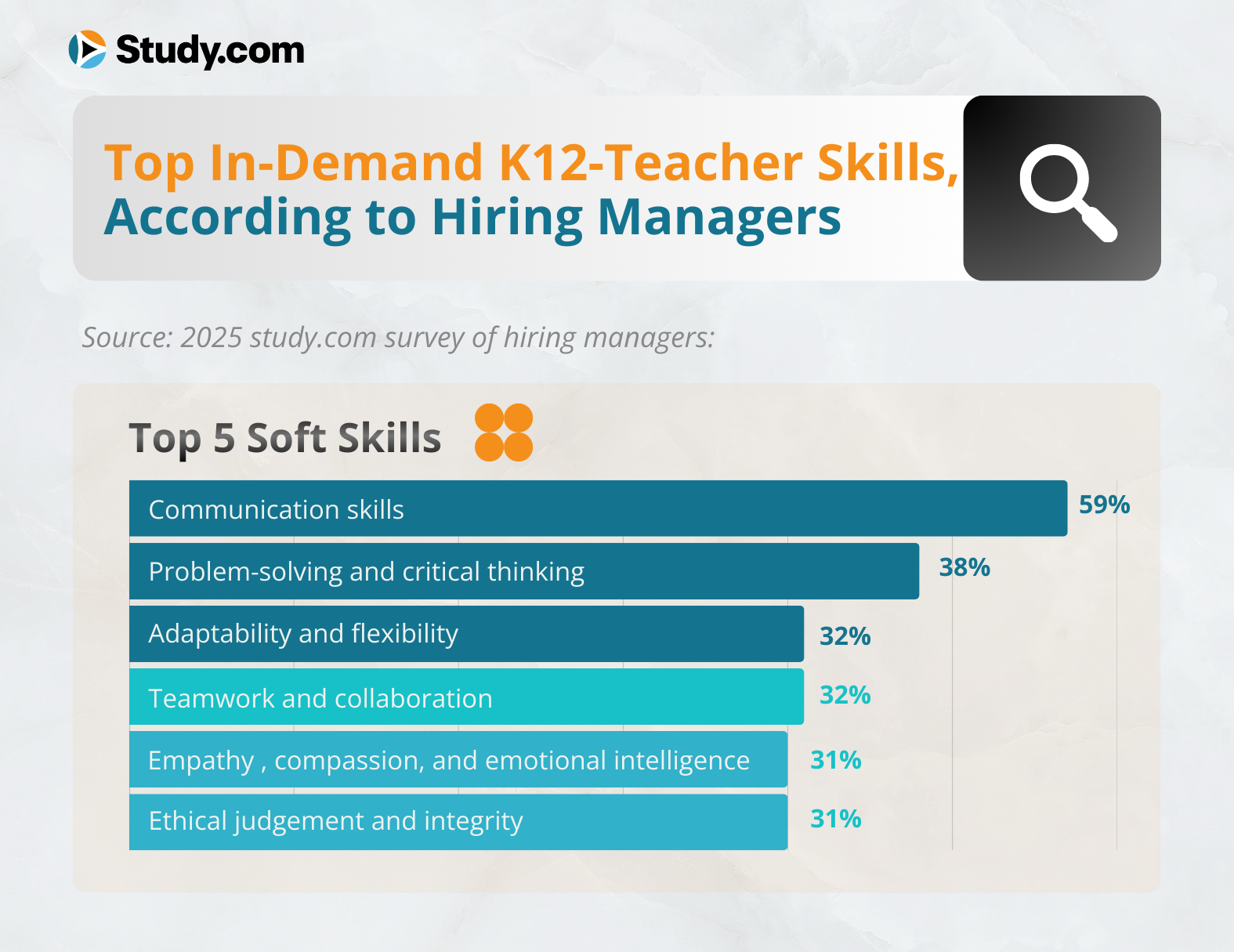 |
Topped off with subject matter expertise, classroom management techniques, and curriculum standard knowledge, K-12 teachers with these skills and knowledge stack find themselves more valuable in the job market.
These are not "nice to have." They are the skills that help you get hired or promoted when routine tasks get automated.
4. Build a personal brand that shows you can adapt
A personal brand is not about posting daily on LinkedIn or on other work-related platforms. It is about making it easy for someone to trust your ability.
A strong, simple proof set includes:
- A small portfolio: 3-5 examples of your work (projects, write-ups, lab work, lesson plans, designs, analyses)
- Credentials: certifications, training badges, or course completions
- A clear story: what you are good at, what you are learning, and what results you can deliver
Hiring managers look for signals that you will stay useful as tools change. Proof beats potential.
Why Gen Z Jobs Still Matter in the Age of AI
AI disruption is transforming work, but Gen Z careers are evolving with it. The bigger challenge is not that Gen Z jobs disappear overnight. It is that the entry-level path is changing, and the old "learn by doing the basics for two years" model is getting thinner in AI-exposed roles.
The best jobs for Gen Z will be the ones that merge technology with human judgment, trust, and real-world problem-solving.
Building AI skills can start even before you step into the workplace. Study.com's Generative AI course, for example, introduces foundational, practical AI skills across industries so you can integrate AI skill-building into your college coursework. When you pair your credentials with real-world AI skills, you're well on your way to becoming a competent candidate in today's job market.
Explore how Study.com can help you future-proof your career with affordable, flexible online degrees and skill-building programs.
FAQs
What are the best jobs for Gen Z that can survive AI disruption?
Jobs that hold up best tend to be hands-on, regulated, safety-critical, or deeply people-centered. Examples include nurse practitioner, solar PV installer, wind turbine technician, many skilled trades, and many healthcare support roles.
How can I future-proof my career without a tech degree?
Build two things at once: (1) AI literacy and (2) a human-centered strength. You can learn AI basics through short courses and apply them in healthcare, education, trades, business operations, or marketing. The goal is to become the person who can use AI responsibly and deliver outcomes, not the person doing only repeatable tasks.
Are trade careers safer from AI disruption?
Many trade careers are harder to automate because they happen in real-world environments with unpredictable conditions. Clean energy installation and maintenance is also projected to grow quickly, which can create stable entry points.
Which industries offer the most future-proof jobs for Gen Z?
In general, healthcare, clean energy, infrastructure, skilled trades, and security and risk roles tend to be more resilient. AI will still change how work gets done, but these industries rely on human judgment, hands-on problem-solving, and accountability.