
Key Takeaways
- AI-related roles are projected to grow through the decade. The US AI job market shows sustained demand and a growing need for reskilling due to AI.
- You do not need an advanced technical degree to start an AI career. Many roles prioritize core skills, projects, and applied experience over advanced research credentials.
- AI skills are needed across industries. Healthcare, finance, marketing, transportation, and cybersecurity all rely on AI, expanding career options.
- About 69% of employers plan to hire people to design and improve their AI tools, which opens more opportunities for AI careers.
- A clear roadmap improves your chances of breaking into AI. Focusing on a career path, building fundamentals, and creating a portfolio helps non-tech professionals start their AI career.
In the past years, industries saw how AI has reshaped careers faster than expected.
According to World Economic Forum, 85% of employers are now prioritizing reskilling their workforce, driven by the demand for technology-related skills .
Not surprisingly, the US Labor Market also projects faster-than-average growth for computer and AI-related occupations through 2033, making the field one of today's safest career pivots.
For many non-tech professionals looking to switch careers, the practical question is clear: how to get a job in AI without a technical background?
The positive news? You don't need an advanced degree—just the right roadmap and real experience.
What Is Artificial Intelligence (and Why It's a Great Career Path)
At its core, artificial intelligence is about building systems that can learn from data and make decisions or predictions.
AI combines three main elements:
- Algorithms that define how systems learn and reason
- Data that trains those systems
- Learning models that improve performance over time
You will often hear related terms used interchangeably, but they are not the same.
- Artificial Intelligence is the broad umbrella. It covers any system designed to mimic human intelligence.
- Machine Learning is a subset of AI focused on systems that learn patterns from data rather than following fixed rules.
- Deep Learning is a further subset that uses neural networks to handle complex tasks like image recognition or language translation.
Is Artificial Intelligence a Good Career?
Because AI is embedded in so many fields, it offers a wide range of career paths, from technical roles to positions focused on strategy, ethics, operations, or product decisions.
For example, it can support diagnostics in healthcare, fraud detection in finance, routing and safety systems in transportation, personalization in marketing, and threat detection in cybersecurity.
This means you can blend your non-tech expertise with a technical AI-centered skillset, strengthening your chances in the job market today and in the future.
AI Jobs in High Demand
According to the World Economic Forum Future of Jobs Report, 69% of employers expect to hire talent to design and improve AI tools, and 49% plan to reshape their business models around new AI-driven opportunities.
This growing demand has created more AI career pathways, especially roles that focus on applying AI tools rather than building systems from scratch.
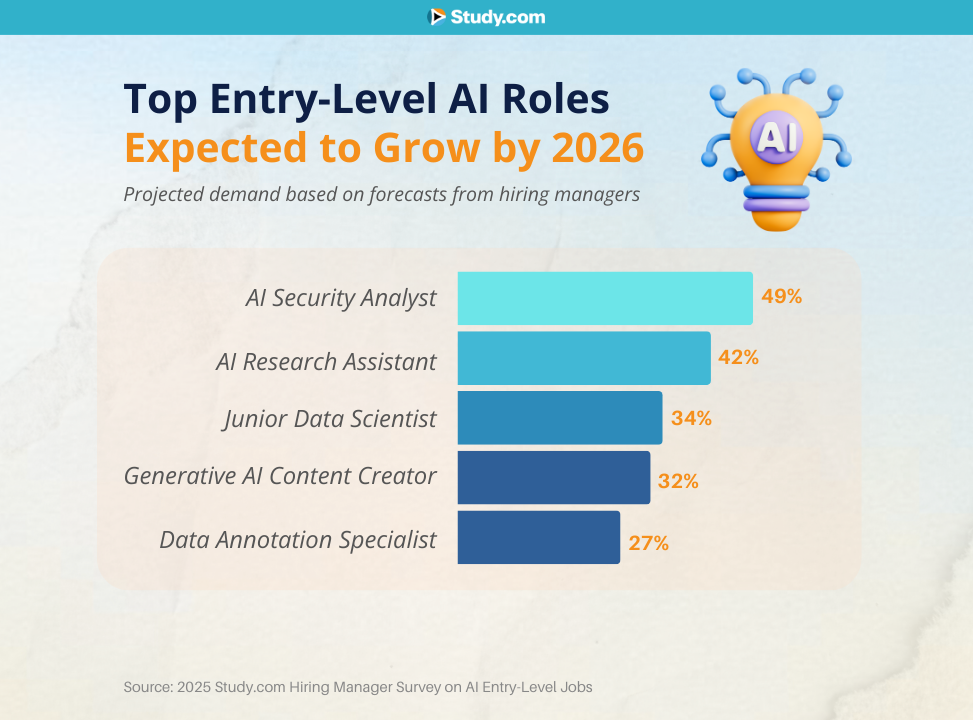
Here are some of the most in-demand entry-level AI jobs for beginners, according to hiring managers:
 |
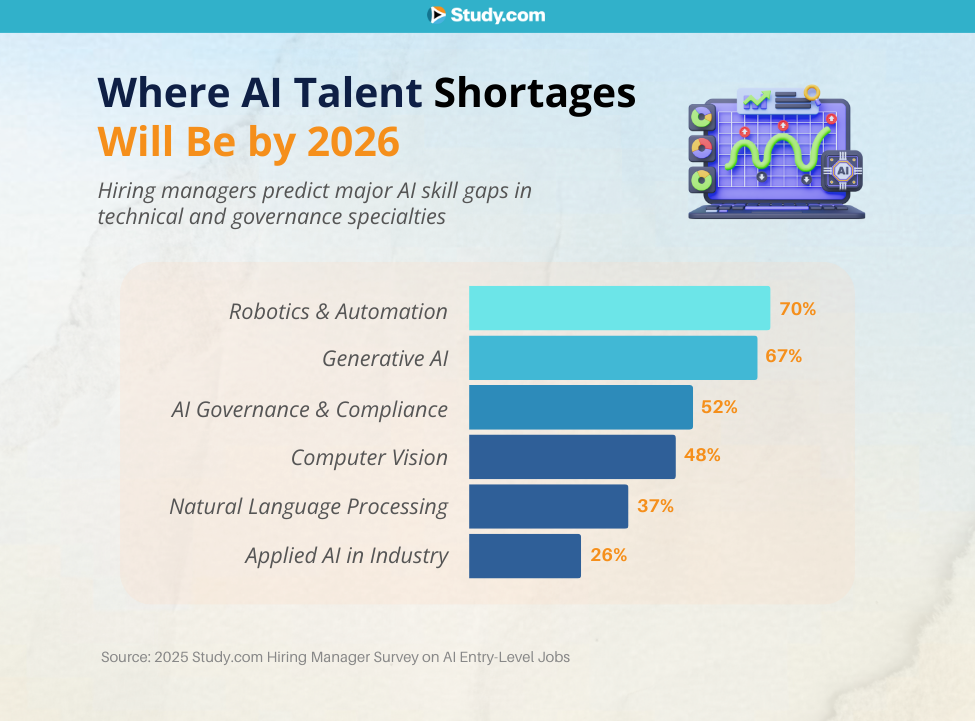
In 2026, hiring managers also predict talent gaps in these AI career fields:
 |
Knowing which roles are in demand is a crucial step in deciding which field to pursue, so you can see the best AI career options that are most beneficial for you in the long run.
How to Get a Job in AI (Step-by-Step Roadmap)
Understanding demand is one thing. Learning how to get a job in AI is what turns interest into a real career plan.
The roadmap below breaks down how to get into AI jobs, from choosing the right role to building skills, gaining experience, and applying with confidence.
 |
Step 1: Choose Your AI Career Path
As we've seen, there are multiple AI career pathways, each suited to different skills, interests, and backgrounds.
The roles mentioned above all roll into specific AI career pathways, like:
- Engineering and machine learning roles focused on building models
- Data analytics roles that interpret AI outputs and trends
- AI strategy and ethics roles that guide responsible use
- Product and business integration roles that connect AI to real-world needs
When you've decided which path to take, the next step is to start building your AI skills.
Step 2: Build a Strong Foundation in AI Skills
AI roles typically share a common skill base.
Here are some of the usual core skills you'll need as you're starting out:
- Programming fundamentals (primarily Python)
- Basic statistics and probability
- Introductory machine learning concepts
- Data visualization and interpretation
You do not need to master everything at once. You can start learning the fundamentals at your own pace and build your expertise from there.
Study.com, for example, offers entry point courses such as Introduction to Artificial Intelligence and Data Science Courses, which are designed for learners without deep technical experience.
Once you have the basics, you can then learn how to code with AI using tools like Claude Code or Cursor. This will be crucial as coding is one of the most important skills employers look for in candidates.
Step 3: Get Hands-On Practice
Hands-on projects are one of the best ways to build and strengthen AI skills. You do so by starting your own AI project or looking for on-the-job training or apprenticeship opportunities.
Good starter projects can be:
- Building a basic chatbot
- Creating an image classifier
- Running sentiment analysis on customer reviews
Platforms like GitHub, Kaggle, and Google Colab are essential AI career tools for building projects and showing real-world skills.
Or if you want a more controlled pace, you can also do a guided practice. Taking Computer Science 113: Programming in Python in Study.com, for example, helps bridge the gap between knowledge and hands-on skills by letting you create while learning.
Step 4: Gain Certifications and Learning Credentials
Certifications are not mandatory, but they help signal commitment and baseline knowledge.
In fact, a Study.com survey on entry-level AI jobs reveals that hiring managers believe that industry certifications make candidates stand out in their applications.
Well-recognized options include:
- Google AI and Machine Learning certifications
- IBM Applied AI
- AWS Machine Learning Specialty
- ARTiBA AI Engineer
Certifications and credentials, along with your applied skills, will be the best ways to build your portfolio.
Step 5: Build Your Portfolio and Resume
Your portfolio will matter equally as your resume because it shows what you can actually do—and some hiring managers even believe a portfolio matters more than just having a formal education.
Employers want to see a GitHub repository with clear, well-documented projects and a simple personal website that explains what you built and why.
Here are key things to remember when building your resume portfolio:
- You should also be able to clearly describe your role, skillset, and the results you achieved.
- When writing your resume, focus on measurable outcomes, such as improving model accuracy or reducing processing time.
- Look at resume writing tips that help you make the right connection from your past experience to AI roles.
Step 6: Network Strategically
The industry is booming, and the best way to find opportunities is to build a network that can help you look for a suitable role that fits your skillset.
To start, you can join AI-focused groups on platforms like LinkedIn, Discord, and Reddit, where professionals share insights and openings. They can also serve as your initial AI job hunting tools, especially referrals and early-stage roles.
Attending industry events such as AI Summit or NeurIPS can also help you meet people working in the field. In addition, seeking mentors through ADPList or alumni networks can give you guidance and connections as you move deeper into AI.
Step 7: Apply and Interview with Confidence
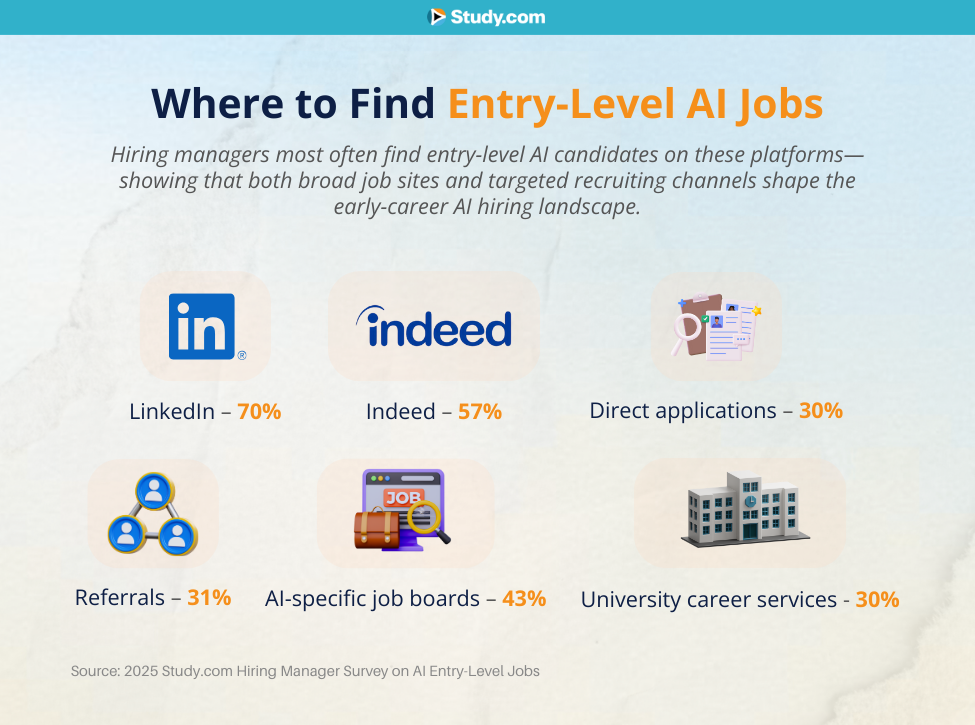
When you are ready to apply, it's time to spend some time on job boards like LinkedIn, Indeed, AI Jobs Board, and Dice.
 |
Remember: focus on quality over the volume of applications. You'd want to start off your career on a good foot so you can build the right foundation.
Prepare for interviews by:
- Practicing Python coding challenges
- Reviewing core machine learning concepts
- Preparing to explain ethical trade-offs in AI systems
Your AI Career Starts Here
If you're finally deciding to switch into an AI career, remember that you do not need to reinvent yourself overnight. With the right roadmap, consistent practice, and practical learning resources, a career in AI is achievable even from a non-technical background.
Ready to take a step into AI? Start learning with Study.com's Artificial Intelligence courses to build your foundation and open doors to high-demand AI jobs.
FAQs
How to get into AI as a career?
Start with the fundamentals: Python, basic math, and machine learning concepts. Then build projects that prove what you can do. Add a certification once you have hands-on work to back it up. That is the fastest way to get credibility.
Can I get an AI job with no experience?
Yes, but you need proof. Certifications, bootcamps, and self-guided projects can count as experience if you document your work well and can explain it in interviews. The roadmap above is built for people aiming for AI jobs with no experience.
Is artificial intelligence a good career?
If you want strong pay, long-term demand, and skills that carry across industries, AI is one of the strongest bets right now. Lots of resources highlight both demand and salary strength as major reasons AI remains "future-proof."
What AI jobs are best for beginners?
Look for roles that are adjacent to AI but still hands-on:
- Data analyst roles that use AI tools
- Junior ML or data science roles (with a portfolio)
- AI product associate roles
- Responsible AI or governance support roles
What are the best AI career tools?
For beginners, the most useful AI career tools are:
- GitHub (portfolio)
- Kaggle (projects)
- Google Colab (practice)
- LinkedIn (networking and job discovery)
- Study.com AI courses (structured learning)