
| This article is one of four in a series on the 2026 TOEFL® updates, covering exam changes, section tips, and the new scoring scale. |
Key Takeaways
- TOEFL® test will be adaptive in 2026: Starting January 21, 2026, the TOEFL® iBT Reading and Listening sections will feature multistage adaptive testing.
- Personalized TOEFL® Experience: Adaptive testing gives you questions matched to your skill level for a more accurate assessment of your English language abilities.
- Effective strategies for adaptive TOEFL® preparation: To succeed with adaptive testing, focus on accuracy, learn to recover quickly after tough questions, and manage your time for each section.
- Study.com for TOEFL® Test Preparation: Study.com offers adaptive practice tests, personalized study plans, and expert tips to help you pass the TOEFL® test.
Starting January 2026, the TOEFL® iBT exam update will feature multistage adaptive testing that adjusts question difficulty to your skill level.
This approach provides a more accurate measure of your English skills while offering a personalized, efficient test aligned with real-world communication needs.
In this article, we'll explain how adaptive testing works in the new TOEFL® and share strategies to help you succeed in the updated TOEFL® format.
What Adaptive Testing Means for TOEFL® Test-Takers
What is Adaptive Testing
Adaptive testing adjusts the difficulty of questions based on your performance.
Everyone begins with the same initial set of questions, and your results in that stage determine whether you move on to a more difficult or easier set. This process continues in real time, ensuring the questions you see match your current skill level.
How Adaptive Testing Works in TOEFL®
Starting January 2026, ETS will introduce a multistage adaptive design for the Reading and Listening sections of the TOEFL® iBT.
In this new design, the difficulty and number of questions you receive may change as you progress, which will affect pacing, strategy, and the overall test experience.
Key changes TOEFL® test-takers can expect include:
- Strong start advantage: Performing well on the early stages of the TOEFL® test can lead to harder questions. This boosts your scoring potential but also means tackling more complex passages and audio clips.
- Less predictable TOEFL® test experience: No two test-takers will see the exact same set or order of questions. The passages you read or the audio clips you hear will depend on your performance.
- New timing and pacing strategies: Difficulty and the number of questions on the TOEFL® exam may change as you progress, so you might spend more time on challenging passages or audio clips and finish easier items more quickly.
How Adaptive Testing Affects TOEFL® Score
In adaptive testing, your TOEFL® score is influenced not just by how many questions you answer correctly, but also by the difficulty of those questions.
- If you perform at a C2 level, you'll face C2-level questions, and your score potential is higher.
- If you perform at a B1 level, you won't encounter C2-level items, and your maximum possible score will reflect that.
- Getting an easier set of questions and answering all of them correctly will not score as high as doing well on a more difficult set — the test is designed to reflect the skill level you demonstrate during the exam.
Common Misconceptions About Adaptive Tests
With the upcoming major shifts in the TOEFL® iBT, it's natural for future test-takers to feel uncertain or confused about how this will impact their experience and performance.
Let's clear up some common misconceptions:
Misconception 1: Adaptive Tests Are Less Accurate Than Fixed-Form Tests
Adaptive tests can actually be just as accurate as traditional fixed-form tests. They adjust the question difficulty in real time according to your performance, allowing them to capture your true proficiency more accurately.
 |
Misconception 2: Adaptive Questions Are Random and Harder to Pass
Adaptive questions follow a structured algorithm, not random selection. This format matches each question to your skill level, making the test fair and appropriately challenging rather than impossibly difficult.
How to Prepare for an Adaptive TOEFL®?
Getting ready for the updated TOEFL® test requires strategy, flexibility, accuracy and effective time management.
Here are practical, actionable tips to help you confidently navigate this new TOEFL® testing format:
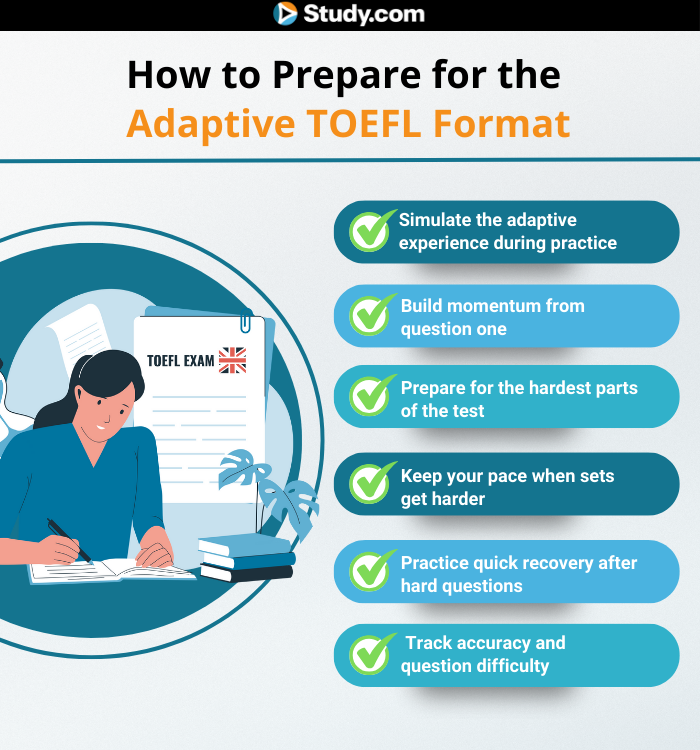 |
1. Simulate the adaptive experience during practice
- Mix easy, medium, and hard question sets in your study sessions.
- Use realistic TOEFL® practice sets that replicate the multistage design so you get used to sudden jumps in difficulty.
2. Build momentum from question one
- In the first stage, aim for your highest possible accuracy to unlock harder questions (and a higher score ceiling).
- Drill first-stage question sets until you're hitting at least 85% correct without slowing down.
3. Prepare for the hardest parts of the test
- Practice with longer academic passages and audio clips so you can handle tougher material without losing focus.
- Summarize them in just a couple of sentences to keep your understanding sharp.
4. Keep your pace when sets get harder
- Since question counts vary, practice with both shorter and longer Reading and Listening sets so your pacing feels natural in either scenario.
- Break practice sessions into "time checkpoints" (for example, every 5 questions) to stay aware of your speed without rushing.
5. Practice quick recovery after hard questions
- Have a "reset move" - like taking one deep breath or quickly noting the main idea - before moving on
- In practice, plant extra-challenging questions to train yourself to recover fast without losing time.
6. Track both accuracy and question difficulty
- Don't just measure how many questions you got right - note the difficulty level.
- If you're only scoring well on easy items, spend more time breaking down medium and high-level questions until you can hit them consistently.
- After each practice stage, note how the difficulty change affected your timing and focus, then fix those weak spots.
Using Study.com to Pass TOEFL®
The changes to the TOEFL® iBT test can be intimidating, but Study.com updated TOEFL® test prep resources make it manageable. Our platform builds your skills, targets your weak areas, and prepares you for the adaptive format.
Here's how Study.com can support your TOEFL® preparation:
- Comprehensive Skill-Building: Learn and practice all four TOEFL® sections with clear lessons, targeted drills, and section-specific practice tests.
- Personalized Adaptive Learning: Get practice that adjusts to your skill level and focuses on weak areas, , mirroring the TOEFL®'s adaptive structure.
- Realistic Practice Tests: Take full-length adaptive TOEFL® practice exams that match the new adaptive format.
- Expert-Tested Strategies: Master effective test-taking methods and expert-approved strategies designed to help you pass the TOEFL® exam.
By using Study.com's updated test prep resources, you'll develop a well-rounded and personalized preparation strategy to help you achieve your target TOEFL® score.
Frequently Asked Questions
Why is the TOEFL® becoming adaptive?
The TOEFL® is becoming adaptive to create a more efficient, personalized, and fair testing experience for students.
Are adaptive tests fair?
According to research and past studies, adaptive testing could provide a more accurate and fair assessment of the abilities of the test taker.
Which section of TOEFL® is adaptive?
Starting January 2026, the Reading and Listening sections of the TOEFL® iBT will be adaptive. The Speaking and Writing sections will be updated with new question types and tasks, but will not be adaptive.
How many questions will be in each section of the adaptive TOEFL®?
The exact number of questions depends on the difficulty level presented to the test-taker. Reading has 35-48 items, Listening has 35-45, while Writing and Speaking are fixed at 12 and 11 questions.
Will I still be able to skip or go back to questions?
Yes, in the TOEFL® Reading section, you can skip questions and return to them later.
Will adaptive testing make it harder or easier to get a high score?
Adaptive testing doesn't automatically make the TOEFL® easier or harder. Your score still depends on your English proficiency and preparation.
Can I choose between the adaptive and the old TOEFL® format?
No. Starting January 21, 2026, the TOEFL® iBT will use a multistage adaptive format for Reading and Listening, and all test-takers after this date will take the updated version.
Where can I find updated prep materials that reflect the new TOEFL® test format?
Visit ETS's official TOEFL® test-takers page , the TOEFL® TestReady portal, and Study.com's TOEFL® prep courses for the latest updates and practice tests.