




Are you looking for some fun ways to celebrate STEM Day in your elementary school classroom? This blog post offers six great activities appropriate for young students that teach science, technology, engineering, and mathematics.
Celebrating National STEM Day Every Day
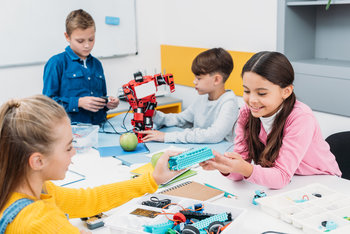
STEM, or science, technology, engineering, and mathematics, is a group of academic disciplines of great importance to society. It's often seen as more challenging and lucrative than other fields, as well as an area that has been traditionally less favored by and accessible to underrepresented groups like women and minorities. However, it's also fun and engages natural curiosity, making it something that young children usually enjoy. If you want to encourage and awaken a love of STEM in your elementary students on National STEM Day (November 8th), here are some fun activities you can do with your class.
 |
1. Binary Baubles
One of the STEM disciplines that most intersects with our lives today is technology. After all, we are all - children included - interacting with computers throughout the day. So it only makes sense to try and learn a bit about how these important machines work. This binary baubles activity is an hour-long project that teaches students how to encode letters into binary numbers and how to decode binary numbers into letters.
All you need is a binary alphabet decoder key and beads in different colors, as well as some string. Your students can then follow the key to create bracelets that spell a short word or their name, trade with a partner, and decode the bracelets back to words.
2. Candle Seesaw
One effective way for children to learn the laws of physics is to see them in action for themselves. This candle seesaw balancing act uses a concept familiar to most kids - a seesaw - to teach basic physics' laws such as gravity. It only requires a few, easy-to-obtain materials, making it a convenient project to try.
You'll need:
- Birthday candles
- Tape
- A needle
- A knife
- Drinking glasses
- A lighter or matches
Tape the candles together with the wicks at the opposite ends. Push the needle through the exact middle point of where the candles meet. Place the needle between the two glasses so that the candles are perpendicular to the glasses, perfectly balanced. Light both candles and have students observe the ''seesaw'' movement.
3. Build a Roller Coaster
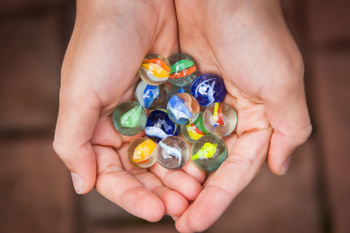
Like the activity above, this roller coaster building activity relies on a familiar (and exciting) object as an introduction to key engineering concepts. Students build small roller coasters for marbles and analyze them to explore ideas such as friction, energy, and gravity.
 |
4. Probability Dice Game
The best part of this probability dice game is that it's so easy to put together, requiring only a few sets of dice. Students roll the dice to explore the mathematical concept of probability and the likelihood of possible outcomes, including how they apply to specific numbers. This activity can be combined with a known board game afterwards for a truly fun day of school.
5. Popsicle Stick Catapult
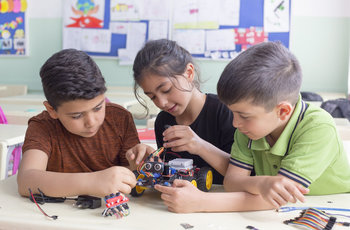
Another engaging way to teach elementary students introductory engineering concepts is to build catapults out of popsicle sticks. You'll be able to find many different versions of this activity, including this easy-to-understand explanation. We recommend adding a little extra fun by using marshmallows as the object to be catapulted. Just make sure that the kids wash their hands and clean off their desks beforehand and the marshmallows can even be eaten!
 |
6. Rainbow in a Jar
This beautiful rainbow activity teaches kids about the scientific concept of density by allowing them to create a rainbow in a jar. It uses simple kitchen ingredients, making it easy to execute, and the colors will be sure to capture your students' attention.
You'll need:
- Glasses
- Water
- A measuring cup and spoons
- Sugar
- Food coloring
- A baster
- A spoon
- Test tubes
Set out six glasses with exactly one cup of water in each one. Add food coloring to each glass so that they represent the different colors of the rainbow. Then add different amounts of sugar to each glass, ranging from zero teaspoons to ten in incremental measures of two teaspoons. Stir each glass until the sugar is dissolved.
Then allow the students to use the baster to suck up a bit of each color and transfer it into the jar, observing how the different densities allow them to separate into the colors of the rainbow.
Which of these activities are you excited to try out in your classroom? Let us know on Twitter @studydotcom.
For more information and resources about teaching STEM in your classroom, check out this helpful STEM education page on Study.com.