
-
 Use this material to answer questions #1 through #5
The biological species concept defines a species as a population whose members can interbreed to produce viable, fertile offspring that are reproductively isolated from others. There are several ways species are isolated reproductively, both before zygote formation and after.
 Word count: 49
 -
1.
Musa acuminata and Musa balbisiana herbs hybridize to form Cavendish bananas, which are common table bananas. Cavendish bananas cannot reproduce genetically unique banana plants because Cavendish banana seeds are infertile. However, they can clone themselves. Cavendish bananas reproduce by root sprouts that eventually grow large enough to survive independently. Describe the characteristics of the Cavendish banana that fit the biological species concept (BSC).
-
2.
Abalone gastropods use broadcast spawning as a means of reproduction. Eggs and sperm are released in open water. The abalone sperm carries a protein called lysin that dissolves a hole in the envelope of the egg so sperm can pass through, but only if the sperm and egg are of the same species. Predict the impact this has on the Abalone's ability to hybridize with other gastropods.
-
3.
Female Pacific oysters can produce between 50-200 million eggs when spawning. The eggs are released in open water, where fertilization occurs. Explain how the Pacific oyster's genetic information flows into the next generation.
-
4.
Hybrid sterility is a common reproductive barrier, though often only one sex is sterile. This observation lead to Haldane's Rule, which states that the inviable/sterile sex is usually the heterogametic sex. In mammals, that would be the XY sex. There can be varying degrees of viability and fertility among the homogametic, which is the XX sex in mammals. Describe how this serves as a reproductive barrier according to the biological species concept (BSC).
-
5.
Oak trees (Quercus) hybridize easily. A common hybrid is Q. xbinundorum (Q. robar x Q. alba). The "x" refers to the fact it is a hybrid. Q. xbinundorum is called "Two Worlds Oak" because it is hybridized from an old-world oak and new-world oak. Q. xbinundorum often can't reproduce, but when it does, the progeny looks like Q. robar or Q. alba. Describe why Two Worlds Oak does not meet the biological species concept (BSC).
-
Use this material to answer questions #6 through #10
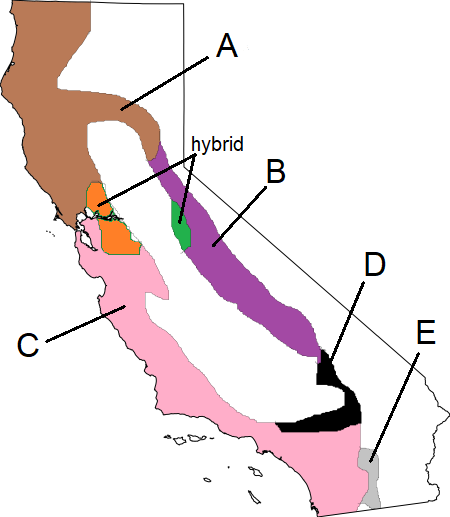
Ensatina salamanders live in California's Sierra Nevada and along the coastal range. Seven populations are identified on the map, each with strikingly different coloration. The salamander populations form a ring around Central Valley.
 Word count: 43
 -
6.
Salamander population A hybridizes with populations B and C. The hybrid populations are viable and fertile with their own unique markings. Identify the characteristics of the hybrid offspring that determine whether or not salamander populations A and B are the same species according to the biological species concept.
-
7.
Salamander populations B and D successfully create hybrid offspring, as well as C and E. Both hybrid populations are frail and fail to develop to maturity. Using the biological species concept, predict whether populations B and D are the same species.
-
8.
Salamander populations D and E do not hybridize. Mitochondrial DNA samples indicate that populations B, C, D and E are related to population A. Researchers suggest the salamanders in population A originated up north and traveled south, going around the Central Valley on either side. Explain why the salamander populations interbreed to form hybrids north of the valley but not south.
-
9.
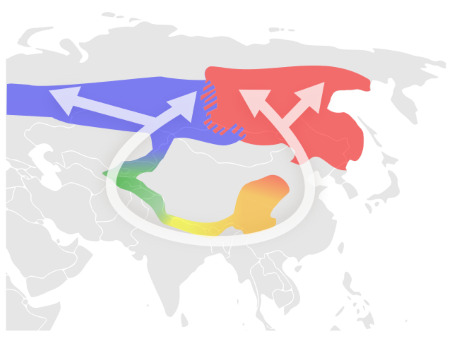
The image shows the greenish warbler bird's migration. As the population spread north around the Himalayas, the two groups became increasingly genetically different. Applying the BSC, predict whether the descendants will be able to interbreed when the two populations meet.
-
10.
Dog breeders choose dogs with specific qualities for breeding. Though dogs are one species with great variability, there are limits to dog breeding. For example, Saint Bernards are held to be a large breed. Chihuahuas are held to be the smallest. They cannot interbreed. Explain why this individual example cannot be applied to the biological species concept.
-
Use this material to answer questions #11 through #15
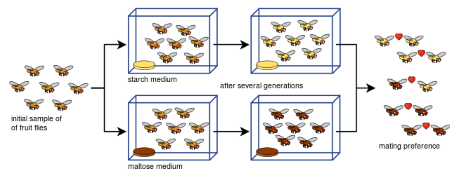
Physical isolation of one population can lead to changes that result in reproductive barriers between the populations when their habitats overlap again, as shown in the image. Sometimes these barriers are due to behavioral changes or preference.
 Word count: 47
 -
11.
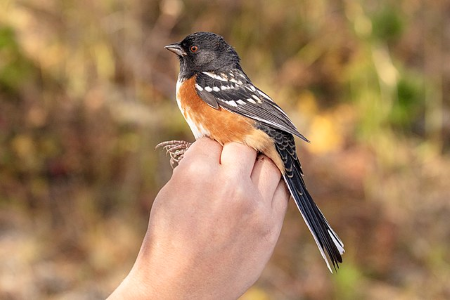
Towhees (Pililo erythrophthalmus and Pipilo ocai) interbreed to form hybrids in some places where their habitats overlap, but in other places they act like two different species and no hybrid towhees can be found. Propose a hypothesis that explains this phenomenon.
-
12.
Borneon elephants are native to the island of Borneo. They are also called pygmy elephants because of their smaller size. They are most genetically similar to the Asian elephant. Borneo and Asian elephants may be able to interbreed to produce viable, fertile offspring, but due to their endangered status and the fact their habitats do not overlap, it's difficult to prove. Describe the relationship between the Borneo and Asian elephants applying the BSC.
-
13.
A fertile hybrid population that does not grow to maturity cannot pass genetic information on to another generation. Some hybrids may reproduce in captivity, but the offspring are not as viable compared to their parent species. Describe why a frail hybrid population does not meet the biological species concept.
-
14.
Sheep cannot produce offspring with goats, but the union may result in a zygote that fails to survive birth. Predict why sheep and goats cannot have healthy offspring together.
-
15.
Many flowers reproduce by cross-pollinating, as well as self-fertilizing. Pollinators, like bees and hummingbirds, are often responsible for these cross-pollinating events, and many prefer the nectar of only one kind of flower. This creates additional barriers to reproduction between species. Describe how pollinator preferences may limit the chances a flower has to hybridize.
-
Use this material to answer questions #16 through #20
Below is a graph showing the population of coywolves in an area over time. Coywolves are a hybrid between coyotes and wolves. Wolves and coyotes don't normally hybridize, however, due to habitat loss, previously separate populations have been forced together in close quarters.
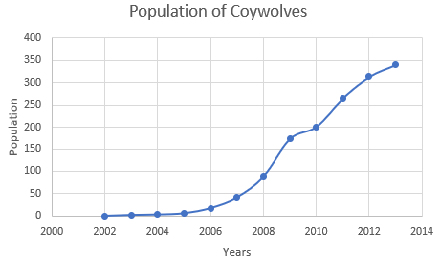 Word count: 53
 -
16.
Describe the trend shown in the graph.
-
17.
These coywolf hybrid are fertile and can produce fertile offspring. Explain what this implies in the context of the biological species concept.
-
18.
If wolves and coyotes are continued to live close together and continue to hybridize, predict the most likely result.
-
19.
If the new population of coywolves is subsequently genetically isolated from other members of the canis genus, predict the most likely result.
-
20.
Since coyotes and wolves are currently classified as different species, explain what their ability to produce fertile offspring implies about their evolutionary history.
-
Use this material to answer questions #21 through #25
Below is a picture of two different breeds of dog. One of these breeds is quite small and the other is quite large.
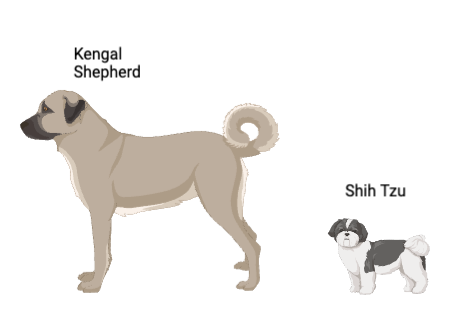 Word count: 33
 -
21.
Currently these two animals are both classified as the same species. Describe what impediments, if any, exist to mating between these dog breeds.
-
22.
Say these two animals are mated and they produce fertile offspring. Explain what this implies under the concept of biological species.
-
23.
If these two dog breeds were to be separated for a very long period of time, predict the most likely outcome.
-
24.
Let's say that groups of these dogs are placed in a habitat together. Despite being able to produce fertile offspring via artificial insemination, it is observed that when left to their own devices these two dog breeds do not successfully mate or produce offspring. Justify the claim then that these two dog breeds are different species.
-
25.
Explain why it is important to the concept of biological species that these two animals must be able to organically produce fertile offspring to be considered the same species.
-
Use this material to answer questions #26 through #30
Below is a picture of what is known as a "zorse" or a hybrid between a male zebra and female horse. This hybrid is infertile.
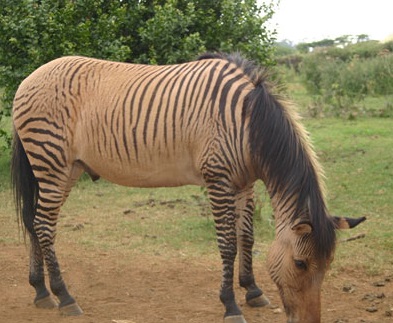 Word count: 36
 -
26.
Explain what being able to produce a living, infertile hybrid implies about the evolutionary history of the horse and the zebra.
-
27.
Identify the most likely reason why the zorse is sterile.
-
28.
Identify the most likely reason why the horse and zebra developed into different biological species.
-
29.
Say that horses and zebras continue to be separated for many thousands of years and do not continue to hybridize. Estimate the likelihood that after this isolation they will still be able to produce a living hybrid.
-
30.
Describe the relationship between hybridization and species in this case.