History / World History / Late Modern Period /  World War I

End of WWI, the Treaty of Versailles & the League of Nations

British soldiers in a trench during WWI

British soldiers in a trench during World War 1

By 1917, much of the war had come to a stand-still. This was the first large-scale war that used weapons like machine guns and advanced weaponry. Because of this, armies on both sides dug into trenches where they could have more protection, but this meant it took years to advance even a few miles in some places.

These trenches were most prevalent along the western front in France. France, along with Great Britain, Italy, and the Russian Empire, made up the Allied Powers. This group was also called the Entente and they were fighting the Central Powers. The central powers were made up of Germany, the Austro-Hungarian Empire, and the Ottoman Empire.

While there was very little movement along the western front in 1917, the eastern front in Russia was crumbling. In the Ottoman Empire, the allied forces were slowly moving northward towards the heart of the empire. Between the crumbling of Russia and advancement into the Ottoman Empire, WWI could have gone on for many more years as countries continued to pour resources into the war effort.

An error occurred trying to load this video.

Try refreshing the page, or contact customer support.

Your next lesson will play in 10 seconds
  • 0:06 The End of World War I
  • 0:53 Peace Negotiations
  • 2:22 The Terms of the…
  • 3:47 Germany's Reaction
  • 5:01 Lesson Summary

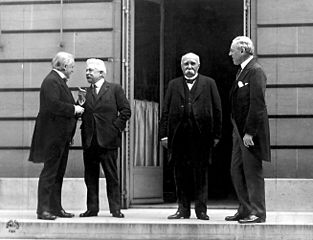
The Paris Peace Conference began in 1919 in the Hall of Mirrors within Versailles Palace. The Conference had one goal: write a treaty that would end the WWI conflict. The main leaders of this conference were known as the Big Four. This included the Prime Minister of Great Britain, the President of Italy, the Prime Minister of France, and U.S. President Woodrow Wilson.

The Big Four standing for a picture at the conference

The Big Four standing together in Paris

World War I was not started by Germany, however, the allied powers blamed a majority of the war on them. This was because the British and French had to spend an incredible amount of money fighting along the western front in the trenches. They had to spend so much that the United States ended up lending them $12.5 billion which they were going to have to pay back somehow.

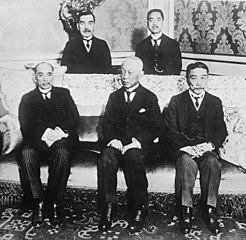
Despite the Big Three making most of the decisions, multiple countries actually attended with requests to be put into the Treaty of Versailles. Members of the Central Powers were also present but not welcomed to participate in negotiations.

Parties Affected by Paris Peace Conference

While the British and French were focused on punishing Germany so much that they could never wage war again, U.S. President Woodrow Wilson had a different idea. He came up with a set of Fourteen Points that he hoped would ensure peace around the world for decades and centuries to come. Why did Wilson want peace so bad?

The United States was only in the war for a short period, was not damaged at all, and was the primary lender to the European powers. This meant that the U.S. was poised to rapidly grow in power and prosperity and peace was the best way to ensure this would happen.

To try and encourage peace throughout the European Empire and the world, Wilson presented his 14 points. They are as follows:

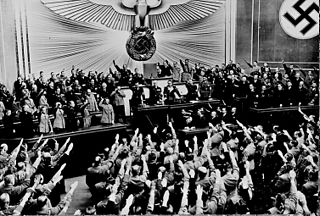
Germany's hope that negotiating a peace would be better than surrendering turned out to be a false hope. They were going to have to pay a massive sum in war reparations and would be significantly hampered in their defense spending. Moreover, they were not happy to have to take the blame for a war they did not feel they started. This led Germany bitter towards the allied powers and much of the world.

Many of Wilson's fourteen points went unheard. But the League of Nations was actually established. However, the United States was not able to join because membership in the league had to be approved by the U.S. Congress. Wilson was very concerned with preserving peace and allowing democracy to spread around the world for many reasons, however, Congress was worried that a League of Nations would limit democracy at home. If the U.S. joined, Congress worried there would be laws and restrictions that the U.S. would have to follow without any say being given to the U.S. legislators.

In reality, the restrictions would have been very minimal, but the fear of another war in Europe was of much less concern to Americans who did not suffer very much from their participation in World War I. This meant U.S. Congress members largely voted against joining the League of Nations in the interest of preserving democracy at home. Most Americans were not that worried about the political situation in Europe and the idea of another world war was not a big concern for the traditionally isolationist United States.

  • World War I ended largely due to the United States joining on the side of the Allies which convinced the Central Powers that defeat was inevitable
  • The Paris Peace Conference was called in which the Big Four would construct the Treaty of Versailles and formalize the terms of peace for the defeated Central Powers
  • The British and the French wanted to punish Germany so they could never wage war again and to get back what they spent to fight the war
  • Many groups that helped win were not included in the Treaty of Versailles for several reasons and it was primarily Great Britain, France, and the U.S. who decided what the post-WWI world would look like.
  • The League of Nations was one of the fourteen points which was actually followed, but because the U.S. Congress did not approve the country's admittance, the U.S. did not join it. Many of the other Fourteen Points were ignored completely.

Video Transcript

The End of World War I

The armistice that stopped the fighting in World War I went into effect at 11 a.m. on November 11, 1918. After four and a half years, the war was finally over, but the results remained. Devastation was everywhere. People's homes and lands were destroyed. Large areas of France had been reduced to rubble. Cities, like Flanders and Ypres in Belgium, were nearly wiped off the map.

The war's human toll was even more devastating. Millions of soldiers for the Allied Powers of Great Britain, France, and the United States were killed, wounded, or missing. The Central Powers of Germany, Austria-Hungary, Turkey, and Bulgaria lost even more men. Countless civilians also lost their lives or loved ones. Now, in 1918, the Allied Powers emerged victorious, and they were ready to make Germany pay.

Peace Negotiations

The Paris Peace Conference opened on January 18, 1919, with the goal of developing a treaty that would punish Germany and meet the goals of the various Allied Powers. Negotiating the treaty, which would be known as the Treaty of Versailles, was a long and complex process. At first, the Council of Ten, consisting of the heads of state and foreign ministers of ten Allied Powers, tried to hammer out a deal. The Council soon proved to be too large, and its members had too many conflicting opinions. By March, the treaty negotiations were being handled by the Big Four, namely, the United States, Great Britain, France, and Italy. Italy soon dropped out of the process when its representative became angry that his demands for more territory were rejected.

Only the Big Three were left: the United States, led by President Woodrow Wilson; Great Britain, led by Prime Minister David Lloyd George; and France, led by Prime Minister Georges Clemenceau. Each of these men had a different view of what peace should look like and how Germany should be treated. Wilson was interested in building a world trade network, avoiding war in the future, proposing his Fourteen Points for a better world, and avoiding harsh treatment of Germany. George was also looking ahead to potential world trade, but he wanted Germany to pay reparations. Clemenceau, whose country suffered some of the worst damage during the war, desired large-scale reparations from Germany and a demilitarized zone between France and Germany in case of future German aggression.

The Terms of the Treaty of Versailles

After months of debate and lots of hard work, the Big Three created a treaty with the following provisions:

Register to view this lesson

Are you a student or a teacher?

Unlock Your Education

See for yourself why 30 million people use Study.com

Become a Study.com member and start learning now.

Become a Member  Back

Resources created by teachers for teachers

Over 30,000 video lessons & teaching resources‐all in one place.
Video lessons
Quizzes & Worksheets
Classroom Integration
Lesson Plans

I would definitely recommend Study.com to my colleagues. It’s like a teacher waved a magic wand and did the work for me. I feel like it’s a lifeline.

Jennifer B.
Teacher
Jennifer B.
FAQ
What were the main terms of the Treaty of Versailles?

The main terms of the Treaty of Versailles were:

- Germany had to pay a large sum in war reparations

- Germany could not have a large military or create war grade weapons

- Germany could not move soldiers near the French border

- Germany was also reduced in size and had to return land taken

- New sovereign states were created

Why did Germany surrender in ww1?

Germany did not technically surrender, they agreed to negotiate a peace treaty in hopes they would get more favorable terms. However, this ended up not being the case and Germany had to sign it anyway because they were so weak by the end of the war.

How was the First World War won?

The First World War was won by the Allied powers once the United States joined in 1917 which finally tipped the scales against the Central Powers and the war was over by 1918.

Create an account to start this course today
Used by over 30 million students worldwide
Create an account