
Learn about the Triangle Shirtwaist Factory fire of March 25, 1911, including the cause of the fire and outrage from the public. Discover how the tragedy spurred legislative action and improved labor and workplace safety in the country.
Triangle Shirtwaist Factory Fire | History, Cause & Commemoration
Table of Contents
- Triangle Shirtwaist Factory in the Early 1900s
- Triangle Shirtwaist Fire
- Outrage Directed at the Triangle Shirtwaist Company
- Never another March 25, 1911
- Commemoration of the Triangle Victims
- Lesson Summary
Frequently Asked Questions
What was the average compensation to families of Triangle Shirtwaist Factory victims?
The average compensation to families of the Triangle Shirtwaist Factory victims was $75 per victim. Furthermore, only twenty-three cases were settled, so many families did not get compensated for the loss of their loved ones.
What laws came from the Triangle Shirtwaist fire?
Over thirty laws were passed after the Triangle Shirtwaist fire. Most of these laws implemented workplace safety protocols, like fire alarms, sprinklers, and mandatory fire drills. The laws gave power to the Department of Labor to enforce regulations in the workplace.
What outrage happened after the Triangle Shirtwaist Factory fire?
After the Triangle Shirtwaist Factory fire, there was outrage from garment workers' unions and the public. A large protest was held on April 5 in response to the fire. It was attended by over 80,000 people.
Who was taken to court for the Triangle Shirtwaist fire?
The owners of the Triangle Shirtwaist Factory, Max Blanck and Issac Harris, were indicted on seven counts of manslaughter. They were found not guilty on all counts but later paid compensation for victims as a result of the many civil cases brought against them.
What was the cause of the Triangle Shirtwaist fire?
The fire at the Triangle Shirtwaist Factory was caused by a discarded cigarette. However, conditions in the building, such as a lack of fire alarms, ventilation, and emergency exits, contributed to the high number of casualties.
Did anyone survive the Triangle Shirtwaist fire?
The Triangle Shirtwaist Factory employed approximately 500 employees at the time of the fire. In total, 146 people lost their lives in the fire.
Table of Contents
- Triangle Shirtwaist Factory in the Early 1900s
- Triangle Shirtwaist Fire
- Outrage Directed at the Triangle Shirtwaist Company
- Never another March 25, 1911
- Commemoration of the Triangle Victims
- Lesson Summary
The Industrial Revolution of the mid-1800s resulted in technological advancements, such as the sewing machine, which led the United States to economic prosperity in the early 20th century. The mass production of cheap goods allowed the manufacturing industry to create many employment opportunities in factories across America. Due to a lack of labor and workplace safety regulations in the country, factory work was hazardous and dangerous. In addition to the safety concerns, it offered very low pay and long working hours. The majority of factory workers at this time were immigrants, who came to America in search of better opportunities. Factory positions usually required little to no skill, which made these jobs high in demand for immigrants and allowed employers to keep wages low.
Sweatshops, or companies that require long working hours for low pay in dangerous conditions, were common in manufacturing. By 1910, the garment industry in America was almost entirely run on sweatshop labor. The Triangle Shirtwaist Factory was a sweatshop located in Manhattan. It was known for its unsafe conditions and the owners' questionable business practices. After a fire broke out in the factory in March 1911, owners Max Blanck and Isaac Harris faced criminal and civil charges for creating workplace conditions that led to the deaths of many factory employees.
A Typical Day at the Triangle Shirtwaist Factory
The Triangle Shirtwaist Factory operated twelve hours a day, seven days a week, and often on weekends and holidays. The factory was located in the Asch Building at 23-29 Washington Place, in the Manhattan neighborhood of New York City. The Asch Building was a ten-story building that the lead architect touted for its "fireproof rooms."
The workforce primarily consisted of non-English speaking immigrants—mostly young women aged 15-23. These workers produced ready-to-wear clothing, primarily ladies' blouses, on sewing machines in an assembly line. The job paid between $6 and $15 per week, and workers often had to provide their own needles and thread.
Conditions at the factory were unsafe and unsanitary. Workers were crammed into spaces with no occupancy limits, running machines for several hours a day without ventilation. The factory lacked emergency precautions like fire exits or sprinklers, and employees did not have access to bathrooms or drinking water. Even more egregious, management would lock employees inside the building during shifts to keep them from using the bathroom and to reduce break times. They also did not trust their employees and wanted to prevent theft. Employees complained about the unsanitary working conditions and joined unions to gain support, but no changes were made.
The Union and the Triangle Shirtwaist Factory
Garment worker unions, such as the Ladies' Garment Workers' Union had been lobbying for workplace safety regulations, better pay, and reduced hours for several years before the Triangle Shirtwaist Factory fire. In 1909, the Ladies' Garment Workers' Union organized a strike that resulted in approximately 20,000 garment workers walking out of their jobs in support of the demands made by the union. The demands included a raise in pay, shorter hours, extra pay for overtime, and emergency exits and fire escapes. After the strike, many factories agreed to the list of demands, but some factories did not, including the Triangle Shirtwaist Factory. Rather, the owners of the Triangle Shirtwaist Factory hired people to arrest the women who participated in the strike. Had the owners agreed to the union's demands, tragedy could have been prevented.
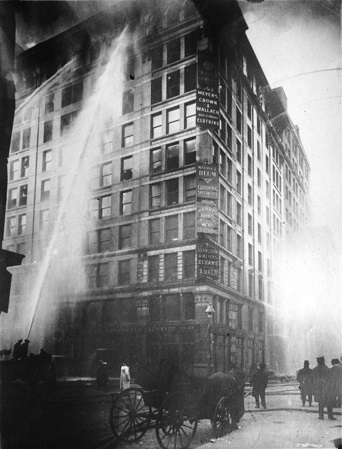
The Triangle Shirtwaist Fire began in the middle of the workday, on March 25, 1911. At around 4:40 PM, a fire began on the 8th floor after a cigarette was thrown into a scrap fabric bin beneath a workstation. The lack of ventilation and sprinkler systems allowed the fire to spread quickly. Employees could only access a few of the available exits. The building housed four elevators, but only one was operational, and few people were able to escape using that route. There were stairs at both sides of the building, but one stairway was blocked by the fire. The other led to a locked door. Workers were trapped. The single fire escape on the building was old, rusted, and crumbled under the weight of escaping workers. In just under twenty minutes, the Triangle Shirtwaist Factory fire killed 146 employees, most of whom were trapped inside the locked factory and could not escape.
 |
18 Minutes on March 25, 1911
The Triangle Shirtwaist Factory occupied the 8th, 9th, and 10th floors of the Asch Building. Employees worked on the two lower floors, while management occupied the 10th floor. When the fire began on the 8th floor, a supervisor attempted to extinguish the flames, but the water valve was rusted shut. The 8th-floor employees contacted management via telephone and alerted them to the fire. Workers from the 8th floor escaped down the stairs or elevator while the 10th-floor employees escaped to the roof. The workers on the 9th floor, however, suffered the worst fate.
With no building alarms, the 9th-floor workers did not know about the fire until they saw the smoke. Workers tried to use the stairs but found the locked doors. By the time a witness rang emergency services for help, it was too late. Workers had to choose between jumping out of windows or waiting and hoping to be rescued. To complicate matters, firefighters had difficulty accessing the 9th floor. The firetruck ladders only reached the 7th floor of the building, and the water pressure was not powerful enough to reach the flames. Witnesses watched in horror as the roof collapsed and workers trapped inside screamed for help.
In only eighteen minutes, the fire that tore through the Triangle Shirtwaist Factory left 146 dead and many more injured. It was the deadliest workplace disaster in New York City for decades.
The public was outraged, especially union workers who had lobbied hard for better working conditions. The fire could have been prevented if the company had heeded demands from the Ladies' Garment Workers' Union. In response to the tragedy, the workers' union organized a march on April 5, 1911, protesting the conditions responsible for the fire at the Triangle Company and demanding the company owners be held legally responsible. More than 80,000 people attended the march, and the public response to the tragedy fueled legislation that regulated workplace safety laws.
 |
On April 11, owners Max Blanck and Isaac Harris were indicted on seven counts of manslaughter. The owners had been warned about the conditions in the factory and had resisted union demands to improve them. Both owners were found not guilty of these charges and faced no criminal charges related to the fire or deaths. The jury determined that they could not prove the owners were directly aware of the locked doors that prevented workers from escaping.
After the criminal cases, the pair faced civil suits from families seeking compensation for the deaths of their loved ones. It took nearly three years before the civil cases were heard, and in March 1914, a settlement was reached in 23 cases. Compensation was only $75 per victim.
After the tragedy, cries for workplace safety laws mounted. Public outrage motivated lawmakers to pass laws regulating labor and safety in the workplace. A Committee on Safety of the City of New York was organized after the fire to help pass labor and workplace safety regulations. In the first year after the fire, eighteen bills were passed. One of the first and most important laws was the Sullivan-Hoey Fire Prevention Law, which created a bureau within the Fire Commission dedicated to fire prevention in the workplace. This bureau worked to enforce laws and make recommendations for changes to safety regulations going forward.
By 1915, more than thirty laws had been passed in New York City as a result of the fire. City fire codes were updated and required workplaces to install fire alarms and sprinkler systems. Fire drills were mandated, and factories could no longer lock exits and emergency doors. Workplaces were also required to provide bathrooms and access to clean drinking water, and labor inspectors were allowed to tour and shut down factories that did not pass inspections or were deemed unsafe. The laws passed in New York City after the Triangle Company fire would set a precedent for a slew of labor and workplace legislation across many states, and eventually at the federal level as part of Franklin D. Roosevelt's New Deal in the 1930s.
There are many events held in commemoration of the Triangle victims, such as the Chalk Project, and the 146 Shirtwaist Kites procession, organized by the Remember the Triangle Coalition. These events honor the victims of the fire and continue to promote social and political platforms for workers' rights and labor regulations. The Chalk Project is a volunteer-run art event that occurs each year on the anniversary of the fire, in remembrance of the victims. Volunteers write the name of a deceased victim in front of the homes they lived in when the accident occurred.
The Remember the Triangle Coalition educates the public about the disaster and helps support various activities held in honor of the victims each year. The coalition has a permanent memorial in the Asch Building, which today is known as the Brown Building, and is part of New York University's campus. The memorial is a steel ribbon that reaches the 9th floor, where most of the workers lost their lives. On the centennial anniversary of the fire, the Remember the Triangle Coalition hosted a symbolic funerary procession, in which volunteers carried 146 poles that flew shirtwaist kites, representing the 146 lives lost in the fire.
The Triangle Shirtwaist fire was the deadliest workplace disaster in New York City for many decades. The fire killed 146 employees on March 25, 1911, and fanned changes to labor and workplace regulations across the country. Located in the Manhattan neighborhood of New York City, the Triangle Factory was a sweatshop that produced ready-to-wear ladies' blouses. Working conditions at the factory were hazardous, and the pay was low. Many unions hosted strikes to improve working conditions in factories such as the Triangle Shirtwaist Factory. The fire began on the 8th floor and 146 workers lost their lives trying to escape the building. Despite being responsible for the lack of fire alarms and sprinkler systems, factory owners Max Blanck and Isaac Harris were found not guilty on all criminal counts. Following the tragic fire, over thirty laws were introduced to regulate workplace safety. Several of these laws included giving the Department of Labor the power to enforce stricter labor and workplace laws. There are many organizations and projects that work to commemorate the Triangle Shirtwaist Factory fire, including the Chalk Project and the Remember the Triangle coalition.
Additional Info
Early 20th Century Working Conditions
The early 20th century was a time of great success for the economy of the United States. The Industrial Revolution had led to modern advancements in technology that allowed goods to be produced much cheaper and faster than had ever been achieved. This created vast opportunities for employment with manufacturing industries with factories located in American cities. However, the working conditions were brutal and dangerous.
The new machines being used for mass-production were not only inherently dangerous (no safety switches, toxic fumes, etc.), but, because they were more automated, were also now being operated by unskilled workers. In addition, many of the workers in these factories were immigrants who, because they needed any job, could not complain about the dangerous and terrible working conditions.
Triangle Waist Company
The Triangle Waist Company (also called the Triangle Shirtwaist Company) was a sweatshop, a company where the employees are required to work long hours in dangerous and poor working conditions for very low wages. They had hundreds of employees, mostly recent immigrants, who worked on a 'sewing machine assembly line' for a minimum of 12 hours a day, 7 days a week to produce shirtwaists, or ladies' shirts. The employees of the factory found the conditions to be unsanitary and unhealthy due to the long working hours and lack of ventilation in the building. Due to the employers concerns about theft, employees would often be locked in during work hours with no access to fire escapes in case of emergency.
For their labors, they were paid $15/week, or about $.18/hour. This pay was well below the minimum wages that had been agreed upon after the 1910 strike by the International Ladies Garment Workers Union. The employers of the Triangle Waist Company refused to sign the agreement of the strike and neglected the terms of limited hours, a minimum wage pay, and safer and cleaner working conditions.
March 25, 1911
On the afternoon of Saturday, March 25th, 1911, a fire began on the 8th floor of the Triangle Shirtwaist Factory in the Asch Building in Manhattan, New York. The cause was later to be determined as a cigarette that had not been completely extinguished before being tossed into a pile of rags. The fire spread rapidly throughout the building. Over 500 employees were still at work and were about to end their shift. The factory workers were on the 9th floor while the owners of the company and management were on the 10th floors. Employees on the 10th floor were able to be alerted to the fire quickly and escaped to the roof and then onto neighboring buildings. However, no one alerted the employees sewing on the 9th floor and it was not until they saw the smoke that they became aware of the fire.
Fire escapes and exits did exist on two sides of the building. However, the fire spread so quickly on the 9th floor that one exit was blocked by flames. The other exit was locked and the key could not be found. The fire escape was old and rusted and collapsed under the weight of the women trying to escape. Nor did the building have any sprinkler systems, although that was required by law.
Employees that were not able to escape quickly faced a decision to jump out of the windows or wait to be rescued. Unfortunately, when the firemen arrived with the firetrucks and hoses, they quickly realized that their ladders would not reach to the 9th floor, nor was there adequate water pressure for the water from their hoses to reach the stranded victims.
Bystanders had to watch helplessly as women begged for help out of their windows and many jumped instead of being burned by the engulfing flames. The fire lasted only 18 minutes, but in that timeframe, 146 of the over 500 employees of the Triangle Waist Company were dead. Hundreds more were seriously injured due to burns and smoke inhalation.
Outrage and Reforms
Outrage and protests began quickly after the disaster. Within 4 weeks, the owners, Max Blanck and Isaac Harris were charged with seven counts of ''manslaughter in the second degree under section 80 of the Labor Code, which mandated that doors should not be locked during working hours.'' On December 27, 1911, Blanck and Harris were found not guilty due to the fact that it could not be determined beyond a reasonable doubt that these men knew that, at the time of the fire, the doors were locked. However, civil suits were later filed by the families of the victims and three years to the day of the fire, on March 11, 1914, a settlement of 23 cases was reached for $75 per victim. The company later closed its doors in 1918.
Shortly after the disaster, over 30 laws were presented for legislation to give more power to the US Department of Labor to enforce stricter labor laws to help protect employees who did not have the benefit of unions or representation. The fire victims had been martyrs for a cause to which they had previously fought in strikes in 1910. The deaths of the victims was a turning point in a progressive era of reform for the rights of workers.
Lesson Summary
On March 25, 1911, a fire erupted in the Triangle Waist Company, a sweatshop located in Manhattan, New York. This tragedy and the senseless deaths of 146 employees was mourned throughout the world. The victims of the tragedy became martyrs for a movement in the early 20th century that led to reforms in the treatment and working conditions of workers.
Register to view this lesson
Are you a student or a teacher?
Unlock Your Education
See for yourself why 30 million people use Study.com
Become a Study.com member and start learning now.
Become a MemberAlready a member? Log In
BackResources created by teachers for teachers
Over 30,000 video lessons
& teaching resources‐all
in one place.


I would definitely recommend Study.com to my colleagues. It’s like a teacher waved a magic wand and did the work for me. I feel like it’s a lifeline.
Jennifer B.
Teacher

Back
Triangle Shirtwaist Factory Fire | History, Cause & Commemoration Related Study Materials
Explore our library of over 88,000 lessons
Browse by subject