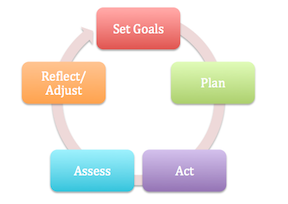
As Mr. Smith seeks to evaluate his school and the needs that might exist using the cycle of inquiry, he works through the following steps:
- Set Goals - During this step, administrators make determinations as to what results they are trying to accomplish and where they wish to be after a given amount of time. Goals are an essential part of any improvement process because they give direction and help set the course for effective improvement. They might include:
- Student achievement goals (looking to increase student learning and achievement)
- Student motivation goals (working to increase levels of student commitment and motivation)
- Goals for narrowing the achievement gap
- Goals for teacher practice and production (working to improve teacher performance)
- Organizational or administrative goals
- Plan - It is within this step that a plan of action is developed. Actions developed should be based on goals set in the previous step and should provide a method or strategy for achieving the goals. A suggested process for plan develop might include:
- Definitive actions that will be taken
- Explanation as to who is responsible for each action
- Ideas as to what steps might need to be followed in order to implement the plan
- Description of possible hurdles or roadblocks that might come up
- Ideas for overcoming these difficulties
- Shared responsibility assignments (who will lead the process, what role the teachers will have, what role administration will play, who will keep track of data, etc.)
- Suggestions for collaborative practices during the process (such as creating teams or organizing regular meetings for group discussion of the plan)
- Act - During this step, the plan is officially put into practice. Data should be collected during this process so that the plan might be assessed later in the cycle. Data should include:
- When/where/how the plan was implemented and by whom
- Notable successes
- Notable weaknesses
- Other important data related to the original goals (attendance data, student achievement data, teacher effectiveness data, or whatever the focus might be)
- Assess - It is during this step that data collected during the prior phase is analyzed. It is helpful, during this process, to organize data and make it visual. Create charts, graphs, or other visual means of displaying the data so that it is easily read and easily analyzed.When looking at the data, determinations should be made as to:
- Whether or not the plan was executed as intended
- Whether or not the results were as expected
- Whether or not the plan implemented helped to accomplish the original goals
- What problems came up during implementation of the plan
- What successes should be celebrated
- Whether or not the plan should stay as is or needs to be adjusted
- Reflect and Adjust - Though it should never be considered the final step (because the cycle will be repeated), it is during this step in the cycle that assessment of the data is compared back to the goals that were originally set. This is the point where there is opportunity for reflection on the goals that were originally set, the plan that was developed in order to meet those goals, and the data that was collected during the implementation process. At this point, it is time to decide:
- Did we meet our goals?
- If so, what part of the plan helped us to get there?
- If not, where did we fall short and why?
- If not, how can we revisit and/or rewrite the plan?
- Whether or not goals were met, should the plan be continued as originally implemented or are changes needed?
- Where do we go from here? What new goals might need to be looked at?
Naturally, after this fifth step, the process would repeat again with the setting of new goals. Even if it has been decided that the plan must be revisited, it is important to continue the cycle and go directly to the step allowing for new goals to be established.
The cycle of inquiry is cyclical and can actually be started at any point in the process. Once the process has been completed, wherever that point of completion might fall, the cycle is repeated over and over again as any true cycle would be.