
Learn about the American Civil War weapons. Examine developments in Civil War technology, and study examples of Civil War guns, bullets, knives, and artillery.
American Civil War Weapons | History, Facts & Types
Table of Contents
- History of American Civil War Weapons
- Types of American Civil War Weapons
- Notable American Civil War Weapons
- Significance of American Civil War Weapons
- Lesson Summary
Frequently Asked Questions
What were the main weapons during the Civil War?
Early in the war, both sides focused on the production of edged weapons including sabers, knives, and bayonets. However, these were soon revealed to be useless due to the near absence of hand-to-hand combat. Innovations to rifles, such as a percussion system, and to ammunition, such as the Minie bullet or the fixed cartridge that could be loaded from the breach, made warfare from a distance possible. The Union's standard issue repeating rifle was the Springfield, with the Richmond appearing as the Confederate copy. Along with heavy artillery like canons, infernal weapons such as the Gatling gun made their appearance in the war using these new technologies.
Who had more weapons in the Civil War?
Before the war, the Northern states were more industrialized than those in the South, whose economies were largely rural and dependent upon slave labor. As a result, the Union had an advantage in producing weapons and providing other manufactured goods to supply their forces. Early on, they implemented a naval blockade on the South which made raw materials scarce and further hindered the Confederacy's ability to equip their soldiers.
Why were weapons important in the Civil War?
Innovations to weapons of war, especially repeating rifles, led to increased speed, accuracy, and range. The ability of the Union to implement and manufacture more state-of-the-art weapons rendered traditional forms of warfare, such as hand-to-hand combat using sabers or knives. Faced with a chronic shortage of raw materials, the Confederacy could not innovate as quickly and ultimately lost the war.
Table of Contents
- History of American Civil War Weapons
- Types of American Civil War Weapons
- Notable American Civil War Weapons
- Significance of American Civil War Weapons
- Lesson Summary
The American Civil War was a conflict between the United States of America and 11 Southern states that seceded from the Union to form the Confederate States of America. The war broke out in 1861 as the culmination of decades of growing tensions between North and South, largely related to the stark economic differences between the two regions and the issue of slavery. The fighting lasted until 1865 and largely concluded following the surrender of Southern General Robert E. Lee following the battle of Appomattox Court House.
Due to the technological advances made during the Industrial Revolution, new state-of-the-art weapons with unprecedented destructive power appeared on the battlefield during the Civil War. These included famous weapons, such as the Civil War-era cannon known as the Napoleon, and the rapid-fire Gatling gun. Partially due to the destructiveness of these weapons the American Civil War ultimately resulted in over 600,000 deaths. It remains the deadliest war to have taken place in United States history.
 |
Due to advances in weaponry, as the Civil War began, many of the military strategies employed by both the Union and Confederacy were outdated. Additionally, as the war progressed, weaponry advanced as well, forcing greater and greater adaptations by both sides. Indeed, by the latter stages of the war, some battles came to resemble the protracted trench warfare that World War I would later become famous for. Here are weapons facts that illustrate how weaponry affected warfare during this conflict, and how technological advances shaped weapons and tactics.
 |
Civil War Rifles and Muskets
Both Union and Confederate infantry soldiers commonly carried .58 or .577 caliber rifle-muskets during the war. The innovative use of rifling grooves inside of rifle barrels to generate bullet spin and thereby increase its stability greatly increased the range and accuracy of shooting, and as a result, these weapons were significant improvements over what had been available in the past. For both rifles and pistols, another important invention was a percussion cap made of copper that would send a spark to a powder charge when struck by the hammer, allowing for three or more shots per minute. Prominent rifle manufacturers of the time included the United States Arsenal at Springfield Massachusetts (which produced rifles commonly known as "Springfields," Colt and Remington, and Enfield, imported from England.
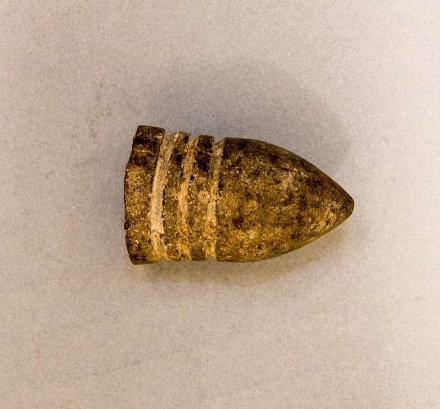
Innovations in ammunition also improved during the Civil War era. The French Minie bullet had a conical design that allowed for much quicker reloading on the battlefield and is credited with having significantly changed the cadence of warfare. Metallic rimfire cartridges also allowed for fixed ammunition, resulting in the creation of action-lever magazine-fed rifles, such as the Spencer repeating rifle. This rifle proved more efficient and less prone to jams by its use of a tubular magazine of seven rounds that was inserted through the butt of the stock. A lever would expel the used cartridge and load a new one.
 |
Confederate Revolvers and Swords
Many of the same innovations seen in rifles were applied to handguns, pistols, and carbines—lightened rifles with shortened stocks. These types of weapons were typically flintlock single-shot arms until after the Mexican War-American War in the late 1840s. However, in the 1830s, inventor Samuel Colt produced a highly innovative multi-shot pistol with a rotating cylinder that required its user only to draw back the hammer to revolve and load the chamber. This design became popular through the 1840s and became a standard military issue before the Civil War.
During the war, unable to buy Colts, the Confederacy commissioned gun manufacturers Griswold and Gunnison to make a copy using an iron frame instead of brass. Although few were made, one Confederate revolver known as the LeMat became famous due to its unique .42 and .63 caliber double-barreled design.
In addition to fired weapons, various edged weapons such as swords, knives, and bayonets played a role in the Civil War. Cavalrymen who rode on horseback were typically equipped with sabers, and men who manned the artillery cannons were generally issued their own short swords to fend off the enemy cavalry should it approach.
There were various models of standard-issue swords fabricated by military units, such as the light artillery saber model 1840 which had a deeply curved, single-edged blade. Confederate-edged weapons often copied Union designs, but often with poorer quality due to shortages in raw materials. The Confederacy also imported swords from outside of North America. The most popular imported sword was the 1853 Pattern Cavalry Saber manufactured in England.
Civil War Artillery and Cannons
 |
During the Civil War, artillery played a major role in many key battles. Both the Union and the Confederacy possessed cannon weapons, in addition to other types of artillery such as guns, howitzers, and mortars.
Field artillery was largely defined by the 12-pounder Napoleon field cannon, which is generally considered to be the most famous of Civil War cannons. French developed, by 1833 the Napoleon was estimated to make up 39% of all artillery in both the Army of the Potomac (the primary Union army in the East) and the Army of Northern Virginia (the primary Confederate army in the East). Projectiles—usually solid round cannonballs—were shot into the field, causing not just grave bodily injury, but also shock and disorientation.
Larger forms of artillery were used in sieges and for other purposes. Occasionally civil war cannons gained particular reputations, such as "Whistling Dick," a Confederate 18-pounder gun that was used during the Siege of Vicksburg and took its name from the peculiar sound it made when fired.
In terms of ammunition, cannonballs from the Civil War came in a variety of different types for different purposes. Case shot was hollow and full of shrapnel so that it would be more effective as an anti-personnel projectile. Meanwhile, grapeshot would be filled with tiny metal balls that would explode outward over a target like a shotgun.
 |
Specifically, the following Civil War weapons were known to make an impact in the conflict:
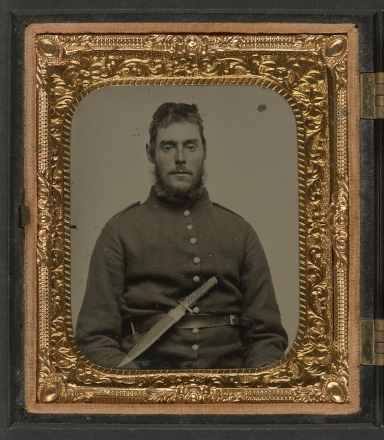
- Bowie Knife: Bowie knives were especially common among Confederate regiments, mostly due to their largely inferior weapons. Designed as a hunting knife by Rezin Bowie in the 1830s, the fixed blade was long and thick, shaped into a curve ending in a sharp point. It became popular due to the exploits of the inventor's brother Jim Bowie.
- Springfield Rifle: With the US government commissioning over 800,000, the model 1861 Springfield percussion rifle was the most common weapon of the Union forces. It was manufactured in Springfield, Massachusetts, although copies were made in the Confederacy. Equipped with percussion caps and Minie bullets, this rifle was lightweight compared to its predecessors and could fire three shots per minute.
- Minie Bullet: The Minie bullet, or Minié ball, improved the accuracy and range of rifled shots through its hollow, conical shape. The projectile would expand once it was fired, making it much more efficient compared to the ammunition of muzzle-loading rifles which had to be the same diameter as the barrel. By enabling longer shots, the battlefront changed, and frontal assaults became more deadly compared to the old combat styles of hand-to-hand combat using edged weapons.
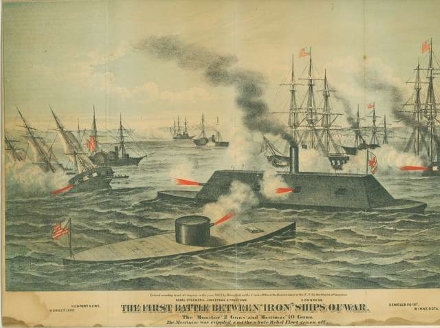
- Ironclad Ships: Early in the war, the Union established a blockade of the Southern states in a strategy to strangle the supply chain known as the Anaconda Plan. Union efforts to update their wooden-hulled steam frigates and Confederate efforts to break the blockade led to the first ironclad ships and gunboats.
- The H.L. Hunley: The H.L. Hunley was a Confederate submarine. Although the Confederate states had to build a navy from scratch and faced serious manufacturing and material limitations, the Hunley revolutionized naval warfare by being the first submarine to sink an enemy ship (the USS Housatonic) with torpedoes.
 |
The conceptualization of warfare before the outbreak of the American Civil War differed immensely from what would prove itself the reality. Romanticized notions of Napoleonic warfare from half a century earlier were prominent, leading to an idea of war as a sort of nationalistic pageantry. As such, military leaders were better known for their great speeches than military prowess, recruits lining up to enlist were met with fanfare and marching bands, soldiers wore brightly colored uniforms, and weapons were beautifully ornate.
Technological advances had led to a new phase in the production and development of military weapons by 1861 which forever changed the face of warfare. The importance of technological innovation—both the ability to conceive of it and the means to apply it—in this conflict cannot be understated. In the Confederate southern states, manufacturers were severely limited by failing machinery and a lack of raw materials, thus tending to fabricate simpler muzzle-loading rifle designs. Repeating rifles were, thus, more readily available to Union soldiers and granted the North a distinct advantage in military might near the end of the war.
The American Civil War between the United States of America (the Union) and the Confederate States of America (the Confederacy) lasted from 1861 to 1865. Technological advances during the Industrial Revolution saw innovations in the accuracy, speed, and range of weapons which forever altered warfare, and during the Civil War, these innovations in weaponry prompted a similar evolution in military tactics.
Many types of weapons were utilized during the war. Inventions like the percussion cap, bullets that expanded upon impact, including the Minie bullet, rifling grooves to create a spin within the barrel, and rimfire cartridges, improved hand-fired weapons dramatically. Swords and other edged weapons were still issued, though proved less useful than in previous conflicts. Civil War artillery was defined by the 12-pounder Napoleon field canon, though other Civil War canons were far larger. Cannonballs from the Civil War came in a variety of different types, including case shot and grapeshot. Overall, discrepancies in resources and manufacturing capacity between the Union and Confederacy meant that Union soldiers generally possessed better equipment. Due to a shortage of manufacturers and raw materials, Confederate forces were equipped with edged weapons—such as the Bowie knife made famous by the exploits of the inventor Rezin Bowie's brother prior to the war—for lack of better options.
Additional Info
Weapons
You may recognize modern-day weapons from news stories or from your own knowledge of weapons. Did you ever wonder if older versions of them were used during the Civil War? In this lesson, we will look at weapons of the Civil War, many of which might be recognizable as predecessors of modern-day weapons.
Small Arms
Before the Civil War, most small arms were single-shot, meaning the guns had to be reloaded each time through a muzzle. However, during the Civil War, semi-automatic weapons, which can repeatedly fire bullets, were developed. This helped the soldier because he did not have to shoot and then reload every time, allowing for quicker firing. Another name for single-shot is single action, because the shooter had to cock the hammer every time to fire, whereas double-action guns release the hammer simply by pulling the trigger.
Long Arms
Long arms refers to weapons such as rifles. While rifles are less commonly used in combat today, replaced by faster so-called assault rifles, they were the primary long-shooting gun of the time. Some common rifles included: Springfield muskets, Colt Revolving rifles, and Enfield rifles. The technology was similar to the small arms.
Bullets
While not technically a weapon, guns are pointless without bullets. One of the major changes from the previous wars was the development of the Minie ball, a newly designed bullet. The Minie ball could travel farther and more accurately and cause more damage. This is because it was cyndrical, hollow, and expanded upon impact, causing more damaging wounds.
Cannons
If you have watched movies set during the Civil War or even the Revolutionary War, you have probably seen re-enactments of cannon shots. Usually, one person loads the cannon with the cannon ball, another person may add powder, and a third might light a fuse. These were early versions of modern-day missile launchers or even tanks.
Cannons are an example of artillery, a type of weapon that fires longer range, compared to small arms, which shoot at close distances. There were many types of cannons used during the Civil War, including mortars, which were less accurate but could fire farther. As you can imagine, mortar cannons were useful for hitting large targets, such as walls or military camps. Parrott rifle cannons could fire faster and were easier to move since they were much lighter. Parrott cannons were not as powerful as mortar cannons but were more mobile, which was helpful for quick strikes.
 |
Knives
If you've watched movies like Davy Crockett or other frontier-based movies or Civil War based-movies you have likely seen the famous Bowie knife. In the early 1800s, Jim Bowie popularized the Bowie knife invented by his brother Rezin ( a little-known fact!). Many Civil War soldiers already owned Bowie knives and carried them with them at all times. However, Confederate soldiers, who were responsible for providing many of their own weapons, carried Bowie knives more often than Union soldiers.
Knives were used for several reasons. At close quarters, they could be used to hand to hand fighting. Knives could also be used to cut a rope, food, or other things that had to be cut while reducing how many tools a soldier would have to carry on himself.
 |
Lesson Summary
In this lesson, we've reviewed some of the basic weapons used during the Civil War. The weapons we discussed today are similar to weapons we still use; single-shot revolvers have evolved into faster handguns; knives are still used but not as prominently for fighting; artillery cannons have moved into more accurate and farther shooting missiles and moved onto the tops of tanks, ships, and planes.
Register to view this lesson
Are you a student or a teacher?
Unlock Your Education
See for yourself why 30 million people use Study.com
Become a Study.com member and start learning now.
Become a MemberAlready a member? Log In
BackResources created by teachers for teachers
Over 30,000 video lessons
& teaching resources‐all
in one place.


I would definitely recommend Study.com to my colleagues. It’s like a teacher waved a magic wand and did the work for me. I feel like it’s a lifeline.
Jennifer B.
Teacher

Back
American Civil War Weapons | History, Facts & Types Related Study Materials
Explore our library of over 88,000 lessons
Browse by subject