Math Courses / Course

How to Solve Trigonometric Equations: Practice Problems

Instructor Michael Quist

Michael has taught college-level mathematics and sociology; high school math, history, science, and speech/drama; and has a doctorate in education.

Trig equations can look like some kind of alien language, but once you get the principles down, they're not too bad. In this lesson, we'll work through some examples.

If you've been working in trigonometry, you've probably seen sines, cosines, tangents, and angle relationships until it's nearly driven you nuts. Before you lock yourself in a psych ward somewhere, let's take a look at some of them, and see if we can't make them just a bit easier.

A trigonometric equation is an equation that involves trigonometric functions, ratios of the sides of a right triangle. Trig functions help us solve many kinds of problems. In this lesson, we'll be looking for the angle(s) that make an equation true.

When you're solving trig equations, you're looking for x (or some other value), using trig identities and the rules of algebra. You simplify the equation down to a single identity, such sin(x) = .5, then use your calculator or a table to find out the value of angle x. The following is a simple example:

  • 3 sin(x) = 1.5
  • sin(x) = .5 (divide both sides by 3)
  • x = 30° (look up .5 on a sine table, or pull the arc-sign from your calculator)

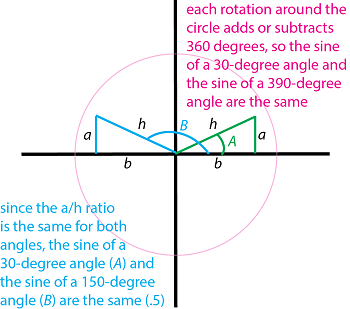
30° is just one of the solutions. An angle is a measure of rotation, and if you keep rotating you'll get more angles with the same sine. The same ratio of sides happens at 150°, 390°, 510°, etc. Not only that, you can rotate backward (clockwise), and get negative angles. -210° and -330° also have a .5 sine.


The sine is the same for many angles
Repeating sine function


Rotating clockwise creates negative angles
Negative Angle Rotations

Because of this, most trig problems include a domain limitation (upper and lower limits for possible inputs). For example, domains might be limited to 0° to 180°, 0° to 360°, -180° to 180°, etc.

All right, let's try one. It looks pretty scary, but remember, treat the sin(x) terms like variables and use algebraic rules. This example is a quadratic equation, so let's treat it like one.

  • 2 sin²(x) - sin(x) = 1
  • 2 sin²(x) - sin(x) - 1 = 0 (subtract 1 from both sides to form a trinomial)
  • (2 sin(x) + 1) (sin(x) - 1) = 0 (factor the trinomial)
  • 2 sin(x) + 1 = 0 OR sin(x) - 1 = 0

Solving for sin(x), we have the following:

  • 2 sin(x) + 1 = 0
  • 2 sin(x) = -1 (subtract 1 from both sides)
  • sin(x) = -1/2 (divide both sides by 2)

For the second solution, we have these steps:

  • sin(x) - 1 = 0
  • sin(x) = 1 (add 1 to both sides)

Glancing at our table, we can see that our two values for x will show up at 90° (x = 1), 210° (x = -1/2), and 330° (x = -1/2). Remember, there are also an infinite number of other positions (in other rotations) where x also appears.

Trigonometric equations, equations that involve trigonometric functions (ratios of the sides of a right triangle), can be solved using algebraic steps, trig rules, and conversions. A domain limitation establishes upper and lower limits for possible input angles, otherwise you have to allow for an infinite number of solutions in positive and negative rotations.

Register to view this lesson

Are you a student or a teacher?

Unlock Your Education

See for yourself why 30 million people use Study.com

Become a Study.com member and start learning now.

Become a Member  Back

Resources created by teachers for teachers

Over 30,000 video lessons & teaching resources‐all in one place.
Video lessons
Quizzes & Worksheets
Classroom Integration
Lesson Plans

I would definitely recommend Study.com to my colleagues. It’s like a teacher waved a magic wand and did the work for me. I feel like it’s a lifeline.

Jennifer B.
Teacher
Jennifer B.
Create an account to start this course today
Used by over 30 million students worldwide
Create an account