The five Platonic solids have been used and are in use all over the world due to their "perfect" nature. They hold an appeal in terms of mathematical precision as well as in their symmetrical nature that is often considered attractive for a variety of reasons.
One example is their use in dice. The most common dice are in the form of a cube, but tabletop games often use tetrahedral, octahedral, dodecahedral, and icosahedral dice as well.
Another example of Platonic solid use is in computer-assisted three-dimensional modeling. Due to the nature of graphics chipsets being optimized for triangular calculations, octahedra and icosahedra are common base shapes to create spheres from, and cubes (with square faces easily created from pairs of triangles) are famously used in the popular videogame Minecraft.
The Kaaba, the cuboid building at the center of the Great Mosque of Mecca and whose name translates literally to "The Cube", is the most sacred physical site to the Islamic religion. Renaissance artists thought the Platonic solids provided excellent demonstrations of symmetry and applied the solids' geometries to provide perspective in their art. The Pyramids of Giza are perfect halves of octahedra, or pyramids with square bases.
Tetrahedron
Tetrahedra
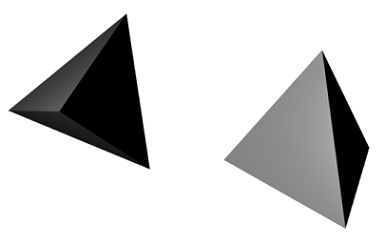 |
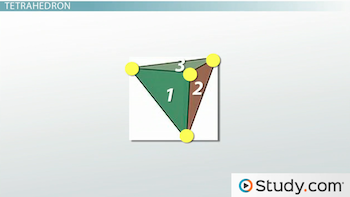
A tetrahedron is described as a regular polyhedron whose vertices are created by three equilateral triangles meeting at their corners. The prefix tetra- means four, which stands for the four faces of the object.
Cube or Hexahedron
A cube
 |
A cube, which is also called a hexahedron, is described as a regular polyhedron whose vertices are created by three squares meeting at their corners. The prefix hexa- means six, which stands for the six faces of a hexahedron. This is also the only Platonic solid that is created with square faces, due to squares having internal angles of 90 degrees. To construct a regular polyhedron from squares limits the number of faces meeting at vertices to three, as four meeting at a vertex would total their angles to 360 degrees and result in a flat object.
Octahedron
An octahedron
 |
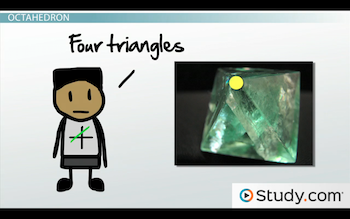
An octahedron is an object whose vertices are the corners of four equilateral triangles. The prefix octa- stands for eight, which is the number of faces of this solid.
Dodecahedron
A dodecahedron
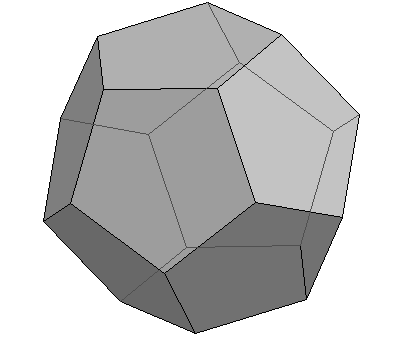 |
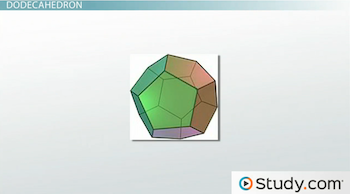
A dodecahedron is the only Platonic solid whose faces are composed of pentagons, with vertices created by three pentagons meeting at their corners. The prefix dodeca- stands for twelve, which is the number of faces of the object. Like the cube with its square faces, no other regular polyhedron can be constructed with pentagon faces, as the internal angles of four or more meeting would be equal to or greater than 360 degrees.
Icosahedron
An icosahedron
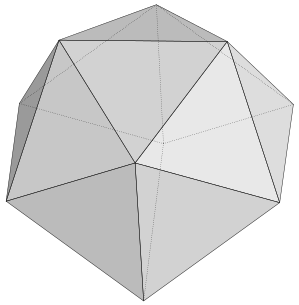 |
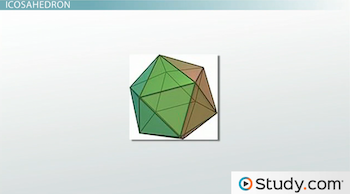
An icosahedron is characterized by five equilateral triangles meeting at its vertices. The prefix icosa- stands for twenty, which is the number of faces of an icosahedron.
Why Are There Only 5 Platonic Solids?
A regular polyhedra must have interior angles of polygon faces meeting at vertices that total less than 360 degrees. If interior angles added up to exactly 360 degrees, the object would no longer be a polyhedron, as it would be a flat object and no longer three-dimensional. If the interior angles added to greater than 360 degrees, the shape would no longer be convex. Its surface would be curved in the wrong direction and the surface would not be on the polyhedron's "outside". This limits the potential number of regular polydehra to the five Platonic solids due to the math surrounding their interior polygonal angles.
This table describes the total vertices, edges, and faces of each Platonic solid.
| Platonic solid |
Faces |
Vertices |
Edges |
| Tetrahedron |
4 |
4 |
6 |
| Cube |
6 |
8 |
12 |
| Octahedron |
8 |
6 |
12 |
| Dodecahedron |
12 |
20 |
30 |
| Icosahedron |
20 |
12 |
30 |
Euler's formula describes a property of all polyhedra, which can also be applied to regular polyhedra, or Platonic solids.
{eq}F + V - E = 2 {/eq}
This formula states that the total number of faces of a polyhedron plus its total vertices, minus its total edges, will always equal two.
As an example, a tetrahedron has four faces plus four vertices, minus six edges, which equals two.
A dodecahedron has twelve faces plus twenty vertices, minus thirty edges, which likewise equals two.
Repeating this process with the properties of each Platonic solid will always produce a result of two.