
Learn about the Cefalu Cathedral and its history. Discover the mosaics of the Cefalu Cathedral and the Moorish and Norman-Arab architecture of the Cefalu Church.
Cefalu Cathedral History, Mosaics & Architecture
Table of Contents
- Cefalù Cathedral
- Cefalù Cathedral History
- Cefalù Cathedral Architecture
- Cefalù Cathedral Layout
- Lesson Summary
Frequently Asked Questions
How old is the cathedral of Cefalu?
Construction of the Cefalù Cathedral began in the year 1131 and continued through the 12th and 13th centuries. The Cathedral was finished in 1240 and consecrated in 1267.
Why is Cefalu famous?
The Cefalù Cathedral is famous for several different reasons. Some of these reasons are as follows: it was built to fulfill a vow, it demonstrated the power that the Normans had in Sicily, and it contains a Byzantine-influenced mosaic program.
Who built Cefalu Cathedral?
The Cefalù Cathedral was built by the Normans under King Roger II. It has Arab, Norman, Byzantine, and Islamic influences.
Table of Contents
- Cefalù Cathedral
- Cefalù Cathedral History
- Cefalù Cathedral Architecture
- Cefalù Cathedral Layout
- Lesson Summary
The Cefalù Cathedral, located on the southern Italian island of Sicily, is an example of Italian Moorish architecture. This cathedral is one of nine UNESCO World Heritage Sites, meaning it has legal protection on an international level. It was built between 1131 and 1240 BCE by the Normans under King Roger II.
The architecture of the Cefalù Cathedral has Norman, Byzantine, and Islamic influences. The combination of these different architectural styles formed Norman-Arab architecture. The Cefalù Cathedral has an introverted character, with the outside of the building being more sober-looking and the interior being more decorated, which is common in Italian Moorish architecture.
 |
The Norman King Roger II built the Cefalù Cathedral. King Roger decided to build the Cefalù Cathedral, one of his first building projects, in the summer of 1130. The ceremonial founding of the church took place on June 7, 1131 BCE, which in that year was Pentecost Sunday. On September 14, 1131, the church was elevated to cathedral status by Anacletus II.
Although the actual events surrounding the creation of the Cefalù Cathedral are unknown, according to several stories at the time, King Roger built the church to fulfill a vow. When Roger was at sea returning from the mainland, a storm threatened the lives of Roger and his sailors. As Roger prayed for his life, he vowed that if he and the other sailors were spared, he would build a church at the landing site, which came to be the Cefalù Cathedral.
King Roger initially intended for the church to serve the additional function of a royal mausoleum; Roger donated two sarcophagi, or stone coffins, to the church in 1145. This added function required several changes in the church's original structure: closing three circular windows in the apse, inserting a conch (dome), and installing two cross vaults.
These changes made space for the addition of mosaics in the sanctuary, and mosaics were later installed into the apse and sanctuary bay of the church. These were installed between the installation of the sarcophagi in 1145 and the Pope's reconciliation with the church in 1170.
The inscribed date of 1148 at the bottom of the apse mosaic indicates that the majority of the east end of the cathedral, including the mosaics in that area, was built by the late 1140s. The remainder of the mosaics were completed during the reign of William in the 1160s. The cathedral was not finished until 1240 and was consecrated, or dedicated to a sacred purpose, in 1267.
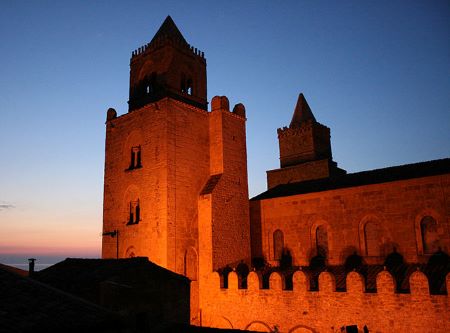 |
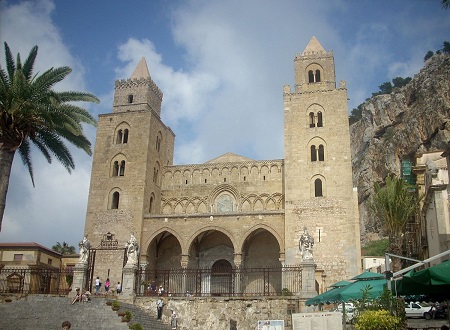
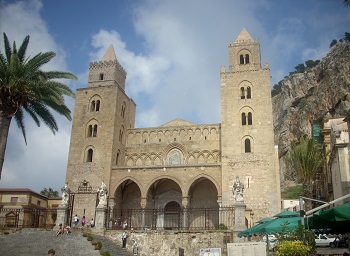
The west facade of the Cefalù Cathedral contains two towers rising from the main church. Each tower has a pyramidal structure that rests atop a smaller square body containing five windows. There is a vaulted porch connecting the two towers over the singular entrance. The porch below has two decorated rows of blind arcades (arches) and chevron motifs; these arches are the main constructive element for the cathedral's facade.
The Cefalù Cathedral shares some similarities with the traditional Romanesque architecture of Normandy; one example is its three-part stepped apse echelon inside. This floor plan style is commonly found in other 11th-century Norman buildings, such as the Abbey Church of Cluny II. Architects used this floor plan in Norman buildings in Sicily at the time. For example, the Cefalù Cathedral has a columnar basilica nave, similar to the original floor plan of the Cathedral of Salerno. In addition, these two cathedrals have oculi, or circular windows, at the top of a dome. The upper level of the transept arms inside the Cefalù Cathedral has wall passageways, which are also common in Norman churches of the 11th century.
The north side of the Cefalù Cathedral also has a rectangular cloister or a covered passage next to a courtyard. The garden cloister at the Cefalù Cathedral is said to be one of the greatest in Sicily. Part of the cloister had to be restored after World War II, due to damage from retreating Germans and Italians. The cloister is large for its size and is decorated with popular biblical figures. Visitors are allowed to visit the Cefalù Cathedral cloister for a couple of hours every morning and afternoon for a small fee.
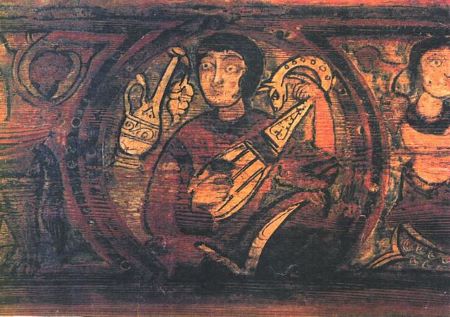
While there are similarities between the Cefalù Cathedral and Sicilian and Norman architecture, the court of King Roger II had Muslim influences in the artistic and architectural projects around the kingdom. This Muslim influence is seen in the Cefalù Cathedral in the use of Islamic imagery and inscriptions in the rafters. Finally, Byzantine influences are seen in the mosaics in the east end of the Cefalù Cathedral.
The Cefalù Cathedral is known for its introverted character rather than its sober external features; this means that the inside is highly decorative. The Cefalù Cathedral's exterior looks like a basilica with its twin towers on the west side of the building. The Cefalù Cathedral's interior has the shape of a Latin cross. Its descending aisle is longer than the horizontal aisle, the latter of which is divided into a central nave and two aisles. This use of symmetry was common in Byzantine and Arab architecture at the time.
There is also a rectangular cloister on the north side, which was added in the 14th century. Besides the presbytery and south transept arm, which contain ribbed cross vaults, the building is unvaulted. The side points of this cross have a barrel-vaulted roof. The tops of both transept arms have continuous wall passageways.
There are several oculi within the Cefalù Cathedral: three in the main apse and two in each transept. The throne sat on the south side of the sanctuary, allowing the King to look at the mosaics on the north side.
The west facade of the Cefalù Cathedral has two towers with pyramidal blocks at the top that rise up from the main church and stand out against the cityscape in the background. The upper sections of these bell towers were added to the cathedral in the 15th century, one a square tower and the other an octagon. The architects also added a portico to connect the two towers.
Cefalù Church Arches and Roof
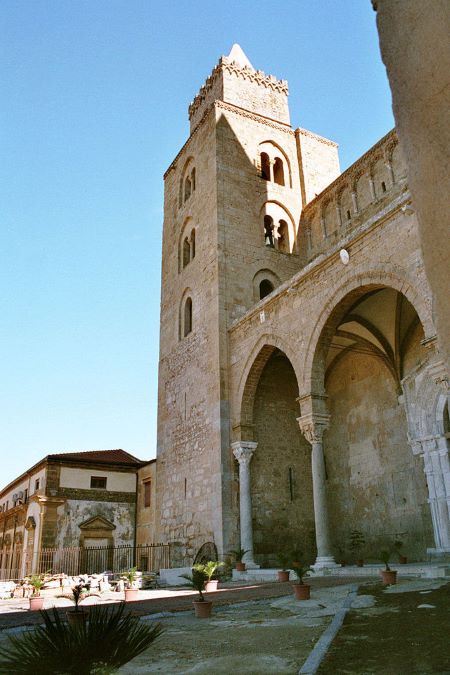
Arches, common features of Arab buildings, are the main constructive element for the facades of the cathedral. The decorative arches of the Cefalù Cathedral serve as windows while also connecting the granite and marble columns on the interior of the cathedral.
 |
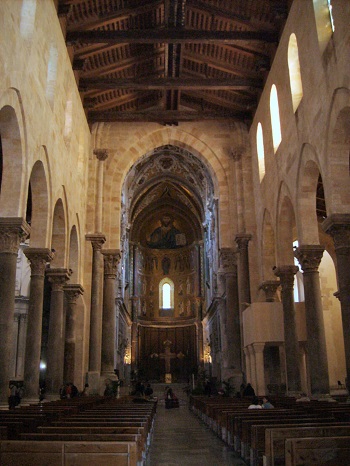
The wooden boards on the ceiling are painted with pastel colors and precious pigments to represent lively, naturalistic, and imaginary scenes. The area near the altar has a stone ribbed-vault roof, while the sides of the cross layout are barrel-vaulted.
 |
Cefalù Church Materials
Cefalù Cathedral is composed of various materials, including stone and limestone in the towers, brick, mortar, stucco, granite, and marble. The most common material used when creating the Cefalù Cathedral was brick.
Cefalù Cathedral Mosaics
Although the Cefalù Cathedral is well known for its mosaics, its mosaic program is limited compared to other decorated Norman churches. The Cefalù Cathedral mosaics were the work of Byzantine masters and are an abbreviated adaptation of the Middle Byzantine basilica church decorative program. It appears that the mosaics in the Cefalù Cathedral were set on the wall from top to bottom.
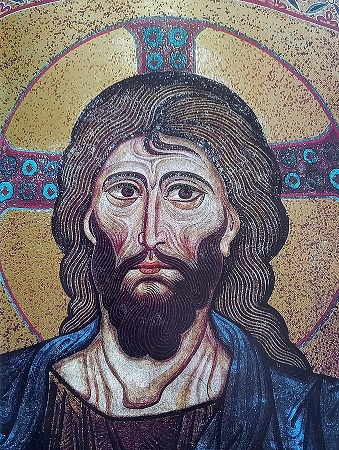
The mosaic of Christ the Pantokrator is in the conch of the apse at the top and center of the mosaics. In this mosaic, Christ holds an open book, and a Latin inscription appears above him. The remainder of this wall is divided horizontally into three sections.
 |
The top section shows an image of Mary, front and center, with pairs of archangels dressed in imperial clothing on either side. The other sections contain the 12 apostles and some evangelists with Greek inscriptions. The mosaic depicts these saints in a hierarchy. Between the top and bottom sections sits a window, which splits up the apostles so that Matthew, Mark, and Peter are in the upper left, with Andrew, James, and Phillip below them. Paul, John, and Luke are in the upper right, with Simon, Bartholomew, and Thomas below them.
The north and south walls are divided into four sections. The upper regions contain a medallion flanked with various figures and Old Testament prophets occupying the top two sections on each side, while the bottom sections depict different saints. The mosaics on the highest sections of the north and south walls are a slightly different style than the mosaics in the apse and the walls' lower areas. For example, the figures in the top registers stand in relaxed poses with their heads to the side, while the figures at the bottom are stiff and facing forward.
The vault mosaics show images of cherubim, seraphim, and various angels who appear to look toward Christ. There are no narrative mosaic scenes in Cefalu Cathedral, unlike other decorated Sicilian churches at the time.
The Cefalù Cathedral is in Sicily, Italy. It is an example of Italian Moorish architecture, with Norman, Byzantine, Islamic, and Arab influences. It was built by the Normans under King Roger II, starting in 1131. The church was completed in 1240 and consecrated in 1267. It has two towers on the west facade, a cloister on the north side of the cathedral, and several windows around the cathedral. Although construction on the cathedral started in 1131 and continued until 1240, the upper bell towers on the towers in the west facade and the portico were not built until the 15th century. The main decorative element in the facades were its arches. The Cefalù Cathedral was built using stone, limestone, brick, mortar, stucco, granite, and marble, but the main material was brick.
The Cefalù Cathedral is known for its elaborate mosaics on the inside. Famous mosaics in the cathedral are those of Christ the Pantokrator and Mary the Virgin, among others. Additional characteristics that the Cefalù Cathedral is known for are the symmetrical, Latin cross layout on the inside, and its introverted character. Many areas in the cathedral have wooden roofs that are unvaulted; however, the sections by the altar and edges of the Latin cross have either barrel-vaulted or ribbed-vault roofs.
Additional Info
Cefalu Cathedral
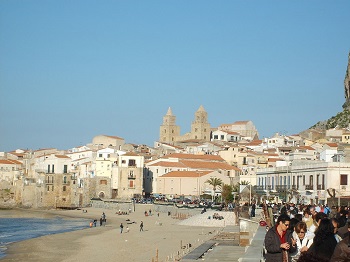
A church with the appearance of a fortress dominates the skyline of the medieval town of Cefalu. It is the Cefalu Cathedral, an Islamic-influenced building, showing the power and presence of the Normans in the territory.
The Cefalu Cathedral is located on the Southern Italian island of Sicily. This religious building was built by the Normans who originally came from Scandinavia and occupied the island between the eleventh and the thirteenth century. They incorporated Islamic traditions combined with influences adopted from the Eastern Roman Empire architecture, known as Byzantine; they created a singular style known as Norman-Arab architecture.
 |
History of the Cefalu Cathedral
The King of Sicily, Roger II, erected the Cefalu Cathedral as a way to fulfill the promise he made to the Holy Savior. After being trapped by a storm on the sea, he promised to build a church on the place he could safely land. He managed to escape the storm and arrived at Cefalu's beach.
Construction started in 1131. Although the cathedral was originally conceived as a mausoleum for the royal family, that use was given to the Church of Palermo after the death of Roger II. Between 1172 and 1215, construction slowed down significantly. In 1240, it was finally completed. The square in front of the cathedral and the stairway were built over the old cemetery. Local lore say the square in front of the cathedral was created with earth brought from Jerusalem.
Architecture of the Cefalu Cathedral
The Cefalu Cathedral was built to fulfill the king's promise, to demonstrate the power of the Normans in Sicily, and to defend the town in case of an invasion. This is why the building almost has a military appearance and is located in a place where it very visible in the town. It is a great example of Italian Moorish architecture, as it clearly shows the combination of Arab and Byzantine influences in Norman constructions.
 |
Construction Materials
The Cefalu Cathedral was built using traditional materials and techniques from Arab architecture. Brick and mortar were used and some walls were covered in stucco. Some noble materials like granite and marble were used for the interior. In Norman architecture, the use of opulent materials was uncommon, and the elegant character of the buildings were given through the ornamentation of the interior areas.
General Layout
The complex of the cathedral consist of two buildings: the structure of the church and the convent area. The convent is adjacent to the church building and consists of a courtyard enclosed by an arcade, known as a cloister.
The church has a Latin cross plan layout, with the descending point of the cross being longer. It is divided into a central nave and two aisles. The use of symmetry was also a common characteristic of both Arab and Byzantine architecture, and it was adopted by the Normans as well.
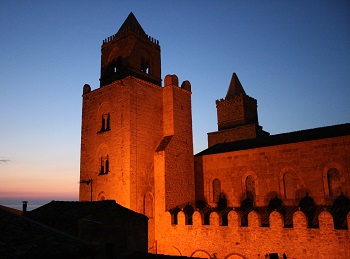
The cathedral has an introverted character, very common of Moorish architecture. The exterior consists mostly of solid walls, and it is rather sober in comparison to the decorated interiors. A few arches were used for the decoration of the facades.
 |
The Use of Arches
Arches were commonly used in Arab structures. On the facades of the Cefalu Cathedral, arches were used for decoration, and we also see the use of interlaced arches. In the interior, the columns are connected by arches. They were also used for other elements like windows and doorways.
The Wooden Roof
Most parts of the cathedral have a wooden roof made out of timber and wooden beams that were left uncovered. They are visible from the interior. The two side points of the cross plan layout have a barrel-vaulted roof. The area of the altar has a ribbed-vault roof made of stone.
 |
Later additions to the Cefalu Cathedral
After the church was completed, some additions and modifications were made, especially on the main facade.
During the fifteenth century, a smaller upper section was built on top of each of the two bell towers. One of them has a square layout and is decorated with flame-shaped elements, symbolizing the Papal authority. The other one has an octagonal layout, symbolizing the royal power.
The portico between the two towers was added in 1472. It has three arches, is supported by four columns, and has a ribbed-vault ceiling. The entrance door, known as King's Door, was built using white marble during the construction of the portico.
Interior Artwork and Decoration
The impressive marble and granite columns with arches on top are notorious in the interior. They were built as structural elements and as part of the decoration.
Mosaic artisans were brought from Constantinople (today's Istanbul) to decorate the interior. These works of art created with very small tiles are characteristic of the Byzantine period. They can be seen behind and on the sides of the altar.
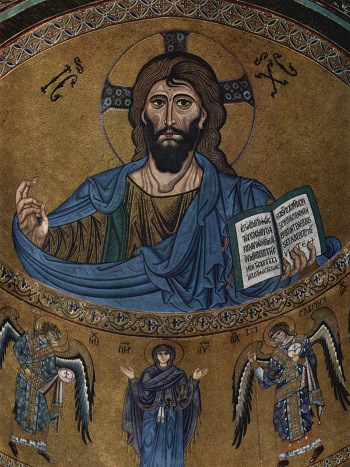 |
The Christ Pantokrator is probably the best-known mosaic of the cathedral. It decorates the area behind the altar. Christ was represented with blue clothing, creating a great contrast with the golden tiles on the background. On his left hand, he carries the Gospel of John. The mosaic of the Blessed Virgin Mary is another well-known piece of art in the cathedral. Both are considered some of the greatest Byzantine mosaics in Italy.
Lesson Summary
The Cefalu Cathedral is a religious building in Sicily, Italy constructed by the Normans. It was completed in 1240. This building shows the combination of Arab and Byzantine influences in Norman-Arab architecture.
Brick and mortar were used as construction materials and some walls were covered in stucco. The layout of the church is symmetrical and has the shape of a Latin cross. The cathedral has an introverted character, with sober exteriors and more decorated interiors. Arches were used both as constructive and decorative elements.
Most parts of the cathedral have a wooden roof made out of timber and wooden beams. The interior has marble and granite columns and is decorated with mosaics. The Christ Pantokrator and The Blessed Virgin Mary are considered some of the greatest Byzantine mosaics in Italy.
Register to view this lesson
Are you a student or a teacher?
Unlock Your Education
See for yourself why 30 million people use Study.com
Become a Study.com member and start learning now.
Become a MemberAlready a member? Log In
BackResources created by teachers for teachers
Over 30,000 video lessons
& teaching resources‐all
in one place.


I would definitely recommend Study.com to my colleagues. It’s like a teacher waved a magic wand and did the work for me. I feel like it’s a lifeline.
Jennifer B.
Teacher

Back
Cefalu Cathedral History, Mosaics & Architecture Related Study Materials
Explore our library of over 88,000 lessons
Browse by subject