Opponents of King George III included the American colonies, France, Spain and Holland
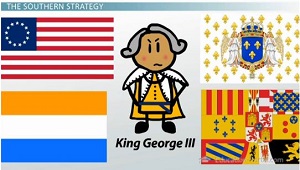 |
In 1773, Britain had a management problem in its colonies. In 1776, it had a war. By 1778, Britain was losing that war. Its northern army - under the command of General Burgoyne - had surrendered to George Washington at the Battle of Saratoga. King George's list of opponents had grown to include not only the American colonists, but France, Spain and Holland, as well. In desperation, Britain abandoned the war in New England and turned their attention to the South.
Colonists in the South were much more likely to be pro-British, and the Southern Strategy counted on these Loyalist, or Tory, forces to help them hold territory while the regular army moved on. Tories and Patriots had already clashed in Virginia and North Carolina earlier in the war; the crown now hoped to intensify that conflict.
Back in 1775, the royal governor of Virginia had offered freedom to slaves who fought for the British. That move backfired. When the so-called 'Ethiopian Regiment' was crippled by a smallpox outbreak, the slaveholding elites banded together and expelled both the governor and his freedmen from Virginia. But by 1779, the new commander-in-chief of the British forces in North America decided that the idea deserved to be revisited. General Henry Clinton issued the carefully drafted Philipsburg Proclamation, effectively freeing any slaves owned by Patriots. In this way, he could bolster his troop numbers without angering slaveholding Loyalists and disrupt the Patriot economy. The proclamation had mixed results. Estimates vary widely, but by war's end, the British evacuated 3,000-4,000 freedmen out of as many as 100,000 slaves who attempted to leave their owners. Not all of them were successful in escaping. Not all of them were Loyalists. Many of them never joined any army. Of course, others died in the war.
The Philipsburg Proclamation freed slaves owned by Patriots
 |