
Vedda People | History, Culture & Characteristics
What language do the Vedda people speak?
The native Vedda language is nearly extinct. Today, the Vedda people speak Sinhala or Tamil, the two official languages of Sri Lanka. However, there is evidence of a distinct Vedda language, which today is a mix of Vedda and Sinhalese.
Where did the Vedda people come from?
The Vedda people are indigenous to Sri Lanka. It is believed they have inhabited Sri Lanka since before the 6th century BCE. Ethnically, the Vedda are related to people from southern India and Southeast Asia.
What are the beliefs of Vedda people?
The Vedda people believe in a form of Animism and worship spirits rather than gods. One key belief is the Cult of the Friendly Dead, or the worship of friendly spirits to aid in the Vedda people's journey through life. They also believe in an afterlife for their ancestors, with whom they communicate after death through Vedda shamans.
The Vedda people, also known as Veddah or Wanniyalaeto, are the indigenous, or the earliest known, people of Sri Lanka. Vedda, a Dravidian word, means "one who uses bows and arrows." The Vedda people refer to themselves as Vanniyalato, which means "people of the forest."
 |
Although the Vedda people lived throughout Sri Lanka prior to the migration of Indo-Aryan people from India in 543 BCE, today, they live in three areas. The largest group, the Anuradhapura Veddas, lives in the Anuradhapura District in northcentral Sri Lanka. The Coast Veddas live on the east coast, south of Trincomalee, while the Bintenne Veddas live in areas that range from the eastern parts of the central mountains to the ocean. The Vedda people today are a small tribal community, making up less than one percent of Sri Lanka's population.
The Vedda people are known as hunter-gathers and forest-dwelling people. They are also known for their collection of bee honey; they climb trees to gather honey, warding off bees with burning leaves. Their unique culture features the Cult of the Friendly Dead, in which the Vedda people worship friendly spirits to aid in hunting and life.
The Vedda people from Sri Lanka are believed to be the original inhabitants of Sri Lanka, although there is not a lot of evidence about their origins. Archeological studies indicate that the Vedda gene pool is related to the prehistoric human known as Balangoda Man, who lived approximately 48,000 to 3,800 years ago. Many believe that the Vedda people have inhabited Sri Lanka since before the 6th century BCE.
Ethnically, the Veddas are related to indigenous jungle people in southern India and early peoples from Southeast Asia. They are genetically related to tribes from Malaysia.
The Vedda myth relating to their origins claims that they have royal ancestry, descending from Prince Vijaya, who founded the Sinhalese nation. According to the myth, Prince Vijaya was the grandson of a lion. He had intercourse with the demon princess Kuveni, resulting in two children. The Veddas allegedly come from an incestuous union between these siblings.
Over time, the Vedda people assimilated and mixed with the Sinhalese people, from whom they faced oppression and stigmatization. Many people considered to be Vedda are assimilated into Sinhalese or Tamil society, with only around 200 to 300 following the traditional Vedda way of life.
The Vedda people have their own unique culture, including religious beliefs, music, and clothing. Traditionally, the Vedda have practiced a form of animism, which attributes a spirit to non-human entities, such as animals, plants, nature, and inanimate objects.
Today, many Vedda have incorporated aspects of Hinduism and Buddhism into their religion. For example, the Coast Veddas worship Hindu gods Shiva, Vishnu, and Bhairava and have built temples and shrines for religious ceremonies.
In many Vedda ceremonial dances, such as the kirikoraha (the hunting dance) and the arrow dance, chanting, instrumental music, and building temporary shrines accompany the dancing. Singing is also a popular pastime for the Vedda people.
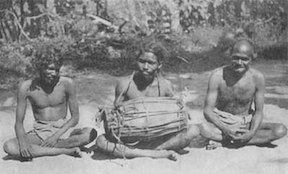 |
The Vedda people have traditionally worn clothing made from the bark of upas trees. Males wear a strip of white cotton, which passes between their legs, then tucks into their waist string, with the ends hanging down. Women wear colored cotton cloth called a hangala that is wrapped similarly to a sarong, extending to the knees.
Rituals of the Vedda People
Considered to be the original Sinhalese people prior to the arrival of the Indo-Aryan people, the Vedda have their own distinct rituals, including marriage ceremonies and the Cult of the Friendly Dead. They primarily worship spirits, rather than gods, invoking spirits to help with successful hunting or day-to-day living.
Cult of the Friendly Dead
The Cult of the Friendly Dead refers to the worship of yakku, or spirits. In particular, they worship the spirits of heroic Vedda, or Na Yakku, spirits of the recently deceased, who they believe live on hilltops, in rocks, and in caves.
The Vedda people invoke Kande Yakka, the chief of the yakku, for successful hunting. Following a good hunt, offerings of meat are left to avoid bad luck. The Na Yakku are invoked five days after a death with offerings of coconut milk and rice. The Na Yakku must obtain permission from Kande Yakka to accept the offering and provide assistance to the living.
In addition to native spirits, the Vedda worship foreign spirits, which are protective of the Vedda people. For example, the Rahu Yakku, derived from a Sinhalese demon and given a Vedda identity, are invoked to cure sickness and ensure successful hunting and the collection of rock honey.
The Vedda people also believe in hostile foreign spirits, which are thought to bring disease. Many Vedda people are fearful of and likely to avoid rocky mountaintops because they believe that these spirits haunt rocks and hilltops. They leave offerings of honey when these locations are unavoidable.
Vedda Death Rituals
When a Vedda death occurs, the tribe moves to a new cave. The body of the deceased is laid on the floor of the cave and covered with leaves. Survivors pray by large trees and offer wild meat, honey, and wild tubers to their ancestors and to deities of trees, rivers, and jungles.
The Vedda people believe these practices will ensure an afterlife for the deceased, allowing their souls to belong to the deities. This also enables the ancestors to look after their descendants.
Vedda shamans play a prominent role in many Vedda rituals, and ancestral spirits communicate with their descendants through shamans. During the death ritual, Vedda shamans present offerings to the spirits. The spirits, who promise that the yams, honey, and game will be plentiful, then possess the shamans. Shamans also preside over ceremonial dances and exorcise evil spirits.
Vedda Marriage Ceremonies
Vedda marriage ceremonies, which often occur between cousins, are fairly simple. The prospective groom presents the father of the bride with gifts of honey, yams, grain, or dried deer. Upon acceptance, the bride attaches a string she made around the groom's waist, thus completing the marriage ceremony. The string is worn around the husband's waist for his entire life. When it is worn, his wife will make a new one. A charm is sometimes placed on the string to ensure fidelity. Wedding gifts from the bride's father include land, bows and arrows, or a hunting dog. The groom gifts his bride with a lock of hair.
The native Vedda language is mostly extinct. Although evidence of a distinct Vedda language exists, today it is a Sinhalese dialect, or a mix of Vedda and Sinhalese that has evolved over time. Most Veddas speak either Sinhala or Tamil, the two official languages of Sri Lanka. The Bintesse and Anuradhapura Vedda speak Sinhala, an Indo-European language, while Coast Veddas use Tamil, a Dravidian language.
The Vedda people traditionally lived in forests, making their homes in caves and rock shelters in Sri Lanka's jungles. Today, they typically live in permanent villages of up to 40 families. Their houses are made from wattle and daub, with floors of packed earth.
As a hunter-gatherer society, the Vedda people continue to engage in their traditional practices, including hunting game using bows and arrows, gathering wild plants, and collecting honey. They typically eat yams, truffles, fruits, and edible flowers and hunt deer, monkeys, and iguanas. Their primary cooking methods include roasting, smoking, and boiling.
The Vedda people of Sri Lanka, also known as the Wanniyalaeto people, are an indigenous group that historians believe inhabited Sri Lanka prior to the 6th century BCE. Today, they primarily live in three areas: northcentral Sri Lanka, the east coast, and the eastern part of the central mountains. Ethnically, the Vedda people are related to indigenous peoples from southern India and Southeast Asia.
There is a unique Vedda culture. They have ceremonial dances, such as the kirikoraha, the hunting dance, and practice a form of Animism, which attributes a spirit to non-human entities. The Vedda people worship spirits, rather than gods, although some have incorporated aspects of Hinduism and Buddhism into their religion. One of the more unique aspects of their culture is the Cult of the Friendly Dead, in which the Vedda people invoke spirits to aid them on their life's journey. The Vedda language is almost extinct; today, most Vedda people speak Sinhala or Tamil, the two official languages of Sri Lanka.
Register to view this lesson
Unlock your education
Become a Study.com member and start learning now.
Become a memberAlready a member? Log in
Go backResources created by teachers for teachers
I would definitely recommend Study.com to my colleagues. It’s like a teacher waved a magic wand and did the work for me. I feel like it’s a lifeline.
