
Norman People, Conquest & Culture
Why were they called Normans?
Normans were called so as an evolution of the title "north men". This portmanteau also led to the name of Normandy, France.
What were the Normans known for?
The Normans are known for many things. Some include introducing castles to England, winning the Battle of Hastings, and being the descendants of Viking invaders. One of the famous Normans was William the Conqueror.
The Normans are the descendants of Viking explorers who settled in Normandy, France. In the 9th and 10th centuries, the Vikings made their way from Norway to settle in what is now known as Normandy, which is on the coast of France. Known as Normans since they were originally referred to as "North men", they were given a portion of France through a deal with the French King, and they settled and integrated themselves into the culture through marriage. They brought Viking culture together with French culture, allowing them to create a new ethnic group within France and a powerful feudal dynasty. They maintained the Viking warrior traditions and continued to explore and conquer Europe. They are well-known for their invasion of England in 1066, which involved the famous Battle of Hastings.
In the 9th century CE, the Vikings landed in France. They had been exploring parts of Europe since the 8th century, having also been to the British Isles. In the 9th century, French King Charles II, also known as Charles the Simple, struck a deal with Rollo, the Viking leader who was apparently so large that a hose couldn't carry him. Charles and Rollo agreed to a protection deal, where Rollo and his "Northmen" could settle on a chunk of northern French land (modern-day Normandy) in exchange for protecting France from future Viking invasions. While there had been Viking camps set up for Viking invaders in the 8th and 9th centuries, Charles' gift of Normandy constituted the first permanent settlement.
Prior to the establishment of Normandy, however, the Vikings and the French had a very violent relationship. From 820 CE onwards, the Vikings were consistently attacking, often sailing up the river Seine to plunder inland France. Major cities, including Paris, were spared if royalty would pay a ransom, but many smaller towns were burned and pillaged. The land that Charles gave to Rollo was at the mouth of the river Seine, which meant that under their protection agreement, Rollo and the Normans would have full control over keeping other Vikings out of France.
Norman Conquests
The most famous Norman conquest was the Norman invasion of England. In 1066, the King of England, Edward the Confessor, died. Harold, the Earl of Essex, was appointed as King, a development that William, Duke of Normandy, was very against. According to William, Edward had promised the crown to him, and William had apparently even tricked Harold into promising the crown to William. Feeling betrayed, William assembled a Norman army and set off for England.
However, there was another challenge for the throne. Harold's brother, Tostig, allied himself with the King of Norway, Harold Hardrada, and formed an army in the north. King Harold went North of London to Yorkshire to head them off, where he and his army won, killing both Hardrada and Tostig. Exhausted from victory, Harold and his army headed back south to face William and the Normans; they faced each other in what would become known as the Battle of Hastings.
The Battle of Hastings was significantly less successful for Harold. Harold was killed by an arrow going through his eye, and the Normans fought until all of Harold's soldiers were dead. The Normans marched on to London, where William the Conqueror was crowned as the King of England on Christmas day of 1066.
Before the Battle of Hastings, however, the Normans were still conquering. Around 1017, Norman forces were making moves on Southern Italy. The Normans were asserting control in Italy during a time of political and geographical conflict, as different regions of Italy were controlled by different, and often opposing, empires. Norman forces worked with Pope Benedict VIII to banish the Byzantine Empire's hold over Southern Italy. Working basically as freelance mercenaries, the Normans made a very identifiable mark on the region, starting with their first state of Obverse. The Normans continued to fight for more Italian land, invading Sicily and Messina prior to the Battle of Hastings. By the end of the 11th century, Normans controlled much of Southern Italy.
 |
When the Vikings arrived in France, they were Norse-speaking Pagans. Through the assimilation into French society, Norman culture picked up Christianity and the French language, as well as active participation in France's feudal economy. This allowed Normans to become some of Europe's most efficient conquerors since they were now culturally assimilated while retaining their Viking ruthlessness.
As the Normans expanded across Europe, their architecture followed them. Due to their assimilation to Christianity, they built churches typically in what is called the Sicilian Romanesque style. This is an architectural precursor to Gothic architecture, more rounded and arched, whereas Gothic architecture is pointed and spiky. Normans are also credited with bringing castles to England, which previously had been relegated to France.
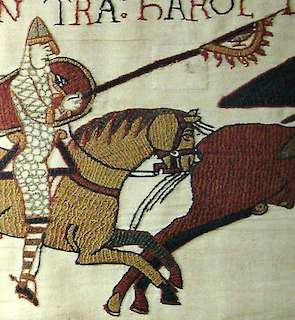
Much of their music also centered around the church, as the Norman empire made significant contributions to liturgical music. Their contributions to the arts did not have quite as much of an impact, with the exception of the Bayeux Tapestry. This tapestry is a 70-meter-long, embroidered narrative intricately detailing the Battle of Hastings. William the Conqueror's half-brother Odo commissioned the tapestry, which is the most famous (and longest-lasting) piece of Norman art.
While Normans descended from Viking invaders, the resulting culture wasn't particularly tied to Norse culture. The Normans retained the Viking aggression and thirst for exploration but fostered the virtues of imitation and adaptability, which had allowed them to fold into French society in the first place. This was especially useful once Normans took significant swaths of land in Italy and England. Normans converted or were born as Christians, which allowed them to more easily acclimate to cultures in Italy and England since there was already a shared religious background.
The Normans also created a system of taxable property registries. William the Conqueror commissioned the Domesday book to assess ownership and tax payments. This allowed the Normans to have a more codified structure for tax collection, in turn allowing the Norman feudal system to perpetuate.
 |
The Normans are the descendants of Viking invaders in France. They were given the land of Normandy, France, in the early 1010s, by King Charles II, as a protection deal to defend France from more Viking invaders. The Normans assimilated into French society, converting to Christianity and speaking the French language. They expanded past France, invading Southern Italy by working with Pope Benedict VIII before invading England in 1066. William the Conqueror, the Norman leader, claimed the English throne after the death of King Edward the Confessor, and the Normans waged war on Harold, the officially appointed King, at the Battle of Hastings. The Normans won, and William the Conqueror was crowned King of England.
Register to view this lesson
Unlock your education
Become a Study.com member and start learning now.
Become a memberAlready a member? Log in
Go backResources created by teachers for teachers
I would definitely recommend Study.com to my colleagues. It’s like a teacher waved a magic wand and did the work for me. I feel like it’s a lifeline.
