
History of Denmark | Overview & Facts
Are the Danes the same as the Vikings?
Viking raiders included Danish men. Not all Danish people were Vikings since Vikings were raiders; instead, most were farmers. The Viking age eventually came to an end in the Medieval Era.
What are some major events in Denmark's history?
Denmark converted to Christianity in the second half of the 900s under King Harald Bluetooth. In 1814, it lost control of Norway after hundreds of years of rule.
Denmark is a country located in northern Europe. In particular, Denmark covers a peninsula, Jutland, that juts into the North Sea and a neighboring archipelago stretching to the east. Denmark has long-standing cultural and historical connections to the other Scandinavian countries of Norway and Sweden. Throughout the history of Denmark, these countries have been united, while, at other times, they have fought wars against each other.
 |
Denmark was likely first inhabited by humans about 12,000 BCE. These early people were nomadic hunter-gatherers who came from the southwest. For thousands of years, these ancient peoples developed stone tools before making bronze and iron tools, and they eventually worked in agriculture.
Over the course of early Danish history, many different Germanic tribal groups moved into Denmark to settle there, and at times they left. These tribes tended to belong to the broader Germanic peoples, which inhabited Central Europe at the time. The name ''England'' is derived from a Germanic people from Denmark called the Angles, which sailed to Britain and settled there in about 500 CE. The name ''Denmark'' is traced to the Dane people, a Germanic group whose name was first recorded in the mid-500s. Eventually, the name Dane came to describe all the people of the Jutland Peninsula. The term Denmark means something similar to ''Dane's country.''
At the time, Denmark had a polytheistic religion. The people there worshiped various gods. Some local variants included worship of Odin, Thor, and Tyr.
Due to their geographic position beside the North Sea, the Danish people developed a culture of seafaring and trading. Besides commerce, Danish and other Scandinavian peoples engaged in raiding expeditions all along the coast of Europe. These raiders, called Vikings, became synonymous with the Danish people; many today refer to medieval Scandinavian people as Vikings. Raids by Vikings occurred as far as Greece and deep into Russia. The earliest Russian state, Kievan Rus', was founded in part by Viking raiders and settlers called the Varangians. Likewise, Viking raiders and Danish settlers took control of northern France, creating Normandy. Norman knights later went on take control of southern Italy too.
Danish and Norwegian seafarers also settled in distant lands, including Iceland. The first major Scandinavian settlement in Iceland dates back to 874 CE. From Iceland, Scandinavian people sailed northeast to Greenland, settling there in the 980s. Most notable was an Icelander named Leif Erikson, who arrived in North America with other settlers sometime around 1000 CE. However, the Greenland and North America (or Vinland) colonies did not last long.
The Middle Ages marked the first unified Danish state. In the first half of the 900s, the various Danish tribes were incorporated into the Kingdom of Denmark, headed by King Gorm. Historians are unsure how unified this Medieval kingdom was. In the second half of the 900s, Gorm's son, Harald Gormsson, nicknamed Bluetooth, took the throne and cemented the kingdom's unity. Alongside taking Norway and other parts of Europe, Bluetooth introduced Christianity to Denmark. Since the reign of King Gormsson, Denmark has been a Christian country.
North Sea Empire
 |
Harald Bluetooth was followed to the throne by his son, Sweyn Forkbeard. Though his father lost control of Norway, Sweyn reconquered it in the name of Denmark in about 1000 CE. In 1013, Sweyn's son Cnut conquered England, unifying the three kingdoms into the so-called North Sea Empire. This represented one peak of Danish power in Europe. However, once Cnut the Great died in 1035, the kingdoms separated.
Despite losing control of England, Danish kings sought to expand their realm in the opposite direction: Estonia. As mentioned, Viking raiders had established a presence in northeastern Europe, even expanding into Russia. In the late 1100s, the pope called for Christian forces to attack non-Christian peoples in northern Europe: the Northern Crusades. One such crusade was the Livonian Crusade, directed against the polytheistic people of modern-day Estonia. Denmark played a key role in that conflict, with King Valdemar II taking control of the northern coast of Estonia.
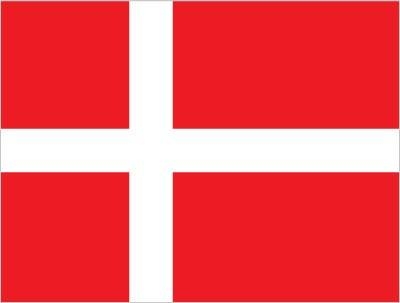
According to legend, the red flag with a white cross fell from the sky during the 1219 Battle of Lindanise, giving hope to the Danish crusaders. Denmark soon adopted the flag as the national flag of Denmark; it has been the Danish flag since then. Denmark continued to hold onto the Estonian coast until about 1572 and the Estonian islands until 1645.
Kalmar Union
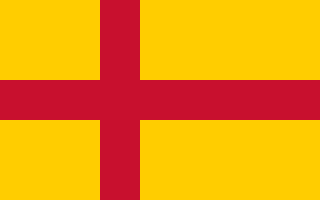
In the 1300s, Denmark confronted a powerful new rival: the Hanseatic League, an alliance of German coastal ports which sought to control trade in the North Sea. Queen Margaret of Denmark married King Haakon VI of Norway to strengthen the Scandinavian position. Their son Olaf II inherited those two kingdoms, though his early death in 1387 marked a setback. Margaret's grandnephew, Eric, later ruled Norway, Denmark, and eventually Sweden after deposing a rival. His coronation as King of Sweden in 1397 marks the creation of the Kalmar Union, a new powerful North Sea Empire. The name is derived from the city of Kalmar, where his coronation was held.
 |
The Kalmar Union did not last forever, however. It suffered a series of rebellions across Sweden, Norway, and Denmark. In 1520, King Christian II's men, prompted by a bloodthirsty bishop, executed dozens of rebellious Swedish noblemen and noblewomen in retaliation for alleged heresy. This is called the Stockholm Bloodbath. King Christian was proclaimed a tyrant, and the Kalmar Union fell apart in the face of a wave of revolt.
While the Kalmar Union fell apart, Denmark and Norway stayed together in a union until 1814. Over this period, however, Denmark-Norway faced significant challenges.
For one, Christian was being torn apart. Martin Luther, a German theologian, launched a campaign of criticism against the Catholic Church in the early 1500s. This inspired the Protestant Reformation, with new sects of Christianity rising. The kings of Denmark-Norway were sympathetic to persecuted Protestants and aimed to create greater autonomy from the church.
In 1533, the Protestant prince Christian III ascended to the throne. This event triggered a civil war between Catholic and Protestant forces, with King Christian winning after a few years. So, Denmark and Norway became Protestant countries, marking the beginning of the modern-day Lutheran Church of Denmark. Throughout the 1500s, Denmark fought wars against its neighbors, including Sweden and Poland, trying to resecure its power in the North Sea.
The Thirty Years' War and the Rise of Sweden
Soon, a religious war erupted across Europe: the Thirty Years' War, which began in 1618. In 1625, Denmark-Norway intervened in the conflict on the side of Protestant forces, fighting against the Habsburg dynasty, which ruled the Catholic Holy Roman Empire and Spain. In 1635, the war changed forms, with Denmark-Norway siding with the Habsburg Empire against Sweden and France. Ultimately the war ended in 1648, with Sweden gaining control of additional lands from Denmark-Norway.
In 1655, the ascendant Swedish Empire invaded Poland. In 1657, Denmark-Norway intervened on the side of Poland, hoping to get revenge against Sweden; this proved to be a disaster. Denmark lost more land to Sweden, though it did manage to repel a Swedish attack on the Danish capital, Copenhagen.
In response to these humiliating defeats, Denmark passed government reforms that granted greater power to the king at the cost of the Danish noblemen. These absolutist reforms were designed to strengthen the country against Sweden.
While Denmark-Norway was in a precarious position in Europe, it also sponsored colonial expeditions to distant lands, including Iceland, Greenland, and the West Indies, as well as commercial expeditions to Africa and India. These overseas territories were never as large as their contemporary rivals, however.
The Great Northern War
In 1700, another war erupted in northern Europe with the Great Northern War. On one side was Sweden and its allies, including Britain, while on the other were Russia, Poland, and Denmark-Norway. The war lasted over twenty years. While Sweden appeared to be winning at some points, ultimately, the anti-Sweden alliance secured a victory. While Sweden fell from its position of preeminence, Denmark did not regain its hegemony in northern Europe. Afterward, Denmark did not fight another major war for decades.
In the early 1800s, a new powerful foe threatened Denmark and much of Europe. This was Napoleon Bonaparte, a genius general and the dictator of France. In a series of wars, Napoleon conquered much of Europe. Denmark remained neutral, only to be punished by Britain, which destroyed the Danish navy so it could not be seized by Napoleon. Denmark ultimately joined Coalition forces as they defeated Napoleon at the war's end. The victorious forces redressed Denmark for its earlier neutrality by splitting it from Norway in 1814 after hundreds of years; Norway was then turned over to Sweden, a better ally to the victors.
Liberalism and Nationalism
Inspired by Napoleon and the French Revolution, which brought him to power, Denmark enacted liberal reforms in the 1800s. In 1849, for example, the King of Denmark had his powers reined in by a new constitution. These reforms deepened as time passed, and Denmark developed a democratic parliamentary government. The last major intervention of the monarch in politics came in 1920 and had significant backlash at the time. Socialist political movements, picking up in this period, drove the Danish government to develop a social welfare state that provided aid and support to its people.
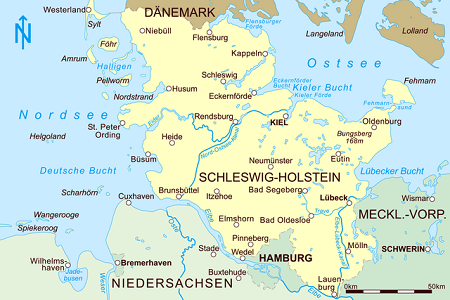 |
The 1800s also saw the rise of nationalism in Europe. Since the southern parts of the Jutland Peninsula were largely inhabited by German people, those areas became the site of independence movements. In 1864, Prussia invaded and seized the southern lands of Schleswig-Holstein to Prussia, which soon created the German Empire.
While Denmark was neutral in the First World War, it did regain Northern Schleswig from Germany in 1919. As the Second World War began, Denmark proclaimed neutrality. Germany invaded and occupied Denmark in 1940 anyway, using it as a base to launch its invasion of Norway. During the war, Britain or the United States occupied Denmark's overseas territories. As a result, Iceland proclaimed its independence from Denmark in 1944. Ultimately, German soldiers surrendered and exited Denmark at the end of the war.
The history of Denmark has shaped the country today. While not a large country (it has a population of roughly 5.9 million), Denmark today is prosperous and thriving. It is a member of the European Union, an economic and political alliance across much of Europe. However, Denmark opted out of using the currency of the European Union, the euro, in a 2000 referendum. Denmark also joined the North Atlantic Treaty Organization, a defensive alliance with the United States and other democratic countries, in 1949.
Denmark is a Scandinavian country in northern Europe. The Danish tribes were united in the first half of the 900s by King Gorm. His son, Harald ''Bluetooth'' Gormsson, cemented the unity of Denmark and converted the kingdom to Christianity. Meanwhile, Viking raiders from Denmark attacked distant lands. Harald's son, Sweyn, ruled over England and Norway in the brief North Sea Empire. Later, Denmark, Norway, and Sweden were united in the Kalmar Union. This empire collapsed after the king perpetrated a massacre in 1520. Afterward, Denmark converted to Protestantism under King Christian III.
In the 1600s, Denmark-Norway struggled against Sweden for control of the North Sea. In the Thirty Years' War, Sweden gained Danish lands. Sweden lost against an international coalition in the Great Northern War, but Denmark did not regain its lands. In 1814, Denmark was forced to turn over Norway to Sweden after its neutrality in the face of the French conqueror Napoleon. Denmark lost its southern lands to Prussia in 1864. It was occupied by Nazi Germany in the early 1940s. Today, however, Denmark is a prosperous and well-off country. It is a member of the European Union, an alliance of democratic states.
Register to view this lesson
Unlock your education
Become a Study.com member and start learning now.
Become a memberAlready a member? Log in
Go backResources created by teachers for teachers
I would definitely recommend Study.com to my colleagues. It’s like a teacher waved a magic wand and did the work for me. I feel like it’s a lifeline.
