
Understand and explore what bioluminescence is. Learn and discuss chemiluminescence, luciferin, and luciferase reactions. Discover the meaning of photoprotein.
Bioluminescence Definition, Types & Examples
Table of Contents
Show
Frequently Asked Questions
What causes a bioluminescence?
Bioluminescence is caused by the oxidation of luciferin within an organism. Luciferin can either be combined with luciferase, a catalyst, and oxygen or combined with photoprotein in the presence of calcium ions. This oxidation reaction converts chemical energy to light energy, resulting in bioluminescence.
What is bioluminescence in plants?
The bioluminescence meaning implies that the chemical reaction that generates light happens within a living organism. While there are no true bioluminescent plants: plants that produce chemical reactions generating light, scientists have found ways to artificially replicate the phenomena. By genetically recombining plants with naturally occurring bioluminescent bacteria, scientists have created bioluminescent plants in labs.
What is bioluminescence and how does it work?
Bioluminescence is the production of light due to a chemical reaction within an organisms' body. Bioluminescence is a result of an oxidation reaction involving luciferin.
Table of Contents
ShowWhat is bioluminescence? The bioluminescence definition is the production and emission of light by a living organism, created through chemical reactions within, or expelled from an organism's body. Bio, meaning life, and luminescence meaning light. Bioluminescence, since it is caused by a chemical reaction that produces light, is a form of chemiluminescence, or "chemi" from chemical, and "luminescence" or light. Along with the light created from the chemical reaction, toxins are also a byproduct of that reaction, which can be harmful to other organisms, including humans.
Types of Bioluminescence
While the bioluminescence meaning implies that light is always a result of a chemical reaction, the type of chemical reaction can vary. The most common type of bioluminescence results from a reaction between luciferin, the light-causing substance, luciferase, the enzyme that catalyzes the reaction, and oxygen. Another less common type of bioluminescence results from a reaction between luciferin and photoprotein in the presence of calcium ions. There are additional unique chemical reactions producing bioluminescence that have not been detailed by science just yet, driven by different variations of luciferin and luciferase.
Bioluminescence can come from many different places in an organism's body, ranging in complexity. Some bioluminescent organisms secrete a luminous substance from the body or produce bioluminescence internally, and the light is visible due to the clear body (some species of jellyfish). Others contain specialized cells called photocytes, where the chemical reaction occurs to produce light. Some organisms have entire organs dedicated to producing bioluminescence, called photophores.
Not only do the chemical reactions and the sources of bioluminescence vary, but bioluminescence can also be present in different colors of visible light from blue through red. Generally speaking, most terrestrial bioluminescence is seen as yellow, green, and occasionally red. In marine environments, bioluminescence is commonly blue or green, due to the differences in transmission of light through water.
Examples of Bioluminescence
Examples of bioluminescence can be found in many groups of organisms. A well-known bioluminescent terrestrial insect is the firefly and its larva.
 |
The group with the most abundant amount of bioluminescent organisms, marine animals, includes examples such as comb jellies, phytoplankton, deep-sea fish, shrimp species, and more that are all bioluminescent. Perhaps one of the most well-known is the lanternfish.
There are even bioluminescent fungi, such as foxfire, which are fungi that grow in moist areas of deadwood forests. While the list of bioluminescence animals is long, there are no true bioluminescent plants, reptiles, birds, or mammals.
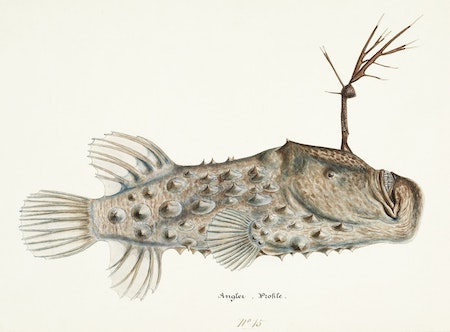
Of true bioluminescent organisms, some make their own luciferin and luciferase, and others consume bioluminescent organisms to obtain it. For example, the anglerfish cannot create its own luciferin and luciferase, so it allows 'photobacterium' to live in the flesh of its protruding lure, providing protection. In turn, the lure of the anglerfish lights up, attracting prey for the fish to eat.
Chemiluminescence is the process of emitting electromagnetic radiation, specifically visible light, as the result of a chemical reaction. These chemical reactions are typically oxidation reactions. In this oxidation reaction, energy is transferred to the molecule that is not undergoing oxidation, which causes an excess of energy in that molecule. The molecule then sheds that energy by emitting photons (light) in a particular wavelength. An example of chemiluminescence is the glowing of blood at crime scenes. The reaction between luminol and hydrogen peroxide, catalyzed by the hemoglobin in the blood causes light to be emitted and the area that had blood on or in it glows.
Because it deals with the emission of light, chemiluminescence is commonly confused with fluorescence. The difference that separates chemiluminescence from fluorescence is how the light is emitted. While chemiluminescence generates light as the result of a chemical reaction, fluorescence is a result of the absorption of electromagnetic or light energy.
Luciferin and Luciferase Reactions
Most bioluminescence is a result of a chemical reaction between luciferin and luciferase. In these reactions, luciferin is the substrate, or the substance being acted upon, and luciferase is a catalyst that speeds up the reaction. This reaction converts chemical energy to radiant energy. Nearly all energy is converted, and very little is lost as heat. This efficiency in energy conversion is why bioluminescence is a cold light.
Photoprotein
The second, less common type of reaction that creates bioluminescence is luciferin and photoprotein. Photoprotein is a protein that gives off light in the presence of oxygen. Different from the luciferin/luciferase reaction, the photoprotein reaction does not require the catalyst luciferase to occur, rather the reaction has to happen in the presence of calcium ions. These calcium ions are what trigger the light emission from photoproteins.
Bioluminescence plays many roles within the lives of organisms, but there are three main uses:
- Luring prey
- Self-defense
- Attraction of a mate
Organisms may use bioluminescence to lure in prey. Some organisms will light up near their mouths, to draw prey in. Others will illuminate the area around them to see prey better. An example of bioluminescence used for attracting prey is the anglerfish. Female anglerfish living in the depths of the ocean have a piece of the spine that protrudes from the face, with a dangling piece of flesh at the end. The flesh at the top lights us due to the bioluminescent bacteria living there. The light produced attracts prey and the anglerfish feasts.
 |
Some organisms use bioluminescence as a defense mechanism to avoid being eaten. The light can frighten, distract, and confuse predators. Occasionally, the light event can attract an even larger predator, allowing the prey species to get away while its predator becomes the prey. For example, phytoplankton, a very common bioluminescent organism, typically light up the water at the sign of a disturbance, such as a boat, predators, etc. The light produced by the phytoplankton can attract larger predators that will frighten away fish attempting to feed on the phytoplankton.
Lastly, some organisms use the attractive quality of bioluminescence not to lure prey, but to lure in a potential mate. A display of light combined with movement can be used as a courtship display in some species. Fireflies, a very recognizable bioluminescent insect, do just that. Male fireflies are the ones that can be seen lighting up and flying around. Females are watching while the males light up, competing for a mate.
Bioluminescence is a form of chemiluminescence that happens within an organism. Chemiluminescence is a chemical reaction that produces light. So, bioluminescence is a chemical reaction that produces light that occurs within an organism. An important distinction is between chemiluminescence and fluorescence: chemiluminescence is the result of a chemical reaction, while fluorescence is the re-emittance of absorbed light energy. The chemical reaction that creates light in bioluminescence will always include luciferin. The other reactants can vary. The most common bioluminescence reaction is between luciferin, luciferase, and oxygen. The second, less common reaction is between luciferin and photoprotein, in the presence of calcium ions.
Most bioluminescent organisms live in the ocean. Examples of bioluminescent organisms include fireflies, anglerfish, comb jellies, phytoplankton, and many more. Different organisms use bioluminescence for different functions. For example, Fireflies use bioluminescence to attract mates, while anglerfish use light to lure prey. Phytoplankton use bioluminescence as a way to defend against predators. Mating, luring prey, and self-defense are the main uses of bioluminescence in nature.
Additional Info
What Is Bioluminescence?
This is one of the coolest topics in biology! Bioluminescence is when a living organism produces and emits light. You're most likely familiar with bioluminescence caused by fireflies, but bioluminescence is much more common in the ocean than on land (and it's almost completely absent from freshwater bodies).
How does this happen? Well, a chemical reaction takes place inside the organism and light is one of the end products of that reaction. Chemical reactions that produce light are called chemiluminescence, so what you're really witnessing, if you're lucky enough to be in the area, is chemiluminescence happening inside an organism, causing bioluminescence. No matter how you break it down, bioluminescence allows you to see a spectacular natural light show. The most common light color produced is a blue-green hue. Organisms usually only produce one color, and the flashes of light are most often intermittent, lasting less than 10 seconds at a time.
 |
Chemical Reactions Causing Bioluminescence
All reactions causing bioluminescence involve a chemical called luciferin. This is the substance that actually produces light. Some organisms make luciferin themselves, while others acquire it though food or by absorbing it from other organisms.
Luciferin then interacts with either luciferase or photoproteins, depending on the type of organism. Luciferase is the most common second chemical that reacts with luciferin, and it's an enzyme that basically jumpstarts the reaction, making it happen. As a result of the reaction occurring, light is produced, and this is what we see in bioluminescence.
The second type of chemical that can react with luciferin is called a photoprotein. These are much less common than luciferase; however, they can still chemically react with luciferin. The catch is that for photoproteins to react with luciferin, calcium ions must also be present. Without these calcium ions involved in the reaction, no light will be produced.
Why Use Bioluminescence?
Sure, it's cool to watch living things emit light, but what is the reason behind that type of mechanism? There are three primary uses of bioluminescence. The first reason is to lure in prey. One of the best-known examples of this is the anglerfish, which lives in the deep ocean where sunlight doesn't reach. The anglerfish partners with bioluminescent bacteria to create bursts of light that attract smaller organisms, providing an easy meal for the anglerfish. Interestingly enough, bioluminescence is the dominant source of light in the deep ocean. Certain species of fish, bacteria, and jellyfish are capable of bioluminescence.
 |
The second use of bioluminescence is self-defense. The light can be used to distract predators and redirect their attention, or it can be used to make the organism appear toxic. In nature, toxic organisms are often brightly colored as a warning signal to predators. Some organisms even have bioluminescent body parts that can break off. When threatened, the brittle star will break off a piece of itself and attach it to a passing fish. The light attached to the fish can act to lure the predator away while the rest of the brittle star flees the scene.
Finally, bioluminescence can be used to attract a mate. Similar to mating dances, bioluminescence acts like an attractive light show.
Lesson Summary
Bioluminescence is a fascinating phenomenon caused by chemical reactions occurring inside living organisms. These reactions produce and emit light - light caused by a chemical reaction is called chemiluminescence. Bioluminescence is most often found in organisms found in the ocean, though some are found on land.
All bioluminescence reactions involve luciferin; this is the substance that actually causes light production. Some organisms make their own luciferin while others have to acquire it.
Luciferin reacts most often with luciferase, an enzyme that jumpstarts the reactions. The second, less common reaction occurs between luciferin and photoproteins, though light is only produced if there are also calcium ions involved in the reaction. Organisms use bioluminescence to lure in prey, to avoid being eaten by predators, and to attract mates.
Register to view this lesson
Are you a student or a teacher?
Unlock Your Education
See for yourself why 30 million people use Study.com
Become a Study.com member and start learning now.
Become a MemberAlready a member? Log In
BackResources created by teachers for teachers
Over 30,000 video lessons
& teaching resources‐all
in one place.


I would definitely recommend Study.com to my colleagues. It’s like a teacher waved a magic wand and did the work for me. I feel like it’s a lifeline.
Jennifer B.
Teacher

Back
Bioluminescence Definition, Types & Examples Related Study Materials
Explore our library of over 88,000 lessons
Browse by subject