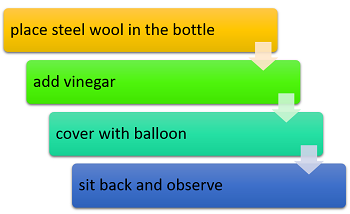
For students, there is often a myth that if you cannot see it, then it is not matter. Often when matter changes form, it is no longer obvious to the naked eye. For example, when you burn wood part it becomes carbon dioxide gas. So while it may look like matter has 'disappeared,' it, in fact, has not. Sometimes we have to force students to practice reasoning out how the law of conservation of mass is always true to help cement their understanding.
Materials
- poster board
- markers
- images that show a chemical change such as a bonfire, Mentos bubbling up soda, or a rusting piece of iron.
- pencils
- post-it notes
Procedures
- Divide your students into small groups of 3-4 students.
- Give each team a different picture from your set.
- Tell each student that whether it is obvious to the naked eye or not, matter is being conserved in each of the pictures. Review with your students the law of conservation of energy.
- Have each team discuss and decide how the chemical change in their picture supports the law of conservation of matter. Using their poster board, have each team create a flowchart to show where the matter is starting in their picture, and where it is going.
Any image that shows a chemical change will work
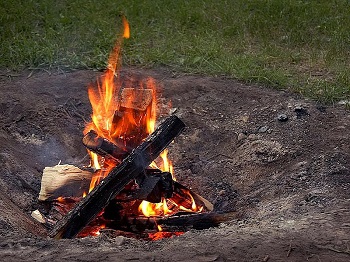 |
- Post the final posters around your classroom. Do a gallery walk and allow other students to use the post-it notes to offer critiques of the reasoning presented.
- As an entire class, go through each poster. Discuss how the chart supports the conservation of mass. If there are any flaws in the students' reasoning, address them to benefit the entire class.