
Learn about the Aztec Flower Wars, their purpose, and their history. Read about the importance of Tlaxcala in the Flower Wars, and important Aztec battle victories.
Aztec Flower Wars | History, Battles & Significance
Table of Contents
- What Were the Aztec Flower Wars?
- The Aztec Flower Wars: Background and Context
- The History of the Aztec Flower Wars
- The Significance of the Aztec Flower Wars
- Lesson Summary
Frequently Asked Questions
When did the flower wars happen?
The Flower Wars were a series of conflicts from 1454-1519 in Mesoamerica. Though they happened over the course of six decades, they were intermittent and regulated over that time.
What was the purpose of a flower war?
The purpose of the Aztec Flower Wars was to provide prisoners of war for human sacrifices. Unlike normal warfare, the purpose was not to kill the enemy but rather to maim them and take them prisoner. Later the Flower Wars were used by the Aztecs as a method of culling enemy forces and maintain dominance in the region.
What flower was sacred to the Aztecs?
The Aztecs were known for their reverence of various types of flowers, and had different flowers for different meanings. Several notable flowers include vanilla, marigold, and dahlia. Though the most revered or sacred to the Aztecs was most likely the Huacalxochitl or basket flower because it was offered in the temples of their gods.
How often did the Aztecs go to war?
Aztecs went to war contently but only in specific months of the year. Normal war could only be done during the Winter and Spring months because the Summer and Fall months were reserved for planting. Flower Wars, since they were regulated, could be scheduled for any time.
Why was it called the Flower War?
Scholars are in disagreement over the origin of the term Flower War. One reason is that they relate flowers directly to their gods, and the Aztecs use the Flower Wars as ways to obtain human sacrifices. Another is that the term for normal war was "hard war" which gives differentiation between the two.
Table of Contents
- What Were the Aztec Flower Wars?
- The Aztec Flower Wars: Background and Context
- The History of the Aztec Flower Wars
- The Significance of the Aztec Flower Wars
- Lesson Summary
The Aztec Flower Wars were a series of ceremonial and ritualistic conflicts among competing tribes in Mesoamerica prior to the arrival of the Spanish. Largely, these wars were highly organized and had a purpose other than territorial conquest or fight for natural resources. From around 1454 to the Spanish arrival in 1519, the tribes of the Aztec Triple Alliance competed in the Flower Wars to provide captives. These conflicts only served to further divide enemies of the Aztec and would assist in their eventual fall by the Spanish Conquistadors.

Your next lesson will play in
10 seconds
The Aztec Flower Wars were a series of conflicts over a roughly 70 year period in what was at the time the Aztec Empire. Various cultural and political factors made the Flower Wars necessary, but warfare was an overall theme of Aztec rule in Mesoamerica. This region of the world was similar to Ancient Greece in that there was constant warfare and infighting between the various cultural groups as they vied for power and supremacy.
Numerous cultures had risen and fallen because of this long history of warfare. The greatest example is the Teotihuacan, which was a dominant force in Mesoamerica about 1000 years before the Aztecs. Much like the Aztecs, the Teotihuacan used their military supremacy to exert power over its neighbors leading to an uprising and its inevitable downfall.
Cultural Diversity in Mesoamerica
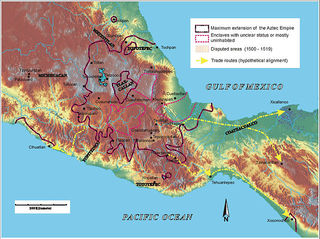
From around 1400 to the arrival of the Spanish, the Aztecs were one of the most powerful cultural groups of Mesoamerica. By that point the Aztecs had spread across Mexico and its military influences spread close to South America and well into the modern day United States. However even though the Aztecs had control over the region by 1450, there was abundant cultural diversity.
The area around modern Mexico City was the heart of Aztec culture called Tenochtitlan, but the central valley of Mexico was full of various cultural groups. Of these groups the Tepenac, Tlacopan, and Texcoco civilizations were the most powerful. Dozens of other groups existed at the time, but were largely subservient to the more powerful civilizations.
 |
The Rise of the Aztec Empire
The Aztec civilization started in the mid 14th century around the area of present day Mexico City. A warlike group, the Aztecs largely served as a mercenary organization and served in the militaries of more powerful civilizations. As skilled warriors who charged for their services they became very wealthy and started building their own civilization on the shores of Lake Texcoco which would become their capital city, Tenochtitlan. As a government body, the Aztecs allowed their conquered neighbors to maintain their autonomy, but they had to pay large amounts of tribute each year.
Around 1430 the Aztecs were growing in power, but still paid regular tribute to the Tepenac Civilization which also lived on the shores of Lake Texcoco. The Aztecs formed an alliance with the Tlacopan and Texcoco civilizations making the Triple Alliance. They used this alliance to destroy their rivals and take control of the region with the Aztecs as the dominant civilization within the group.
The Aztec Flower Wars began in 1454 and were largely between the members of the Triple Alliance. Though many others participated, this ceremonial war played a role in the power struggles of the region, and ultimately led to the downfall of the Aztecs.
In 1450 a series of droughts and poor growing seasons led to large scale food shortages in all areas of Central Mexico. The Aztecs believed the gods must be angry and in need of more offerings, which to the Aztecs took the form of human sacrifices. The Aztec Flower Wars were established around 1454 and the major civilizations in the region, specifically the Texcoco, Tlaxcala, Cholula, and Huejotzingo agreed to engage in flower war for the purpose of obtaining prisoners of war to serve as human sacrifices.
Origins and the Purpose of the Flower Wars
The concept of a Flower War, or an organized ceremonial conflict actually predates the official start of the Aztec Flower Wars in 1454. The Aztecs and surrounding civilizations used similar conflicts in the past to solve disputes and flex their own power. Flowers were important to the Aztec in particular as they represented everything from status, wealth, and particular gods. Tenochtitlan was called the "city of gardens" for this reason. Largely however the use of flowers was to be close to their gods and various flowers such as vanilla, marigold, and dahlia were grown in abundance for their metaphoric value as well as their medicinal value.
Though there is some disagreement among scholars as the specific cause of the Aztec Flower Wars, it can be related back to the 1450 droughts. The purpose of the Flower Wars was to establish dominance in the region while also obtaining prisoners of war for human sacrifice. Human sacrifice was common in the Aztec Empire, but the poor farming seasons were interpreted by the Aztecs to mean their gods were angry and needed more offerings. In particular, the Aztec principle deity Huitzilopochtli (the god of fire, war, and the sun) was appeased with these offerings to bring back good growing seasons.
The Start of the Flower Wars
The Aztec Flower Wars were primarily between the Aztecs, Texcoco, Tlaxcala, Cholula, Atlixco and Huejotzingo civilizations. Normally bitter enemies, they agreed to participate in the ceremonial Flower Wars to appease the gods and bring back the abundance of previous years. The purpose of the war was not to kill the enemy but to capture them for later sacrifice.
However scholars believe that the purpose of the Flower Wars may have also had more political purposes as well. The Tlaxcala civilization, though a prominent member of the Triple Alliance, refused to pay tribute like the others in the alliance. Scholars believe that these ceremonial wars may have also been a way for the other members to slowly destroy the Tlaxcala by systematically capturing their warriors and weakening them in the process.
The Aztec Flower Wars: Battles and Intermittent Warfare
In the early stages of the Flower Wars, the ceremonial conflicts were highly regulated, scheduled, and for the purpose of capturing prisoners of war for human sacrifices. Combating armies would select a time and place and each army had the same amount of soldiers. In addition, armies would limit their weapons to hand to hand weapons and forgo the ranged weapons that made the Aztecs so effective. These wars were intermittent and lasted from 1454 to the Spanish incursion in 1519.
However as the wars progressed many scholars believe that they changed from ceremonial battles between groups to take prisoners, to full fledged battles. It is noted that in the early fighting, nobles who were captured were spared from later sacrifice and instead returned to their native civilization. Later battles, especially ones against the Tlaxcala grew bloodier and even nobles were taken for human sacrifices. One example of this occurred in 1503 when the Aztecs were defeated at a battle near the city of Huexotzinco and records report thousands were killed in the battle. Though named as part of the Flower Wars, it was not a small, regulated event but a full blown battle with massive loss of life.
The Conclusion of the Aztec Flower Wars
As time progressed the Flower Wars shifted from ceremonial wars for prisoners to full battles for regional supremacy. Many historians argue that the evidence points to the Aztecs using the Flower Wars as a way to cull and weaken their enemies rather than appease the gods. The Aztec Flower Wars largely ended around 1519 with the arrival of the Spanish into Mesoamerica.
When the Spanish arrived, they had a hard time immediately quelling the Aztecs who were a honed war driven culture. In order to defeat this powerful enemy, the Spanish began seeking alliances with various other native groups. The Tlaxcala in response to the years of oppression and loss of life during the Flower Wars sided with the Spanish and led to the downfall of the Aztecs. Most of the other traditional combatants were also defeated by the Spanish during their conquest of the region.
The Aztec Flower Wars were initial for religious purposes, but shifted as a way for the Aztecs to maintain control of their neighbors and subjects. War was part of life of the Aztec Empire, and they used the Flower Wars to make sure the other civilizations around them never got too powerful. Though they did keep the Aztecs on top, they weakened their neighboring tribes so much that they were unable to successfully defend themselves from the Spanish Conquistadors.
Further, since the Aztecs began using these wars as a means of suppressing their rivals, it drove other civilizations such as the Tlaxcala to turn on them and help the Spanish. Without the Flower Wars the Tlaxcala might not have aided the Spanish in their conquest of the Aztecs and changed history in Mesoamerica.
Political Fragmentation in Mexico
As the Flower Wars progressed they caused a further divide among the various groups of Mesoamerica. Politically and militarily the Aztec were far superior to the other civilizations in the region, however these conflicts provided more enemies to the Aztecs as time progressed. Many scholars have argued that the Aztecs most likely forced these smaller nations to participate and began to make more emphatic enemies when the Aztecs began killing nobles as well as the lower classes.
This fragmentation was then manipulated by the Spanish when they arrived in 1519. Knowing full well that they could not conquer all of the tribes together, they used the hatred of the Aztecs to their advantage. The Flower Wars not only provided more political divide, it gave the smaller nations an opportunity to keep well trained and functional militaries. Though a majority of the Flower Wars were won by the Aztecs, the neighboring groups began to develop a more well-experienced military as a result. The Spanish took advantage of this and by allying themselves with the Tlaxcala were able to secure victory over the Aztec.
The Aztec Flower Wars were a series of ceremonial wars for the purpose of capturing prisoners of war for sacrifices to the Aztec principle deity Huitzilopochtli. Largely regulated, they were designed to be small and "fair" with a time/place chosen and both armies having an equal number of fighters. However as the wars progressed over the decades they became actual full blown conflicts that the Aztecs used to cull their neighbors and maintain superiority in the region. This was their inevitable downfall as the wars strengthened their enemies by keeping their enemies armies well trained and functional and creating more political divides. Their main rival the Tlaxcala would use the Flower Wars as motivation to betray the Aztecs and aid the Spanish conquest in 1519.
Video Transcript
Flowery Wars
What is the point of war? It's to defeat an opponent, right? Well…sometimes. War-based cultures need warfare; their values and social structures depend on it. This was certainly true of the culture of the Mexica, the people who lived in the capital city of the Aztec Empire. The Mexica even worshipped a god of war as their principal deity, named Huitzilopochtli.
To keep Huitzilopochtli appeased, the Aztec warriors had to keep fighting, and so war actually became ritualized. The ritual wars of the Aztec Empire were known as xochiyaoyotl, or flowery wars (often called flower wars). The Aztecs did fight traditional wars as well, but flowery wars were different. They weren't fought to conquer an enemy; they were fought simply to fight.
History of Aztec Flower Wars
The Mexica were warriors ever since they arrived in the Valley of Mexico. Coming from a mythical homeland far to the north, the Mexica people found the Valley of Mexico already filled with bustling cities. So, they sold their services as mercenaries until they became powerful enough to build their own city, Tenochtitlán. Over time, they grew even more powerful, finally forming the Triple Alliance with the cities of Texcoco and Tlacopan to create the Aztec Empire.
In the mid-15th century, a new ruler named Tlacaelel came to power in Tenochtitlán. As emperor, Tlacaelel built up the cult of the war/sun god Huitzilopochtli and insisted that the Aztecs were a chosen people, selected by the gods to provide human sacrifices.
The gods demanded sacrifices in the form of prisoners captured in war. If the Aztecs conquered everyone, there would be no more war and therefore, no more wartime prisoners. So, the Aztecs made a deal with the nearby city and longtime rival of Tenochtitlán, Tlaxcala. The cities agreed to come together and fight a special kind of ritual battle that would not be fought for conquest or land. These battles would only be fought for prisoners, who each city could take back and sacrifice to the gods. While the Aztecs would go on to fight flowery wars against other cities as well, Tlaxcala was always their primary rival.
The flowery wars became a very important tradition in the Aztec Empire. Rules were outlined, and the ritual became very standardized. In a flowery war, the two opposing armies would meet at a pre-selected location on a pre-selected date. They also agreed on the number of warriors to bring so that each side had equal numbers (which is not something you often see in warfare). A fire of incense was lit, and the battle began. It's important to remember that the war was not fought to kill the enemy. The goal was to maim and capture them, but they had to be alive so they could be sacrificed at the temple. Once they had enough prisoners, the battle ended. Dying in battle or as a captured prisoner was extremely honorable in any war across Mesoamerica, but this was especially true of flowery wars. Captured prisoners went voluntarily to the temple to be sacrificed; in Mesoamerican religions, this basically excused them from a hellish purgatory and sent them straight to the side of Huitzilopochtli.
Interpreting the Flower Wars
Aztec flower wars are very unique; we really don't find anything like it anywhere else. So how do we explain this? The traditional interpretation is what we've just discussed: it was a ritual war used to capture prisoners for human sacrifice. The Spanish once asked the emperor Moctezuma II why he had failed to capture Tlaxcala, and the emperor explained that he could, but then his people would lose their source of sacrificial victims.
Some historians have found different possible meanings in this ritual, however. Some believe that Moctezuma simply failed to conquer Tlaxcala and was making excuses. Other historians think Moctezuma was being completely honest. It's a topic of debate.
There may have been other motivations for flowery wars as well. Individual skill in battle was highly prized by the Mexica people, and flowery wars gave them a chance to continuously show off their fighting prowess to their peers. The smaller size of the armies increased the visibility of each fighter, as did the fighting style. Rather than bring spears and other long-range weapons, flowery wars were fought almost exclusively with close-combat weapons.
Other historians have pointed out that while it seems like the Aztecs were being very fair by agreeing to a battle with an equal number of opponents, the Aztec army was much bigger. They could afford more losses as compared to other cities. In this sense, flowery wars may have weakened a strong opponent little-by-little over an extended period of time. The constant warfare was also a constant demonstration of Aztec military preparedness and skill, should any of the conquered cities in the empire consider resisting.
Overall, it was an intriguing part of Aztec society, which likely fulfilled numerous purposes simultaneously. In the end, however, did it backfire? Most of the Spanish conquest of Mexico was actually fought by Amerindian warriors, most notably the Tlaxcalans, who joined the Spanish to defeat their longtime rival. The flowery wars not only let Tlaxcala survive being conquered, but kept their warriors in tip-top fighting shape as well. The ritual that prevented the Aztecs from conquering their enemies may ultimately have led to their own demise.
Lesson Summary
The warriors of the Aztec Empire were renowned for their skills in battle, which they honed using ritual battles called xochiyaoyotl (flowery wars). The tradition began with the Mexica, a warrior people who lived in the capital city of the Aztec Empire Tenochtitlán. The Mexica worshiped Huitzilopochtli, a god of war and their principal deity. Beginning in the mid-15th century, the Mexica's ruler Tlacaelel decreed that the god of war was to be honored by human sacrifices.
Unlike other battles fought by the Aztecs, flower wars had a unique set of rules. The battle was fought between two armies of the same size and with the goal of capturing prisoners to use as sacrificial victims. This was not a war of conquest but instead a part of Mesoamerican religions, typically between Tenochtitlán and their longtime rival Tlaxcala. Sometimes, the purpose of war is simply to have a war—even a flowery one.
Register to view this lesson
Are you a student or a teacher?
Unlock Your Education
See for yourself why 30 million people use Study.com
Become a Study.com member and start learning now.
Become a MemberAlready a member? Log In
BackResources created by teachers for teachers
Over 30,000 video lessons
& teaching resources‐all
in one place.


I would definitely recommend Study.com to my colleagues. It’s like a teacher waved a magic wand and did the work for me. I feel like it’s a lifeline.
Jennifer B.
Teacher

Back

Aztec Flower Wars | History, Battles & Significance Related Study Materials
Explore our library of over 88,000 lessons
Browse by subject