Copyright
Science Courses / Course

Photons, Particle Soup & Nucleosynthesis

Lesson Transcript
Instructor Artem Cheprasov

Artem has a doctor of veterinary medicine degree.

The Big Bang shot high-energy photons into the universe, creating a particle soup of matter and radiation. Learn how cosmologists define the universe's birth, explore photons and particle soup, discover what happened when the early universe cooled, and examine how nucleosynthesis created the stars.

One of the most difficult things to understand in astronomy is what happened at the very beginning of the Big Bang. No one really knows for certain what was going on at time zero, but cosmologists have an idea as to what happened in the fractions of a second thereafter. A cosmologist, by the way, is a physicist or astronomer involved in figuring out the origin, evolution, and properties of the universe.

So, in this lesson, you'll take a direct look at what cosmologists believe happened during the very first breaths of the universe's evolution.

An error occurred trying to load this video.

Try refreshing the page, or contact customer support.

Your next lesson will play in 10 seconds
  • 0:41 Photons & Particle Soup
  • 3:05 Cooling Off
  • 5:21 Nucleosynthesis
  • 7:25 Lesson Summary

In the first 10 millionth of a second after the Big Bang, the universe was filled with incredibly hot and dense high-energy photons. Photons are packets of electromagnetic energy traveling at the speed of light. You might be wondering what I mean when I say the photons were hot. To a cosmologist, hot means they have a spectrum equal to the blackbody radiation emitted by an object that has the same temperature.

Anyways, the photons in the early universe were actually gamma rays, which is a form of electromagnetic radiation, and consequently such photons were of very high energy because of the very short wavelength and high frequency nature of gamma rays.

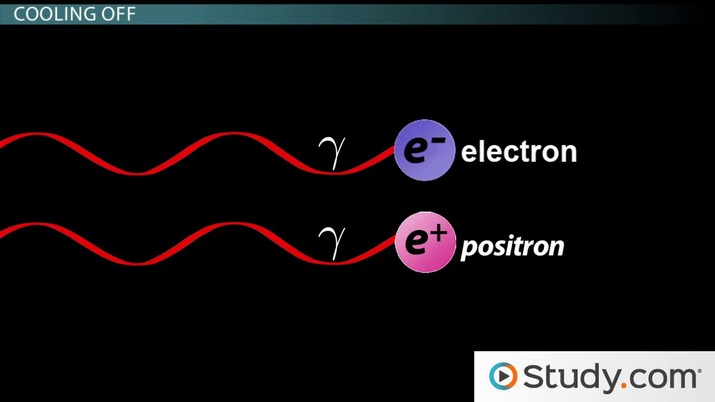
As all of this was happening, the universe was actually expanding and the temperature of the radiation dropped as a result. The temperature drop caused the high energy of the photons to drop as well. This meant that the gamma rays no longer had enough energy to produce heavy particles like protons and neutrons.

Now, you'd think that as a result all the protons and neutrons would've simply combined with their antiparticles and destroyed themselves. This would mean there would be no matter and therefore no sun, no Earth, and no you. However, for some unknown reason, there was a small excess of normal particles. And thank your lucky stars, too! Because there would be no stars to thank if that wasn't the case. Antimatter is actually very rare nowadays.

About two minutes after the Big Bang, the universe cooled down enough to allow for protons and neutrons to hook up and form deuterons, nuclei of deuterium (heavy hydrogen) consisting of a proton and a neutron. Meaning, a process of nucleosynthesis, the formation of new atomic nuclei, had begun.

Deuterons can easily react with protons in nuclear reactions in a stepwise fashion to eventually form ever more massive nuclei, namely helium and a tiny bit of lithium (and perhaps beryllium). You can think of this as taking a ball of playdough and mashing in another colored ball of playdough to make something more massive and new.

This was a tough lesson, so let's cook up our own summary here to make things a bit easier for everyone. The first easy thing is the definition of a cosmologist, a physicist or astronomer involved in figuring out the origin, evolution, and properties of the universe. That's what this lesson was all about: the origin and evolution and properties of our universe right after the Big Bang.

In the beginning, the universe was filled with hot and dense photons. Photons are packets of electromagnetic energy traveling at the speed of light. They were high-energy gamma ray photons that crashed together to become two distinct particles in a process called pair production, the creation of a particle and an antiparticle from gamma rays.

You will have the ability to do the following after watching this video lesson:

Register to view this lesson

Are you a student or a teacher?

Unlock Your Education

See for yourself why 30 million people use Study.com

Become a Study.com member and start learning now.

Become a Member  Back

Resources created by teachers for teachers

Over 30,000 video lessons & teaching resources‐all in one place.
Video lessons
Quizzes & Worksheets
Classroom Integration
Lesson Plans

I would definitely recommend Study.com to my colleagues. It’s like a teacher waved a magic wand and did the work for me. I feel like it’s a lifeline.

Jennifer B.
Teacher
Jennifer B.
Create an account to start this course today
Used by over 30 million students worldwide
Create an account