
Explore alliteration in Beowulf. Discover the purpose of alliteration in Beowulf and then view and analyze examples of alliteration in Beowulf excerpts.
Alliteration in Beowulf | Overview, Examples & Excerpts
Table of Contents
Show
Frequently Asked Questions
What are some examples of alliteration in Beowulf?
Alliteration occurs in nearly every line throughout the poem. Two examples are as follows:
"He moved quickly through the cloudy night, / Up from his swampland, sliding silently / Toward that gold-shining hall."
In this sentence, the alliteration occurs in the phrase "Swampland, sliding silently."
"He grabbed and mauled a man on his bench, / Bit into his bone-lappings, bolted down his blood..."
In this sentence, the alliteration occurs in the phrase "Bit into his bone-lappings, bolted down his blood".
What are the poetic devices used in the poem Beowulf?
Alliteration is particularly common. In addition to this, the poem Beowulf (and Anglo-Saxon poetry in general) makes common use of irony, in which the expectations do not match a given situation, or caesura, a poetic technique in which the speaker pauses in the middle of a line. Caesuras are commonly marked by colons, dashes, or commas in the middle of a line.
Why is alliteration used so often in Beowulf?
Alliteration has a particularly lovely verbal sound. As Beowulf was originally an oral poem, that characteristic of spoken poetry was carried into the written form.
Table of Contents
ShowBeowulf is an Old English epic poem likely recorded by the Anglo-Saxons in the 10th-11th century. Before it was recorded in writing, the poem was performed and passed on through oral tradition. Oral poetry has its own set of strange conventions and particularities, many of which are designed to help the scop (Anglo-Saxon bard/poet) or storyteller both remember and recite the poem. A famous example of this type of particularity occurs in the Homeric epics, specifically regarding the evocative epithets and titles applied to characters, e.g., "stormy-eyed Athena." These epithets have manifold use—scholars have suggested that they help pin specific moments in the story to memory, give the poet an automatic phrase to speak while thinking of coming events, or simply to intensify the poetic imagery and effect.
Within Germanic poetry—and the poetry of the Anglo-Saxons in particular—alliteration fulfills a similar role. Alliteration is defined as a series of words that have the same starting consonant, thereby creating a verbal link that presents a loping rhythm when spoken aloud. As an example, look at the following passage from the Old English poem, "The Dream of the Rood":
No longer some gallows for the guilty,
they nourished it, these holy messengers
watched it grow for human types
across this mortal garden,
matter & mold made famous. (Hostetter 9b-12)
This passage makes extensive use of words that begin with either "g" or "m". The sharpest segments are "gallows for the guilty" and "...mortal garden,/matter & mold made famous." The repetition on display serves as a perfect example of alliteration.
In the same way that the Homeric epithets expedite the process of remembering a poem, as well as amplifying the performative effect of the piece, alliteration improves the recollection and delivery of an oral poem. Binding a series of words with the same initial consonant makes them easier to remember, as well as having a potent auditory ring. Speak the passage above aloud. The alliterative qualities of "gallows for the guilty" create an exceedingly pleasant sound. It imbues the poetry with a certain momentum and intensity, two qualities that will be further explored in the following section concerning alliteration in Beowulf.
 |

Your next lesson will play in
10 seconds
The poem Beowulf follows the titular character throughout a series of heroic adventures. When the epic opens, a malicious creature named Grendel has been plaguing King Hrothgar, coming into his mead hall at night and dragging away warriors. Beowulf, having heard of Hrothgar's troubles, comes to lend his strength of arms to solve the problem. Beowulf handily bests Grendel the following night. He abandons his weaponry to physically wrestle Grendel and, in the process, bodily rips off one of Grendel's arms. Grendel flees to the abode of his mother, who, seeing her son so badly injured (and arguably dead, depending on the translation), goes to take revenge. Beowulf cuts her off, diving deep into her swamp home and battling her to the death.
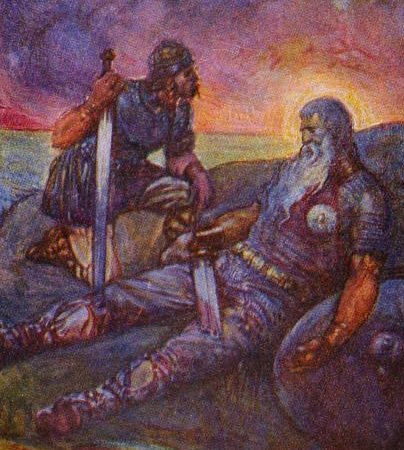
The poem takes a sharp turn, with several decades passing by in a mere moment. Beowulf is now a king and responsible for the lives of his men. A dragon has just awoken nearby, enraged by the theft of a cup from his treasury. In order to protect his people from the burning wrath of the dragon, Beowulf assembles his finest warriors to go combat the dragon. His men flee, and, over the course of the battle, Beowulf slays the dragon but takes a mortal wound. He dies. The final moments of the poem are his people mourning the death of the king, knowing that without Beowulf's strength, they will soon be conquered by the avaricious kings around them.
Beowulf lies within the wider genre of the Germanic heroic poem. Most of the story comes from the perspective of a narrator who, himself, is relating the story to an audience. This narrator, or scop, can best be understood as a bard. In this poem, the narrator lacks a meta-presence—the narrator is assumed to be the individual reciting the poem, but, in a written form, that narrator becomes implied. In the same way that the sudden and necessary distance occurs in the form of the narrator—what would once have been a direct connection must be mediated by the written page—modern translation complicates the reading process. Alliteration was an important aspect of Anglo-Saxon poetry, and as a result, good translators will try to maintain that alliteration through their translation.
The following excerpts are alliteration examples in Beowulf.
...Suddenly then
The God-cursed brute was creating havoc:
Greedy and grim, he grabbed thirty men
From their resting places and rushed to his lair,
Flushed up and inflamed from the raid,
Blundering back with the butchered corpses. (Heaney lines 120-125)
This passage introduces Grendel and his monstrous habits to the audience, showing Grendel loping into Hrothgar's hall and slaughtering the king's people. While Seamus Heaney's translation uses many paired consonants—"resting places and rushed" being the present example, the primary repeating consonant is "g." "The God-cursed brute was creating havoc:/Greedy and grim, he grabbed..." The primary poetic impact of this passage's alliteration is to emphasize the horrific qualities of Grendel—by beginning all of the descriptive words with the same consonant, those descriptors are highlighted and stick in the audience's mind.
"When it comes to fighting, I count myself
as dangerous any day as Grendel.
It won't be a cutting edge I'll wield
to mow him down, easily as I might.
He has no idea of the arts of war,
of shield or sword-play, although he does possess
a wild strength. No weapons, therefore,
for either this night: unarmed he shall face me
if face me he dares. And may the Divine Lord
in His wisdom grant the glory of victory
to whichever side He sees fit." (Heaney lines 677-687)
This passage, containing Beowulf's boasting about the coming fight with Grendel, showcases some of the common paired alliterations mentioned earlier. Some of these pairs are separated from the others—"grant the glory," for example, or "dangerous any day." However, each of these is then paired with another primary descriptor or name. "Grendel" and "grant the glory," or "Divine Lord" and "dangerous any day." Sharing consonants allows the poet to create interesting and implicit connections that wouldn't otherwise exist, allowing alliteration to advance the poetic craft.
He moved quickly through the cloudy night,
Up from his swampland, sliding silently
Toward that gold-shining hall. (Raffel lines 714-716)
Unlike the previous translations, this passage comes from Burton Raffel's edition of Beowulf. This is the moment Grendel descends upon Hrothgar's hall, in which Beowulf waits. As opposed to the paired alliteration that Heaney is so fond of, Raffel attempts to convey the original alliteration through a multiplicative effect. The repetition in "Swampland, sliding silently... gold-shining" creates a sense of momentum throughout the passage. "Gold-shining" may have a slightly different vocalized start than the other, but the "sh" sound is similar enough to both "sw" and "sl" that it nevertheless creates the same impact on the reader.
He grabbed and mauled a man on his bench,
Bit into his bone-lappings, bolted down his blood
And gorged on him in lumps, leaving the body
Utterly lifeless, eaten up
Hand and foot. (Heaney lines 740-744)
Moving back to Heaney's translation, here we see alliterative pairs separated by a caesura, which is defined as a pause in the middle of the line. "Bit into his bone-lappings" and "bolted down his blood" are separated by a comma. Despite that slight separation, they have the same effect—a word related to the body is paired with a word invoking violence; in this case, "bone" and "blood" are matched with "bit" and "bolted," respectively. However, another series of consonants appear in this passage—"lappings," "lumps," "leaving," and "lifeless" make use of alliteration, but they do so (with the assistance of the kenning "bone-lappings") while intertwined with the former, more regimented alliterative words.
Nothing we advised could ever convince
The prince we loved, our land's guardian,
Not to vex the custodian of the gold,
Let him lie where he was long accustomed,
Lurk there under the earth until the end of the world.
He held to his high destiny. (Heaney lines 3079-3084)
In this final Beowulf excerpt, which contains a lament for the deceased titular character, the poet makes use of alliteration to drive home the positive qualities of Beowulf that will be sorely missed. "Loved" begins on a thoroughly positive note, joined by "land's," both of which are quickly contrasted with "let him lie" and "lurk." Beowulf was loved, and he protected his lands and people, but now he will lie underneath those lands. His ability to protect those lands has been removed from him and, perhaps more strikingly, from those who loved and relied on him.
 |
Beowulf was an Anglo-Saxon epic poem, most likely recorded around 1000 AD. It, like many other Anglo-Saxon poems, was originally a poem written in the oral tradition—it was intended to be performed by a scop, otherwise known as a bard. Many aspects of the written poem call back to its origins as an oral poem, most prominently its heavy use of alliteration. Alliteration occurs when words begin with the same consonant, thereby producing the same sound when spoken aloud. Alliteration served a variety of poetic purposes, but its most important effect was to create a singing relationship between the words that sounded pleasant to the ear. An example of alliteration within Beowulf is the phrase "Up from his swampland, sliding silently..." This segment describes the monstrous creature Grendel, who, in the first arc of the epic, battles Beowulf. The alliteration helps emphasize the descriptive nature of the words. The action, "sliding silently," is placed next to the location—"swampland"—thereby creating a distinct image in the mind of the reader.
Video Transcript
Background for Beowulf
The epic tale of Beowulf was first heard in the eighth century CE and was probably written down for the first time in about 1000 CE. This was an oral experience, and the poet, or bard, would chant it to the members of the court or audiences he would find along his travels. While the audience was more than likely aware of the story, it was important that the bard engage them in a way that held their attention. It was the poet's job to make it lively and entertaining. Because of this, there were frequent additions and subtractions made to the story along the way that served to make it more interesting.
Language Makes a Difference
The creative use of language makes all the difference to the listener in the telling of the tale. Alliteration, is the use of repetition of initial sounds in words close to one another. In Beowulf, alliteration is the mainstay of the poem. The use of alliteration, considering it was an oral experience, enhanced the experience for the listener.
'Heorot trembled, wonderfully built to withstand the blows, the struggling great bodies beating at its beautiful walls. . .'
In this example, the repetition of the 'b' would have resounded throughout the hall like the beat of a drum, and it would have signaled to all that a great battle was taking place.
As Grendel approaches the warriors he is going to kill, we hear these lines:
'He found them sprawled in sleep, suspecting nothing, their dreams undisturbed
Up from his swampland, sliding silently. Toward that gold-shining hall.'
We hear the repeating 's' sound, and in our minds we are taken to a place where we imagine the big cats on the Serengeti watching the antelope, waiting for the moment to strike. The words, 'Up from his swampland, sliding silently,' allow us to imagine Grendel slipping into the hall unseen.
Language Grabs Our Attention
The use of alliteration speaks to us. It helps grab our attention, and it holds us captive in the language. The repeating sounds resonate, and with each line we are transported into the action of the piece. The bard understood the necessity for entertaining the audience, and to make it exciting he would exaggerate and emphasize the repetitive sounds to engage and delight, to frighten and entertain. Audiences loved the tales the bard brought to them; they begged for more.
Alliteration helps make lines in the poem sing for the listener and be more easily remembered for the bard. The rhythm helps both the teller and the listener follow the story line, and it enhances the process of retelling the tale. These lines demonstrate how the rhyme scheme made for an exciting and entertaining retelling:
'Cunningly creeping, a spectral stalker
Hot-hearted Beowulf was bent upon battle
He had often haunted Hrothgar's house
How glutted with gore he would guzzle his fill'
The language holds our interest, and it creates a beat that pounds in our heads making the story more powerful, helping the tension rise and fall, and allowing us to get lost in the tale. When we read certain lines, we have to ask ourselves where they allow our minds to wander. In these lines, consider what the repeating 'l' brings to mind:
'To glow across the LAND and LIGHT it;
The corners of the earth were made LOVELY with trees
and LEAVES, made quick with LIFE, with each. . .'
Maybe you are in the forest surrounded by trees, or maybe for you it is a walk in a city park where trees are in bloom and the smell of spring is everywhere. Regardless of what the lines evoke for you, they create images that are comforting and enjoyable.
The bard also used language to signal tempo changes or impending action for the listener. Consider these lines:
'The ancient BLADE BROKE, BIT into
The monster's skin, drew BLOOD, but cracked. . .'
The resonating sound of the 'b' leads us down the path of the action. We are enthralled with the action, but left wondering what the outcome will be. The use of the 'b' is explosive, creating a sound that cannot be ignored. It signals that something is about to happen, and we are on the edge of our seats wondering who will win.
Toward the end of the poem, we encounter lines that, by the use of a booming, repetitive 'g', signal the importance of the moment.
'. . .War-king, the GREAT lord of the GEATS,
GONE to a GLORIOUS death. . .'
We know that this proud leader has met his end in a way that is to be honored and respected. When these words are spoken, they come out as a bellow, letting us know that the loss is profound.
Lesson Summary
Beowulf is the oldest known poem, having been heard for the first time in the eighth century AD and written down in 1000 AD. In Beowulf, alliteration, or the use of repetitive initial sounds, is a powerful tool that helps to engage both the poet and the listener. In this oral tale, the alliteration would have helped the bard remember the lines, and added energy and tension to the telling of the story.
The alliteration creates images and sounds that help the reader engage with the action of the poem, visualize what is happening, and experience the piece with all of the senses. The alliterative elements in Beowulf can be found in almost every line, and they add to the enjoyment of the piece.
Register to view this lesson
Are you a student or a teacher?
Unlock Your Education
See for yourself why 30 million people use Study.com
Become a Study.com member and start learning now.
Become a MemberAlready a member? Log In
BackResources created by teachers for teachers
Over 30,000 video lessons
& teaching resources‐all
in one place.


I would definitely recommend Study.com to my colleagues. It’s like a teacher waved a magic wand and did the work for me. I feel like it’s a lifeline.
Jennifer B.
Teacher

Back

Alliteration in Beowulf | Overview, Examples & Excerpts Related Study Materials
Explore our library of over 88,000 lessons
Browse by subject