
Electrical Energy Storage of Capacitors: Physics Lab
Video transcript
Recommended lessons and courses for you




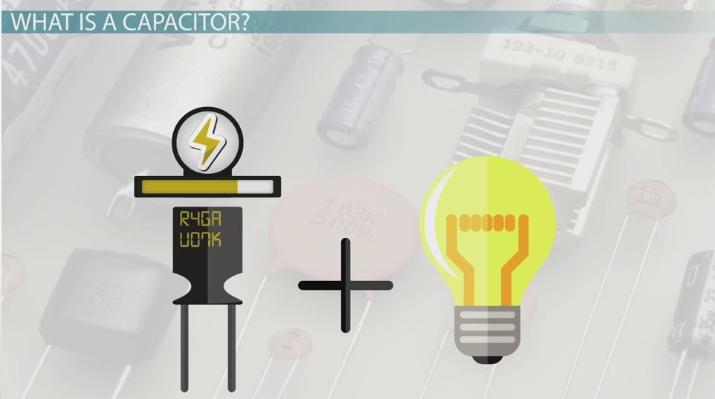
A capacitor is a component in an electric circuit that stores charge and is made up of two nearby (often parallel) plates. You charge a capacitor by connecting it to a battery, and you discharge it by removing the battery and connecting it to another circuit component. Capacitors can release charge faster than batteries and do so periodically: they can charge up, release their charge, and charge up over and over again. This can be really useful in some circuits, such as the flash on a camera. And, in fact, most electronic devices have capacitors of some kind in them.
Today, we're going to investigate capacitors and see how they work for ourselves.
For this physics lab, you will need:
- A battery
- A bulb
- A capacitor
- A resistor
- Two switches
- Seven wires
- Two ammeters (devices that measure current flowing through them)
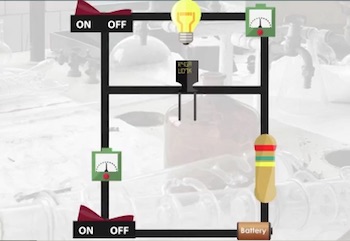
Step 1: Use the components to create a parallel circuit with two branches. On the first branch place the capacitor, a resistor, an ammeter, and a switch. (The resistor is just there to make sure the current isn't too high.) The second branch should connect around the capacitor and contain a bulb, the second ammeter, and the second switch. Keep the switches open (turned off) to start. Here is a diagram of what the circuit should look like:
 |
Step 2: Close the switch on the first branch. Note down your observations, and watch the ammeter reading. You should notice the reading on the ammeter increase as current flows through the circuit. Once the ammeter reading has changed back to zero, proceed to the next step.
Step 3: Open the switch on the first branch, disconnecting the battery from the capacitor. THEN close the switch on the second branch.
Step 4: Note down your observations, and watch what happens to the ammeter reading. Repeat as needed until you're happy with your observations.
If you haven't already, now is the time to pause the video and complete the lab. Good luck!
Now that you've collected some observational data, it's time to analyze what you saw. When you closed the switch in the first branch, you were connecting a charging circuit. Current from the battery flowed to the capacitor, charging it up. Once the capacitor was fully charged, the current stopped and the ammeter reading gradually returned to zero.
Next, you disconnected the battery and then connected the capacitor to a bulb by closing the second switch. The ammeter reading increased, and the bulb lit brightly, but then gradually dimmed until it was dark again. This was the capacitor quickly releasing its charge, lighting the bulb. But as the charge in the capacitor emptied, the bulb got dimmer and went out. This charge is a store of energy, and that energy was released in the bulb as light energy.
This is how capacitors work - you connect them to a charging circuit and then release their charge (energy) when you need it. It comes out in quick bursts until it runs out. When you need a quick or repetitious burst of power, this can be super useful.
A capacitor is a component in an electric circuit that stores charge. You charge a capacitor by connecting it to a battery, and you discharge it by removing the battery and connecting it to another circuit component. Capacitors can charge up, release their charge, and charge up over and over again. This can be useful in some circuits, such as the flash on a camera.
Register to view this lesson
Unlock your education
Become a Study.com member and start learning now.
Become a memberAlready a member? Log in
Go backResources created by teachers for teachers
I would definitely recommend Study.com to my colleagues. It’s like a teacher waved a magic wand and did the work for me. I feel like it’s a lifeline.
