
What are rational zeros? Learn the use of rational zero theorem and synthetic division to find zeros of a polynomial function. Cross-verify using the graph.
Using the Rational Zeros Theorem to Find Rational Roots
Table of Contents
- Rational Zeros
- Rational Zero Theorem
- Finding Zeros of a Polynomial Function
- Cross-Verify Using Graph
- Lesson Summary
Frequently Asked Questions
Are rational roots and rational zeros the same?
Yes. Rational roots and rational zeros are two different names for the same thing, which are the rational number values that evaluate to 0 in a given polynomial.
What is the zero theorem in math?
There is no theorem in math that I am aware of that is just called the zero theorem, however, there is the rational zero theorem, which states that if a polynomial has a rational zero, then it is a factor of the constant term divided by a factor of the leading coefficient.
Table of Contents
- Rational Zeros
- Rational Zero Theorem
- Finding Zeros of a Polynomial Function
- Cross-Verify Using Graph
- Lesson Summary
Given a polynomial function f, The rational roots, also called rational zeros, of f are the rational number solutions of the equation f(x) = 0. Solutions that are not rational numbers are called irrational roots or irrational zeros. These can include but are not limited to values that have an irreducible square root component and numbers that have an imaginary component. Recall that for a polynomial f, if f(c) = 0, then (x - c) is a factor of f. Sometimes a factor of the form (x - c) occurs multiple times in a polynomial. The number of times such a factor appears is called its multiplicity. This is also the multiplicity of the associated root. For example {eq}x^4 -3x^3 +2x^2 {/eq} factors as {eq}x^2(x-2)(x-1) {/eq} so it has roots of 2 and 1 each with multiplicity 1 and a root of 0 with multiplicity 2.

Your next lesson will play in
10 seconds
The rational zero theorem is a very useful theorem for finding rational roots. It states that if any rational root of a polynomial is expressed as a fraction {eq}\frac{p}{q} {/eq} in the lowest terms, then p will be a factor of the constant term and q will be a factor of the leading coefficient. This means that for a given polynomial with integer coefficients, there is only a finite list of rational values that we need to check in order to find all of the rational roots. Furthermore, once we find a rational root c, we can use either long division or synthetic division by (x - c) to get a polynomial of smaller degrees. This gives us a method to factor many polynomials and solve many polynomial equations.
A method we can use to find the zeros of a polynomial are as follows:
Step 1: Factor out any common factors and clear the denominators of any fractions. If there is a common term in the polynomial, it will more than double the number of possible roots given by the rational zero theorems, and the rational zero theorem doesn't work for polynomials with fractional coefficients, so it is prudent to take those out beforehand.
Step 2: List the factors of the constant term and separately list the factors of the leading coefficient.
Step 3: Use the factors we just listed to list the possible rational roots. Note that reducing the fractions will help to eliminate duplicate values. Don't forget to include the negatives of each possible root.
Step 4: Test each possible rational root either by evaluating it in your polynomial or through synthetic division until one evaluates to 0. I will refer to this root as r.
Step 5: Factor out (x - r) from your polynomial through long division or synthetic division.
Step 6: If the result is of degree 3 or more, return to step 1 and repeat. Otherwise, solve as you would any quadratic.
Example 1
Factor the polynomial {eq}f(x) = 2x^3 + 8x^2 +2x - 12 {/eq} completely.
Step 1: Notice that 2 is a common factor of all of the terms, so first we will factor that out, giving us {eq}f(x)=2(x^3+4x^2+x-6) {/eq}.
Step 2: The constant is 6 which has factors of 1, 2, 3, and 6. The leading coefficient is 1, which only has 1 as a factor.
Step 3: Our possible rational roots are 1, -1, 2, -2, 3, -3, 6, and -6.
Step 4: Notice that {eq}1^3+4(1)^2+1(1)-6=1+4+1-6=0 {/eq}, so 1 is a root of f.
Step 5: Use synthetic division to divide by {eq}(x - 1) {/eq}.
{eq}\begin{array}{rrrrr} {1} \vert & {1} & 4 & 1 & -6\\ & & 1 & 5 & 6\\\hline & 1 & 5 & 6 & 0 \end{array} {/eq}
This gives us {eq}f(x) = 2(x-1)(x^2+5x+6) {/eq}.
Step 6: {eq}x^2 + 5x + 6 {/eq} factors into {eq}(x+2)(x+3) {/eq}, so our final answer is {eq}f(x) = 2(x-1)(x+2)(x+3) {/eq}
Example 2
Solve {eq}x^4 - \frac{45}{4} x^2 + \frac{35}{2} x - 6 = 0 {/eq}.
Step 1: We can clear the fractions by multiplying by 4. Since we are solving rather than just factoring, we don't need to keep a {eq}\frac{1}{4} {/eq} factor along. Now we have {eq}4 x^4 - 45 x^2 + 70 x - 24=0 {/eq}.
Step 2: The constant 24 has factors 1, 2, 3, 4, 6, 8, 12, 24 and the leading coefficient 4 has factors 1, 2, and 4.
Step 3: Our possible rational roots are {eq}1, 1, 2, -2, 3, -3, 4, -4, 6, -6, 8, -8, 12, -12, 24, -24, \frac{1}{2}, -\frac{1}{2}, \frac{3}{2}, -\frac{3}{2}, \frac{1}{4}, -\frac{1}{4}, \frac{3}{4}, -\frac{3}{2}. {/eq}.
Steps 4 and 5: Using synthetic division, remembering to put a 0 for the missing {eq}x^3 {/eq} term, gets us the following:
{eq}\begin{array}{rrrrrr} {1} \vert & 4 & 0 & -45 & 70 & -24 \\ & & 4 & 4 & -41 & 29\\\hline & 4 & 4 & -41 & 29 & 5 \end{array} {/eq}
{eq}\begin{array}{rrrrrr} {-1} \vert & 4 & 0 & -45 & 70 & -24 \\ & & -4 & 4 & 41 & -111 \\\hline & 4 & -4 & -41 & 111 & -135 \end{array} {/eq}
{eq}\begin{array}{rrrrrr} {2} \vert & 4 & 0 & -45 & 70 & -24 \\ & & 8 & 16 & -58 & 24 \\\hline & 4 & 8 & -29 & 12 & 0 \end{array} {/eq}
So 2 is a root and now we have {eq}(x-2)(4x^3 +8x^2-29x+12)=0 {/eq}. Since we aren't down to a quadratic yet we go back to step 1.
Step 1: There aren't any common factors or fractions so we move on.
Step 2: Our constant is now 12, which has factors 1, 2, 3, 4, 6, and 12. Our leading coeeficient of 4 has factors 1, 2, and 4.
Step 3: Our possible rational root are {eq}1, 1, 2, -2, 3, -3, 4, -4, 6, -6, 12, -12, \frac{1}{2}, -\frac{1}{2}, \frac{3}{2}, -\frac{3}{2}, \frac{1}{4}, -\frac{1}{4}, \frac{3}{4}, -\frac{3}{2} {/eq}.
Step 4 and 5: Since 1 and -1 weren't factors before we can skip them. To save time I will omit the calculations for 2, -2, 3, -3, and 4 which show that they are not roots either.
{eq}\begin{array}{rrrrr} {-4} \vert & 4 & 8 & -29 & 12 \\ & & -16 & 32 & -12 \\\hline & 4 & -8 & 3 & 0 \end{array} {/eq}
Now we are down to {eq}(x-2)(x+4)(4x^2-8x+3)=0 {/eq}.
Step 6: To solve {eq}4x^2-8x+3=0 {/eq} we can complete the square.
{eq}x^2 - 2x = -\frac{3}{4} {/eq}
{eq}x^2-2x+1=\frac{1}{4} {/eq}
{eq}(x-1)^2 = \frac{1}{4} {/eq}
{eq}x=1+-\frac{1}{2} {/eq}
Putting this together with the 2 and -4 we got previously we have our solution set is {{eq}2, -4, \frac{1}{2}, \frac{3}{2} {/eq}}
Example 3
Find all of the roots of {eq}2 x^5 - 3 x^4 - 40 x^3 + 61 x^2 - 20 {/eq} and their multiplicities.
Step 1: There are no common factors or fractions so we can move on.
Step 2: The factors of our constant 20 are 1, 2, 5, 10, and 20. The factors of our leading coefficient 2 are 1 and 2.
Step 3: Our possible rational roots are {eq}1, -1, 2, -2, 5, -5, 10, -10, 20, -20, \frac{1}{2}, -\frac{1}{2}, \frac{5}{2}, -\frac{5}{2} {/eq}.
Step 4 and 5: Using synthetic division with 1 we see:
{eq}\begin{array}{rrrrrrr} {1} \vert & 2 & -3 & -40 & 61 & 0 & -20 \\ & & 2 & -1 & -41 & 20 & 20 \\\hline & 2 & -1 & -41 & 20 & 20 & 0 \end{array} {/eq}
So 1 is a root and we are left with {eq}2x^4 - x^3 -41x^2 +20x + 20 {/eq}.
There aren't any common factors and there isn't any change to our possible rational roots so we can go right back to steps 4 and 5 were using synthetic division we see that 1 is a root of our reduced polynomial as well.
{eq}\begin{array}{rrrrrr} {1} \vert & 2 & -1 & -41 & 20 & 20 \\ & & 2 & 1 & -40 & -20 \\\hline & 2 & 1 & -41 & -20 & 0 \end{array} {/eq}
So we are now down to {eq}2x^3 + x^2 -41x -20 {/eq}
Once again there is nothing to change with the first 3 steps. This time 1 doesn't work as a root, but {eq}-\frac{1}{2} {/eq} does.
{eq}\begin{array}{rrrrr} -\frac{1}{2} \vert & 2 & 1 & -40 & -20 \\ & & -1 & 0 & 20 \\\hline & 2 & 0 & -40 & 0 \end{array} {/eq}
This leaves us with {eq}2x^2 - 40 = 2(x^2-20) = 2(x-\sqrt(20))(x+ \sqrt(20))=2(x-2 \sqrt(5))(x+2 \sqrt(5)) {/eq}
So we have our roots are 1 with a multiplicity of 2, and {eq}-\frac{1}{2}, 2 \sqrt{5} {/eq}, and {eq}-2 \sqrt{5} {/eq} each with multiplicity 1.
We can use the graph of a polynomial to check whether our answers make sense. Let's look at the graphs for the examples we just went through.
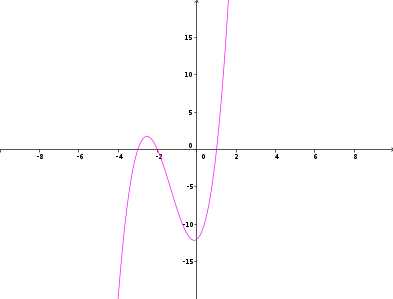 |
In the first example we got that f factors as {eq}f(x) = 2(x-1)(x+2)(x+3) {/eq} and from the graph, we can see that 1, -2, and -3 are zeros, so this answer is sensible.
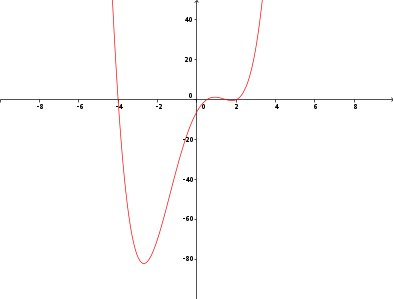 |
In the second example we got that the function was zero for x in the set {{eq}2, -4, \frac{1}{2}, \frac{3}{2} {/eq}} and we can see from the graph that the function does in fact hit the x-axis at those values, so that answer makes sense.
 |
Notice that at x = 1 the function touches the x-axis but doesn't cross it. This is because the multiplicity of 2 is even, so the graph resembles a parabola near x = 1. We also see that the polynomial crosses the x-axis at our zeros of multiplicity 1, noting that {eq}2 \sqrt{5} \approx 4.47 {/eq}. Note that if we were to simply look at the graph and say 4.5 is a root we would have gotten the wrong answer. Graphs are very useful tools but it is important to know their limitations.
The rational zero theorem tells us that any zero of a polynomial with integer coefficients will be the ratio of a factor of the constant term and a factor of the leading coefficient. Using this theorem and synthetic division we can factor polynomials of degrees larger than 2 as well as find their roots and the multiplicities, or how often each root appears. While it can be useful to check with a graph that the values you get make sense, graphs are not a replacement for working through algebra.
Video Transcript
Definitions
Factoring polynomial functions and finding zeros of polynomial functions can be challenging. This lesson will explain a method for finding real zeros of a polynomial function. Please note that this lesson expects that students know how to divide a polynomial using synthetic division. You can watch our lessons on dividing polynomials using synthetic division if you need to brush up on your skills.
Let's first state some definitions just in case you forgot some terms that will be used in this lesson. A zero of a polynomial function is a number that solves the equation f(x) = 0. These numbers are also sometimes referred to as roots or solutions. A rational zero is a rational number, which is a number that can be written as a fraction of two integers. An irrational zero is a number that is not rational, so it has an infinitely non-repeating decimal.
Rational Zeros Theorem
The rational zeros theorem helps us find the rational zeros of a polynomial function. Once you find some of the rational zeros of a function, even just one, the other zeros can often be found through traditional factoring methods. Let's state the theorem:
'If we have a polynomial function of degree n, where (n > 0) and all of the coefficients are integers, then the rational zeros of the function must be in the form of p/q, where p is an integer factor of the constant term a0, and q is an integer factor of the lead coefficient an.'
Just to be clear, let's state the form of the rational zeros again. The rational zeros of the function must be in the form of p/q. The number p is a factor of the constant term a0. The number q is a factor of the lead coefficient an. Let's look at how the theorem works through an example: f(x) = 2x^3 + 3x^2 - 8x + 3.
In this function, the lead coefficient is 2; in this function, the constant term is 3; in factored form, the function is as follows: f(x) = (x - 1)(x + 3)(x - 1/2).
The zero product property tells us that all the zeros are rational: 1, -3, and 1/2. If x - 1 = 0, then x = 1; if x + 3 = 0, then x = -3; if x - 1/2 = 0, then x = 1/2. Zeros are 1, -3, and 1/2.
Let's write these zeros as fractions as follows: 1/1, -3/1, and 1/2. Notice that each numerator, 1, -3, and 1, is a factor of 3. Also notice that each denominator, 1, 1, and 2, is a factor of 2.
Example 1
List the possible rational zeros of the following function: f(x) = 2x^3 + 5x^2 - 4x - 3.
The constant term is -3, so all the factors of -3 are possible numerators for the rational zeros. The lead coefficient is 2, so all the factors of 2 are possible denominators for the rational zeros.
All possible combinations of numerators and denominators are possible rational zeros of the function. The possible rational zeros are as follows: +/- 1, +/- 3, +/- 1/2, and +/- 3/2.
Example 2
Find the rational zeros for the following function: f(x) = 2x^3 + 5x^2 - 4x - 3.
This is the same function from example 1. The rational zeros theorem showed that this function has many candidates for rational zeros. Therefore, we need to use some methods to determine the actual, if any, rational zeros. One good method is synthetic division. Let's try synthetic division.
This method will let us know if a candidate is a rational zero. Let's show the possible rational zeros again for this function:
 |
There are eight candidates for the rational zeros of this function. The number -1 is one of these candidates. To determine if -1 is a rational zero, we will use synthetic division.
The synthetic division problem shows that we are determining if -1 is a zero. The first row of numbers shows the coefficients of the function. If -1 is a zero of the function, then we will get a remainder of 0; however, synthetic division reveals a remainder of 4. Therefore, -1 is not a rational zero.
 |
We could select another candidate from our list of possible rational zeros; however, let's use technology to help us. If we graph the function, we will be able to narrow the list of candidates.
 |
The graph of our function crosses the x-axis three times. It certainly looks like the graph crosses the x-axis at x = 1. If you recall, the number 1 was also among our candidates for rational zeros. To determine if 1 is a rational zero, we will use synthetic division.
 |
The synthetic division problem shows that we are determining if 1 is a zero. Synthetic division reveals a remainder of 0. Therefore, 1 is a rational zero. In other words, x - 1 is a factor of the polynomial function.
 |
Those numbers in the bottom row are coefficients of the polynomial expression that we would get after dividing the original function by x - 1.
We started with a polynomial function of degree 3, so this leftover polynomial expression is of degree 2. In other words, it is a quadratic expression. We can now rewrite the original function.
First, let's show the factor (x - 1). Next, let's add the quadratic expression: (x - 1)(2x^2 + 7x + 3).
 |
We could continue to use synthetic division to find any other rational zeros. However, it might be easier to just factor the quadratic expression, which we can as follows: 2x^2 + 7x + 3 = (2x + 1)(x + 3).
Let's add back the factor (x - 1). Using the zero product property, we can see that our function has two more rational zeros: -1/2 and -3.
2x + 1 = 0
2x = -1
x = -1/2
x + 3 = 0
x = -3
Example 3
Find the rational zeros of the following function: f(x) = x^4 - 4x^2 + 1.
The only possible rational zeros are 1 and -1. Let's use synthetic division again. Both synthetic division problems reveal a remainder of -2. Therefore, neither 1 nor -1 is a rational zero.
 |
This function has no rational zeros. Let's look at the graph of this function. The graph clearly crosses the x-axis four times. Therefore, all the zeros of this function must be irrational zeros.
 |
Lesson Summary
The rational zeros theorem is a method for finding the zeros of a polynomial function. The theorem tells us all the possible rational zeros of a function. We showed the following image at the beginning of the lesson:
 |
The rational zeros of a polynomial function are in the form of p/q. The term a0 is the constant term of the function, and the term an is the lead coefficient of the function.
Using synthetic division and graphing in conjunction with this theorem will save us some time. The rational zeros theorem will not tell us all the possible zeros, such as irrational zeros, of some polynomial functions, but it is a good starting point.
Learning Outcomes
Following this lesson, you'll have the ability to:
- Describe the rational zeros theorem
- Identify the form of the rational zeros of a polynomial function
- Explain how to use synthetic division and graphing to find possible zeros
Register to view this lesson
Are you a student or a teacher?
Unlock Your Education
See for yourself why 30 million people use Study.com
Become a Study.com member and start learning now.
Become a MemberAlready a member? Log In
BackResources created by teachers for teachers
Over 30,000 video lessons
& teaching resources‐all
in one place.


I would definitely recommend Study.com to my colleagues. It’s like a teacher waved a magic wand and did the work for me. I feel like it’s a lifeline.
Jennifer B.
Teacher

Back

Using the Rational Zeros Theorem to Find Rational Roots Related Study Materials
Explore our library of over 88,000 lessons
Browse by subject