
Measurement of Water Vapor in the Air | Overview & Methods
How do you measure a cup of water?
A cup of water can be measured by using a standard measuring cup. Fill the cup to the line marked "1 Cup" by lining up the waterline with the appropriate marking.
What is a unit of water?
Water volume can be measured using a variety of units. The English System includes fluid ounces, pints, quarts, and gallons. The Standard International Units include liters and milliliters.

Recommended lessons and courses for you







Water is everywhere. It is one of the most abundant and most essential compounds on the planet. It fills oceans, travels down rivers, and even floats through the air. What percentage of water vapor is found in the air? Earth's atmosphere can be anywhere from 0.2% water vapor in the arctic to 4% water vapor in the tropics. One may ask, why can't you see water vapor in the air, and can you see water vapor? Water vapor in the air is largely invisible; it is only when the droplets reach sufficient size to reflect visible light that they are visible as fog or clouds. Water vapor is usually defined as {eq}H_2O {/eq} molecules in the air in a gaseous state, particularly when the gas was produced via evaporation rather than boiling.
How to Measure Water Vapor
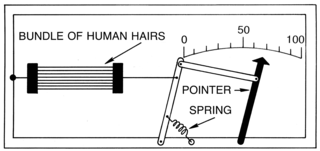
Scientists have attempted to measure moisture levels in the air since at least the 15th century. The Shang Dynasty in Ancient China used charcoal, comparing its dry weight to its damp weight after being exposed to the air, to measure relative humidity. It is said that Leonardo da Vinci built the first hygrometer (a mechanical device used to measure humidity) around 1480. In 1783, Swiss scientist Horace Benedict de Saussure built a hygrometer that used a single human hair whose expansion and contraction due to changes in humidity were measured using a needle gauge.
 |
But the measurement of water vapor in the air can be tricky for a few reasons. First, the gas is invisible. Second, the amount of water vapor that air can hold varies with temperature and pressure. Scientists have learned how to measure water vapor in the air in four distinct ways today. The quantities of vapor pressure, humidity, mixing ratio, and dew point are all measurements of the atmosphere's water content, but they are all measured and calculated differently.
To understand vapor pressure, one needs to imagine a closed container filled halfway with water and halfway with air. Such a container would have most water molecules in liquid form and some in gaseous form floating within the air. It would also have some water molecules evaporating (turning from a liquid to a gas) and some water molecules condensing (turning from a gas to a liquid). Vapor pressure is defined as the pressure exerted by the gaseous water molecules above the liquid surface.
Vapor pressure is measured in regular units of pressure, like pounds per square inch (psi) or kilopascals (kPa). It is measured using a device called a manometer, which consists of a U-shaped tube partially filled with a dense liquid. One end of the tube is left open and exposed to the atmosphere, while the other is sealed. If the pressure in the atmosphere is greater than the air pressure in the sealed end of the tube, the liquid will move toward the sealed end. And if the pressure in the atmosphere is lower than the pressure in the sealed end, the liquid will move toward the open end of the tube. The first manometer was invented in 1661 by the Dutch physicist Christian Huygens.
Another way to measure how much water vapor is in the atmosphere is by measuring "humidity." Humidity is defined as the water vapor concentration in the air. It has three distinct forms: relative humidity, absolute humidity, and specific humidity.
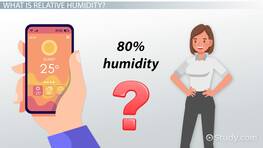
The relative humidity is the most familiar to anyone who keeps track of the weather. It is usually expressed as a percentage, and it compares the amount of water vapor in the air to the amount of water vapor that the air can hold. For example, relative humidity of 50% means that the air is halfway full of water. In comparison, relative humidity of 100% indicates the air is literally full, and no more water molecules can be added. However, relative humidity depends on the air temperature too. A rating of 50% humidity on a cold winter day is not the same as a rating of 50% on a warm, sunny day. This difference is because warm air can hold more water vapor than cold air.
Absolute humidity avoids this problem. It is typically expressed as the mass of water vapor held by the air per unit volume. An absolute humidity of 15g per cubic meter is fairly typical. On the other hand, specific humidity is expressed as the ratio between the mass of water vapor in the air and the mass of a moist air sample. It is typically expressed in grams of vapor per kilogram of air. A typical measurement of specific humidity is around 10 grams per kilogram.
Similar to specific humidity, the mixing ratio is also expressed as a ratio. Mixing ratio is defined as the mass of the water vapor in a parcel of air compared to the mass of the remaining dry air. For example, if a molecule separated a parcel of moist air, and the water molecules had a total mass of 20 grams while the remaining molecules had a total mass of 1.6 kilograms, then one would simply divide the mass of water by the mass of dry air. This result would yield a mixing ratio of 12.5 grams per kilogram, which is fairly typical.
Another way to measure the air's moisture content is by calculating a quantity called the "dew point." Dew point is defined as the temperature to which the air must be cooled to become fully saturated. This quantity assumes a constant pressure and assumes that "fully saturated" means a relative humidity of 100%. Once this humidity is reached, any further cooling of the air would result in condensation on nearby surfaces, which is also known as "dew." Thus, the dew point is the temperature at which dew is deposited.
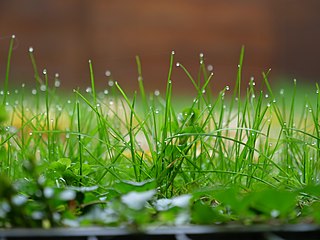 |
Dew point can be calculated mathematically or measured experimentally. But it can also be tracked simply by looking at the grass each morning. Because warm air has more room for water vapor, evaporation during the day usually increases the air's absolute humidity. When that air cools off at night, the relative humidity in the air skyrockets because the amount of water remains constant while the surrounding air temperature decreases. In other words, the number of water molecules remains constant while the amount of room for water molecules drops. Once there is no more room for the water molecules, they begin to be deposited as morning dew (or frost) on nearby surfaces. And nearby grass is often the perfect location.
Water vapor is usually defined as {eq}H_2O {/eq} molecules in the air in a gaseous state, particularly when the gas was produced via evaporation rather than boiling. Scientists measure water vapor content in the air in four distinct ways: vapor pressure, humidity, mixing ratio, and dew point. Vapor pressure is defined as the pressure exerted by the gaseous water molecules above the liquid surface. Humidity comes in three varieties. The relative humidity is a percentage comparing the water vapor amount in the air to the water vapor amount that the air can hold. Absolute humidity is the mass of water vapor held by the air per unit volume. Specific humidity is the ratio between the mass of water vapor in the air and the mass of a moist air sample. Mixing ratio is similar to specific humidity; it is defined as the mass of the water vapor in a parcel of air compared to the mass of the remaining dry air. Lastly, the dew point is defined as the temperature at which the air must be cooled to become fully saturated.
Video Transcript
Water Vapor
Think of all of the things you've measured in the past week: 4 cups of flour for your bread, a quarter of a gallon of gas for your chainsaw, a 5-mile trail for your run and a 32-inch belt for your waist. So, I know you're a bread baking, chainsaw-wielding runner with a nice belt, but I don't know if you can measure water vapor.
Well, don't worry; I'm here to help. Water vapor is water that is a gas. In fact, it's floating all around you right now. Even though you can't see it, I'm sure you've noticed it before. For example, when it's humid out, there's a lot of water vapor in the air, so you've probably felt it. Or, when you see dew, fog or clouds, water vapor has condensed, or become a liquid. Measuring water vapor can help scientists make predictions about weather.
So, how in the world do you measure water vapor? A ruler? A measuring cup?
Vapor Pressure
Let's start with vapor pressure, which is the atmospheric pressure due to water vapor molecules. Now, depending on where you read, this definition can get a little more complicated, but for the scope of this lesson, let's keep it simple. You might not realize these water vapor molecules are exerting pressure, but they are constantly bumping into you!
Since you can't see these water vapor molecules, how do you measure vapor pressure? Excellent question. You can measure vapor pressure by using a manometer. No, that isn't a man-thermometer hybrid.
Instead it's a U-shaped tube usually filled with mercury. As the pressure on one side of the tube increases, it pushes the mercury to the other side. So, now you can be a bread baking, chainsaw wielding runner with a nice belt and a manometer.
Before we move on, how do you think vapor pressure is related to the number of water vapor molecules in the atmosphere? Well, if you have a lot of water vapor in the air, they would be exerting more pressure, so you would have a high vapor pressure! Okay, onto humidity!
Humidity
When you think of humidity, what comes to mind? Being sweaty? Hot? Your hair going crazy? You probably already know that humidity has something to do with how much water vapor is in the air, but there are several ways to measure humidity. There is relative humidity, absolute humidity and specific humidity. Let's look at each.
Relative humidity measures how close the air is to saturation. Saturated air is air that's full of water vapor and can't hold anymore. So, relative humidity is water vapor in the air divided by how much water vapor the air could hold. Relative humidity is measured as a percentage, so if the relative humidity is 100%, it means the air is saturated.
Sometimes it's hard to wrap your mind around definitions, so let me give you an example. Let's use cups to represent air and water to represent water vapor. Our first cup is five ounces and is holding five ounces of water. To make that a percentage (like relative humidity), I'd take 5 / 5 * 100. We'd say this cup has a relative humidity of 100%.
Our second cup is 50 ounces and is holding 5 ounces of water. To make that a percentage, I'd take 5 / 50 * 100. We'd say this cup has a relative humidity of 10%.
In our analogy, the small cup represents cold air, whereas the big cup represents warm air. Warm air can hold more water vapor without 'filling up,' or becoming saturated, hence the bigger cup. Now, technically the warm air isn't 'holding' more water vapor, but realize that warmer air has more water vapor molecules (without becoming saturated).
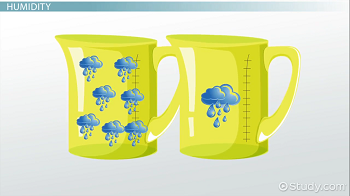
Another measurement of humidity is called absolute humidity, which measures the mass of water vapor in a certain volume, or the density of water vapor. So, here, you can see one of these has more water vapor molecules within a certain area, so you could say it has a greater absolute humidity.
 |
Finally, specific humidity is calculated by taking the mass of the water vapor divided by the total mass of all of the air.
So, you know how each type of humidity is measured, but are there tools to help you out? Yep. For example, there's a tool called a psychrometer, which is a type of hygrometer. A hygrometer, by the way, is a tool that can be used to measure moisture in the atmosphere, like humidity or dew point. This particular type of hygrometer, the psychrometer, works by having two thermometers. One bulb, or the bottom of the thermometer, is wet while the other is dry. The wet bulb has water evaporating off of it, which cools it (think about when you sweat and water evaporates off of you and then cools you).
The difference in temperature between the two thermometers is directly related to how much water evaporates off of the wet bulb, which is related to how much water vapor is already in the air (less evaporates if the air is already full of water). So, the psychrometer gives you the relative humidity, or how close the air is to being saturated. So, now you're a bread baking, chainsaw wielding runner with a nice belt, a manometer and a psychrometer.
Or, you can just use formulas that use the vapor pressure, among other things, to calculate the specific humidity, relative humidity or the absolute humidity. So, you can add a calculator to your ensemble.
Before we move on to mixing ratio, you can pause the video and take some notes on this table to study later. Hey, maybe this table can be one of your tools!
| Type of Humidity | How It's Calculated |
|---|---|
| Relative | Water vapor in the air / how much water vapor the air can hold |
| Absolute | The density of water vapor, which is the mass of water vapor / volume |
| Specific | Mass of the water vapor / total mass of the air |
Mixing Ratio
Next, let's see how you can measure the mixing ratio, or the mass of water vapor divided by the mass of dry air. Although this definition sounds similar to specific humidity, you'll notice the mixing ratio looks at the mass of dry air, whereas specific humidity looked at all air. Like I mentioned for humidity, there are formulas you can use to help you calculate the mixing ratio. We won't get into the specifics, but you know which tool you'll need to do all of that math!
Dew Point
The last measurement we're going to discuss is the dew point. This is the temperature air needs to be cooled to in order for saturation to occur at a specific temperature and pressure. In other words, the temperature where the air cannot hold anymore water vapor, which results in condensation. Dew is condensation on objects, hence the name dew point.
You can measure dew point by using another type of hygrometer made out of a mirror, a light beam and a light detector. The light beam shines into the mirror and then bounces off and is read by the detector. When the mirror is cooled, dew forms on its surface, which makes the beam less bright, which is noted by the light detector, and voila the dew point is recorded. Now you have another hygrometer to add to your collection.
Lesson Summary
So, you're a bread baking, chainsaw wielding runner with a nice belt, a manometer, a couple of hygrometers (including one psychrometer), some math formulas, a table and a calculator. But let's take a moment to review all of the ways we can measure water in the air!
You probably remember that water vapor is water that's a gas in the air, but did you remember what vapor pressure measured? Vapor pressure is the pressure exerted by water vapor molecules that are in the atmosphere. Humidity measures how much water is in the air, and you can measure it several different ways. The mixing ratio sounded similar to specific humidity, but it was actually a little different. Let's take a look at a table that summarizes humidity and mixing ratio.
| Type of Humidity | How It's Calculated |
|---|---|
| Relative | Water vapor in the air / how much water vapor the air can hold |
| Absolute | The density of water vapor, which is the mass of water vapor / volume |
| Specific | Mass of the water vapor / total mass of the air |
| Mixing Ratio | Mass of water vapor / total mass of dry air |
Last but not least, there was the dew point, which is the temperature the air must cool in order for dew to form. And remember all of the tools you can use: formulas, tables, calculators, manometers and hygrometers (including one called a psychrometer).
So, now that you're armed with a whole new set of tools, you can spend all of your free time measuring the water vapor in the atmosphere. And think of all the things you'll be able to tell your friends! When dew will form, how saturated the air is or what's the humidity today!
Learning Outcomes
Once you are done with this lesson, you should be able to:
- Describe how to measure vapor pressure
- Explain and compare relative, absolute, and specific humidity
- Discuss how to measure the mixing ratio and the dew point
- Name some of the tools used in measuring humidity and dew point
Register to view this lesson
Unlock your education
Become a Study.com member and start learning now.
Become a memberAlready a member? Log in
Go backResources created by teachers for teachers
I would definitely recommend Study.com to my colleagues. It’s like a teacher waved a magic wand and did the work for me. I feel like it’s a lifeline.
