
Vertical Asymptote | Equation, Formula & Rules
What does vertical asymptote mean?
A vertical asymptote refers to a specific value (or set of values) which, if equated to the independent variable (x), will result in the function (f(x)) becoming undefined. This means that the function will not exist at those specific x-values.
What are the rules for vertical asymptotes?
1) As the function moves towards the vertical asymptote, it will strive to either positive or negative infinity. This means that the function will move upwards or downwards in an almost parallel fashion to the asymptote as it gets closer horizontally.
2)The function will move ever closer to the vertical asymptote(s). They will get extremely close, but they will never touch. The distance between the function and the asymptote will strive towards zero, but it will never reach zero, essentially.
3)The asymptote can be approached from the left or right or both sides. This means that the function will have a discontinuity at the point of the asymptote if it is being approached from both sides. A function will move in opposite vertical directions when approaching an asymptote from the left versus the right.
How do you find the vertical asymptotes of a function?
Factorize the polynomials in the denominator and the numerator, divide out any common factors, equate the remaining denominator to zero, and then solve for x. The x-values identified using this method are vertical asymptotes.
What is an example of a vertical asymptote?
A vertical asymptote is a specific value of x which, if inserted into a specific function, will result in the function being undefined as a whole.
An example would be x=3 for the function f(x)=1/x-3. If 3 were to be substituted into the equation, then it would equal 1/0, which is undefined.

Recommended lessons and courses for you











A vertical asymptote refers to a specific value (or set of values) that, when plugged into a function as the independent variable ({eq}x {/eq}), will result in the function becoming undefined. This means that the asymptote of an underlying function is a point where that function does not exist. Graphically, the presence of a vertical asymptote is indicated by a vertical dotted line.
 |
It can be noted that the function above strives towards the asymptotes, and as the x-value gets closer to the determined asymptote, the y-value of the function strives towards positive or negative infinity. Vertical asymptotes can also be seen in the limit form.
{eq}\lim_{x\to-3^{-}}f(x)=\infty\;and\;\lim_{x\to-3^{+}}f(x)=-\infty {/eq}
This means that as the {eq}x {/eq} value of the function moves closer to -3 from the left side, the graph will move to positive infinity. As the function's x-value moves closer to -3 from the right side, the function will strive towards negative infinity. Infinity is an incomprehensibly large number and, thus, {eq}x=-3 {/eq} becomes the point where the function is considered undefined.
This module will only discuss vertical asymptotes of rational functions. A rational function can be defined as a function that consists of polynomials, which are located in both the numerator and the denominator. This means that log functions and trigonometric functions will not be discussed within the frame of this lesson.
Vertical asymptotes adhere to the following rules:
- As the function moves towards a vertical asymptote, it will strive to either positive or negative infinity. This means that the function will move upwards or downwards in an almost parallel fashion to the asymptote as it gets closer horizontally.
- The function will move ever closer to the vertical asymptote(s). They will get extremely close, but they will never touch. The distance between the function and the asymptote will strive towards zero, but it can never reach zero.
- The asymptote can be approached from the left or right, or even both sides. This means that the function will have a discontinuity at the point of the asymptote if it is being approached from both sides. The function will move in opposite vertical directions when approaching the asymptote from the left versus the right.
 |
The function will move in the positive infinity direction on the left side and will appear in the negative infinity direction on the right side. This is because the function becomes exponentially larger as it approaches the asymptote from the left side.
This concept can be explored by looking at what happens to the equation as x moves towards the asymptote from either direction. When the approach from the left side is observed, the trajectory becomes quite apparent.
| x | g(x) |
|---|---|
| -4 | -1 |
| -3 | 3 |
| -2.5 | 9.5 |
| -2.25 | 21.75 |
| -2.125 | 45.875 |
Even though the difference between each subsequent x increment is being halved, the associated f(x) value increases exponentially each time. This shows that the function will just keep going up at an ever increasing rate as it moves towards the asymptote. Check to see if the opposite is true for the right side.
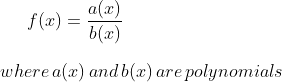
Rational functions can be thought of as two separate functions: one located in the numerator, and the other in the denominator. Both functions are polynomials, meaning they are made up of multiple terms, with each variable having a different degree.
The general form of a rational function can be shown as:
 |
Steps to Find the Vertical Asymptotes of Rational Functions
Consider this specific example of a rational function:
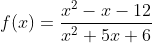 |
The process of identifying the vertical asymptote of any rational function can be broken up into a series of steps.
Step 1: Equate the Denominator Function to Zero
Vertical asymptotes occur where a specific function is undefined. Undefined, in mathematical terms, always refers to a case where a number is being divided by zero. This means that if an equation is set up where the denominator is equal to zero, it can be solved, and the x values for which the equation is true can be identified.
{eq}x^{2}+5x+6=0 {/eq}
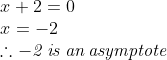
Denominators that that consist of linear functions (functions with only two terms) are essentially solved at this point, but the equation must still be solved for {eq}x {/eq}. To do so, the constant term is subtracted on both sides of the equation and then divided by the coefficient of the x-term.
 |
Step 2: Factorize the Denominator
If the function is quadratic (meaning it has three terms) or larger, though, it will have to be factorized. This will identify what the possible asymptotes are.
{eq}(x+3)(x+2)=0\\ \therefore \mathit{possible\,asymptotes:}\\ x=-3\: and\: x=-2 {/eq}
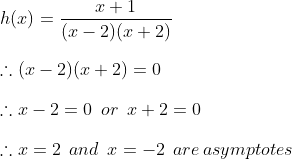
It can be noted that the amount of roots is equal to the degree of the particular polynomial. I.e., a polynomial of the second degree will have two roots. The process is now complete if the function only has polynomials in the denominator or if the numerator is a linear function that does not match any of the roots.
 |
Step 3: Factorize the Numerator and Eliminate Common Factors
If the numerator consists of a function that is quadratic or larger, then it will have to be factorized so that its factors can be identified. This is because not all of the identified roots are asymptotes, necessarily. If there are roots that are found in both the top and bottom of the fraction, then they will eliminate each other.
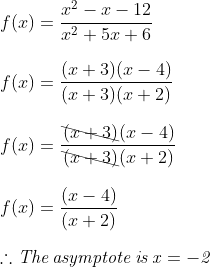 |
This is the same process that takes place when the fraction{eq}\frac{4}{6} {/eq} is simplified as{eq}\frac{2}{3} {/eq} by dividing both the numerator and denominator by 2. The remaining denominator roots can be identified as the vertical asymptotes of the function.
Determining the Domain of a Rational Function
The domain of a function can be defined as the set of x-values for which the underlying function is defined. A rational function is continuous, and thus x can take the form of any rational value (or {eq}x\epsilon \mathbb{R} {/eq}) except for that of its asymptotes.
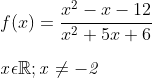 |
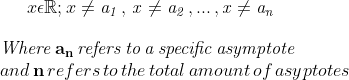
This means that {eq}x {/eq} is an element of all rational numbers, except for -2. The general formula for writing the domain of a rational function is as follows:
 |
- Find the vertical asymptotes of the function {eq}f(x)=\frac{x+2}{x^{2}+2x-8} {/eq} and determine its domain.
 |
The function does not exist for the values where {eq}x=2 {/eq} and {eq}x=-4 {/eq}, but it does exist for every other value that {eq}x {/eq} can take. The domain can thus be defined as {eq}x\epsilon \mathbb{R}\,;\,x\neq 2\,and\,x\neq-4 {/eq}
- Find the vertical asymptote and domain of the function {eq}f(x)=\frac{x^{3}-8}{x^{2}+9} {/eq}
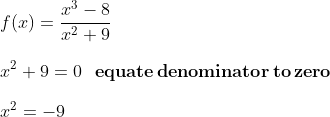 |
Since {eq}x^{2}=-9 {/eq} does not have an answer, it can be concluded that no value of {eq}x {/eq} will result in the denominator becoming zero. This function does, thus, not have any asymptotes. As such, the domain is defined as {eq}x\epsilon \mathbb{R} {/eq}
- Find the vertical asymptotes and domain of the function {eq}f(x)=\frac{x^{3}-8}{x^{2}+x-6} {/eq}
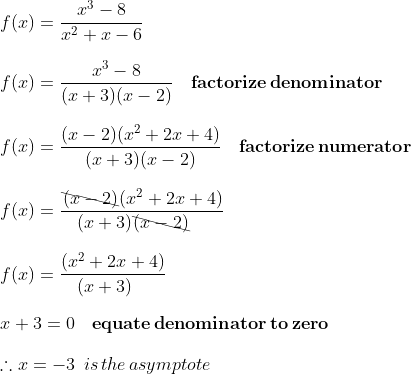 |
This is an example where all three steps were used. The function exists for all values of {eq}x {/eq}, except where {eq}x=-3 {/eq}. The domain is thus {eq}x\epsilon \mathbb{R}\,;\,x\neq -3 {/eq}
It has been shown that rational functions can have multiple vertical asymptotes. Visually, vertical asymptotes are portrayed as dotted lines on the graph of a specific function.
 |
Vertical asymptotes occur where the function is not defined, so they can be identified graphically as points where the graph seems to have a discontinuity. This means that there is a break in the graph, and the function looks different before and after the asymptote.
The main difference between vertical and horizontal asymptotes relates to their impacts on the domain and range of a function. The vertical asymptote enforces restrictions on the domain of a function (where it exists on the x-axis). In contrast, the horizontal asymptote puts limits on the range of a function (where it can exist on the y-axis). This can be seen most starkly in an exponential function, as the function is not able to move below its horizontal asymptote.
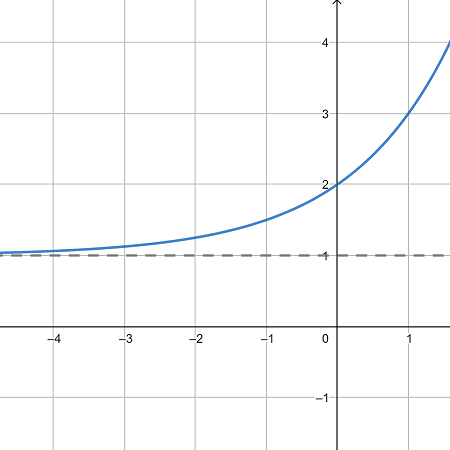 |
In the image, it can be seen that the graph has a horizontal asymptote at {eq}y=1 {/eq}. Sometimes a horizontal asymptote limits the height of a graph. A horizontal asymptote can also be approached by a function from both the bottom and the top. It will never be touched by the function. Horizontal asymptotes generally follow the same rules as vertical asymptotes, but this is instead applied to where the function exists on the y-axis in place of the x-axis.
Some functions have horizontal and vertical asymptotes. The most well-known function of this variety is the hyperbola.
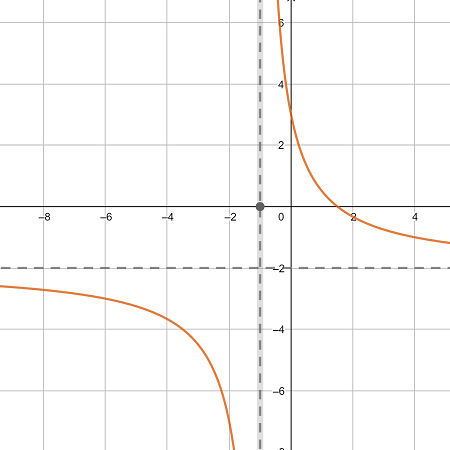 |
It can be seen that the function has a vertical asymptote at {eq}x=-1 {/eq} and a horizontal asymptote at {eq}y=-2 {/eq} . Note how the function moves parallel to both the horizontal and vertical asymptotes, but never quite touches. Vertical and horizontal asymptotes are essentially the same restrictions but applied to different variables of a function.
Vertical asymptotes can be defined as the x-values that will result in a function being undefined. A function will tend to either positive or negative infinity when approaching an asymptote. Functions can approach asymptotes from either direction. A function will never touch the asymptote but it will come very close. Functions that consist of polynomials in the numerator and denominator are called rational functions.
Finding the vertical asymptotes of a particular rational function entails: factorizing the denominator and numerator polynomials, dividing out common factors, equating the remaining denominator to zero, and solving for x. The domain of a rational function consists of all real values, minus the asymptotes.
Asymptotes are graphically represented as dotted lines, and they occur where there is a discontinuity in the graph of a function. Horizontal asymptotes limit the range of a function, whilst vertical asymptotes only affect the domain of a function. This means that the horizontal asymptote limits how low or high a graph can move, or for which y-values it is defined. Some functions have both horizontal and vertical asymptotes.
Video Transcript
What Are Vertical Asymptotes?
Vertical asymptotes are invisible vertical lines that certain functions approach, yet do not cross, when the function is graphed. When you graph some mathematical functions, you will see that the resultant curve avoids certain invisible lines in the graph. No matter what, you can't get the graph to cross those lines. Let me show you what it looks like.
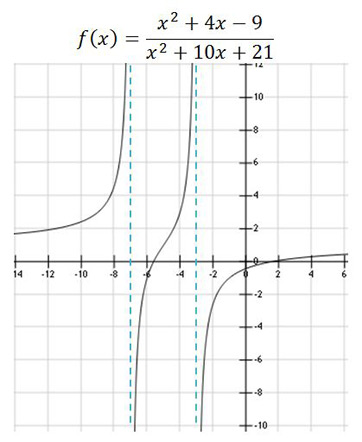 |
The dashed lines have been drawn in to show you where the vertical asymptotes are. Do you see how the graph avoids those areas?
Rules
There are some rules that vertical asymptotes follow.
- The graph tends to either positive or negative infinity as it gets closer to the vertical asymptote. Look at the graph and notice how the curve goes either all the way up or all the way down as it nears the asymptote.
- The distance between the asymptote and the graph tends to zero as the graph gets closer to the asymptote. The graph and the asymptote will seem to almost merge together at the tips, but the curve will never actually touch the asymptote. It is as if the vertical asymptote had a protective field around it preventing anything from touching or crossing it.
- The graph can approach the vertical asymptote from either direction, from either the right or the left. Look at the graph and see how the graph approaches from both directions. Some functions only approach from only one direction, but like our function, others can approach from both.
Functions
The function that we graphed is somewhat complex and is called a rational function. In this lesson, we will focus on the vertical asymptotes of rational functions. There are other functions that also produce vertical asymptotes, but rational functions are the most common.
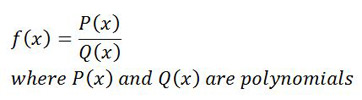
A rational function is a function whose numerator and denominator are made up of polynomials. The general form of a rational function is the following.
 |
Here are some examples of rational functions.
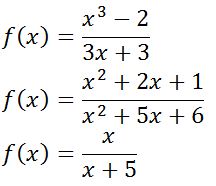 |
All of the above are fractions where both the numerator and denominator are polynomials. Because of this, this type of function makes it easy for you to find the vertical asymptotes.
Determining Vertical Asymptotes
To determine the vertical asymptotes of a rational function, all you need to do is to set the denominator equal to zero and solve. Vertical asymptotes occur where the denominator is zero. Remember, division by zero is a no-no. Because you can't have division by zero, the resultant graph thus avoids those areas.
Let's go back to our first function and see if we can find the vertical asymptotes.
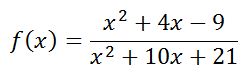 |
To find the vertical asymptotes, you need to set the denominator equal to zero and solve. Let's see what we get when we do that. We would use factoring to solve.
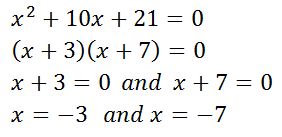 |
We have found that our zeroes for our denominator are -3 and -7. Now, look at the graph to see if that is where my vertical asymptotes are. Yep, looks like it. The graph avoids the lines at x=-3 and x=-7.
There is one circumstance where a zero in the denominator does not produce a vertical asymptote. This is when you have the same zero in the numerator. So, what this means is that you would want to solve both the numerator and denominator for zero. If they have an answer in common, then that number is not a vertical asymptote. Let's see what that looks like. The following function has already been factored, so you can easily see your zeroes.
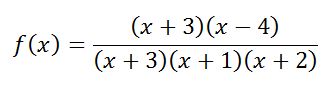 |
Looking at this function, we see that the vertical asymptotes are -3, -1, and -2 from solving the denominator for zero. But, solving the numerator for zero, we see that the numerator has zeroes of -3 and 4. They both have a -3, so that means the vertical asymptote at -3 is canceled by the -3 zero in the numerator. So, my actual asymptotes are only x=-1 and x=-2.
Lesson Summary
To recap, a vertical asymptote is an invisible line which the graph never touches. The graph will approach this line, but it won't dare touch or cross it. The graph can approach this asymptote from either direction - or both. To find the asymptote of rational functions, you solve the denominator for zero. All the zeroes of the denominator are vertical asymptotes, except in the case where the same zero occurs in the numerator.
Register to view this lesson
Unlock your education
Become a Study.com member and start learning now.
Become a memberAlready a member? Log in
Go backResources created by teachers for teachers
I would definitely recommend Study.com to my colleagues. It’s like a teacher waved a magic wand and did the work for me. I feel like it’s a lifeline.
