
Learn about hyperbolic geometry, also known as Lobachevskian geometry. Understand hyperbolic geometry applications and how it is different from Euclidean geometry.
Hyperbolic Geometry | Overview & Applications
Table of Contents
Show
Frequently Asked Questions
What is hyperbolic geometry used for?
Hyperbolic geometry describes the properties of surfaces with negative curvature, which are saddle-shaped. These surfaces appear in the theory of relativity because of the curvature of space-time caused by mass.
What are characteristics of hyperbolic geometry?
Hyperbolic geometry is distinct from Euclidean geometry because it violates the parallel postulate. Given a line and a point, there are at least two non-intersecting lines through that point. Consequences include parallel lines not being always equidistant, and interior angles within triangles do not add to 180 degrees.
Table of Contents
ShowGeometry is the branch of mathematics that deals with the study of space, which covers questions about distance, size, shape, area, volume, and more. Geometry is one of the oldest fields of mathematical study. Some geometric principles with practical applications in surveying or construction were developed in various ancient civilizations, including Egypt and Babylonia. However, the field was revolutionized around 300 BC by a Greek mathematician, Euclid, and his famous textbook, Elements. Euclid's methods for organizing mathematical knowledge and constructing logical arguments are foundational to all of modern mathematics.
Euclid's approach was to formulate a series of fundamental axioms, which are basic statements that express unquestionable, common-sense truths about physical space. From these beginnings, he proceeded to deduce more complex results through logical reasoning. Statements that can be proved in this way are referred to as propositions, or theorems. Euclid defined points and straight lines as geometric objects, and postulated five axioms for two-dimensional geometry:
- A line can be constructed between any two points
- Any line segment can be extended indefinitely
- A circle can be constructed for any given center and radius
- All right angles are equal
- The parallel postulate, which means that given a line and a point not on it, there is a unique line through the point that does not intersect the line.
 |
The parallel postulate is much more complicated than the other, more intuitive axioms. For two thousand years, it was assumed that the statement must in fact be a theorem that could be somehow proved from the first four axioms, and that Euclid included it as an axiom only because he had been unable to prove it himself.
Finally, in the 19th century, it was realized that the parallel postulate could be modified to create other, different kinds of geometry that still allowed mathematicians to prove logically consistent theorems. Henceforth, the system based on the five original axioms was known as Euclidean geometry, and systems using a modified version of the parallel postulate were called non-Euclidean.
One alternative to the parallel postulate was imagined by a Russian mathematician, Nikolai Lobachevsky (1792-1856), and went as follows:
- Given a line and a point not on it, there are at least two lines through the point that do not intersect the line.
This replacement of the parallel postulate defines a non-Euclidean system, known as Lobachevskian geometry, in honor of its discoverer. It is also called hyperbolic geometry, to describe the properties of lines on the surface of hyperbolic shapes. A hyperbolic surface is one which has negative curvature, meaning the surface curves away from itself at every point. Hyperbolic surfaces are saddle-shaped objects. An at-home example can be created by bending opposite corners of a flat sheet of paper upwards, and the other pair of corners downwards.
Euclidean and Hyperbolic Geometry
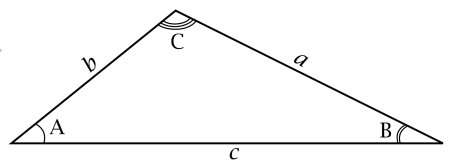
For millennia, Euclidean geometry was assumed to be the only type of geometry because it so effectively describes phenomena in the real world. Many properties of geometric figures, such as triangles, can be proved from Euclid's axioms, as well as measured empirically. For example, it is well-known that the sum of the angles in any triangle must be equal to exactly 180 degrees:
$$\angle A + \angle B + \angle C = 180^\circ $$
 |
Hyperbolic geometry is based on four of Euclid's five axioms, but violates the parallel postulate. The foundational principles of the two geometries, thus, largely overlap, and many Euclidean propositions remain true in hyperbolic geometry. For example, the statement that two lines can intersect once, at most, is still true in hyperbolic geometry. However, the replacement of the parallel postulate in hyperbolic geometry can produce other counter-intuitive results that are quite different from the familiar Euclidean theorems.
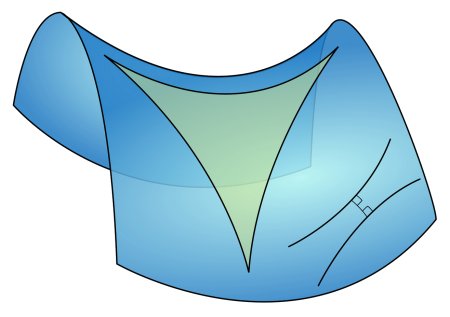
A consequence of the parallel postulate is a simple fact about pairs of parallel lines; the distance between them remains constant, no matter how far the lines are extended. However, this is no longer the case in hyperbolic geometry. Since hyperbolic surfaces are curved, two line segments that are initially parallel will begin to diverge from one another the farther the lines are extended.
Likewise, many properties of triangles differ in hyperbolic geometry versus Euclidean geometry. The angles in a hyperbolic triangle do not add up to 180 degrees, but will total something less:
$$\angle A + \angle B + \angle C < 180^\circ $$
Once again, this is a consequence of the underlying curvature of hyperbolic spaces. The diagram illustrates these two facts about parallel lines and triangles on a hyperbolic surface. An at-home demonstration can be made by drawing lines and triangles on a flat paper, or other flexible surface, then deforming the surface as described above to create a saddle-shaped object. Figures drawn on the surface will be distorted and have different geometric properties.
 |
Another non-Euclidean geometry, called elliptic geometry, replaces the parallel postulate with the statement that there are no non-intersecting lines at all. This describes the behavior of lines on a spherical surface; think of how longitude lines on the Earth all intersect at the poles. Hyperbolic and elliptic geometry are, thus, not only logically valid alternatives to Euclidean geometry, but each describe observable phenomena in certain settings.
Hyperbolic Geometry Applications
The discovery of non-Euclidean geometries raises a fundamental question: what is the geometry of the universe itself? While Euclidean geometry seems to best describe our experience of the world, in most cases, the surface of the Earth seems essentially flat, though of course it is curved and follows elliptic geometry instead. Lobachevsky himself tried to measure the curvature of the universe, without success.
Cosmologists have attempted to calculate the curvature of the universe, and to determine whether if the universe is flat (Euclidean), spherical, or hyperbolic, by measuring the density of mass and energy within it. This question has other significant consequences. For example, a spherical universe must be finite, while a flat or hyperbolic one could be infinite in size. To a high degree of accuracy, scientists have found that the curvature of the universe is close to zero. This means that the universe can at least be approximated very closely by Euclidean space.
The modern understanding of the force of gravity is based on Einstein's theory of relativity, which states that mass causes curvature in space, or rather, in four-dimensional space-time. This is a local effect around massive objects, such as stars and planets, and separate from the question of the curvature of the universe as a whole. In any case, because of the curvature of space, non-Euclidean geometry is necessary to understand the physics of celestial bodies.
Just as two-dimensional maps distort the features of the spherical Earth, it is not possible to perfectly represent a hyperbolic surface within Euclidean three-dimensional space. Interestingly, close approximations of hyperbolic surfaces appear in nature, in the folded, crinkled shapes of lettuce leaves, or coral reefs. This is thought to be due to such surfaces maximizing the amount of surface area available for absorbing sunlight and nutrients.
While our experience of the world is largely Euclidean, these examples show how hyperbolic geometry appears in unexpected places.

Your next lesson will play in
10 seconds
Geometry is the mathematical study of space. The principles of the field were formalized by the ancient Greek mathematician, Euclid, who formulated basic axioms that could be used to prove more complex theorems. Euclid's system of logical reasoning remains the basis for modern mathematics. Using the basic geometric objects of points and lines, Euclid postulated five axioms, which are the foundation for what is now known as Euclidean geometry. Four of the axioms are very simple and intuitive, but the parallel postulate is not. According to this axiom, given a line and a point, exactly one non-intersecting line can be drawn through the point. In the 19th century, it was realized that non-Euclidean geometries that violated the parallel postulate were equally valid.
Hyperbolic geometry, also known as Lobachevskian geometry, replaces the parallel postulate with the statement that two or more non-intersecting lines can be drawn through the point. This geometry describes the properties on hyperbolic surfaces, which have negative curvature and are saddle-shaped. On these surfaces, many geometric theorems have different outcomes than in Euclidean geometry. For example, the sum of the interior angles in a triangle will be less than 180 degrees, and not equal. Hyperbolic geometry is important for the study of cosmology and Einstein's theory of relativity. Elliptic geometry is the other form of non-Euclidean geometry, and describes spherical surfaces.
Geometry is the mathematical study of space. The principles of the field were formalized by the ancient Greek mathematician, Euclid, who formulated basic axioms that could be used to prove more complex theorems. Euclid's system of logical reasoning remains the basis for modern mathematics. Using the basic geometric objects of points and lines, Euclid postulated five axioms, which are the foundation for what is now known as Euclidean geometry. Four of the axioms are very simple and intuitive, but the parallel postulate is not. According to this axiom, given a line and a point, exactly one non-intersecting line can be drawn through the point. In the 19th century, it was realized that non-Euclidean geometries that violated the parallel postulate were equally valid.
Hyperbolic geometry, also known as Lobachevskian geometry, replaces the parallel postulate with the statement that two or more non-intersecting lines can be drawn through the point. This geometry describes the properties on hyperbolic surfaces, which have negative curvature and are saddle-shaped. On these surfaces, many geometric theorems have different outcomes than in Euclidean geometry. For example, the sum of the interior angles in a triangle will be less than 180 degrees, and not equal. Hyperbolic geometry is important for the study of cosmology and Einstein's theory of relativity. Elliptic geometry is the other form of non-Euclidean geometry, and describes spherical surfaces.
Video Transcript
The History of Geometry
A little over 2,000 years ago, a Greek mathematician named Euclid first wrote down the set of definitions and axioms that we now know as geometry. In Euclid's geometry, he assumed that all surfaces were flat, and he worked out relationships between lines and angles on flat surfaces. Even today, Euclidean geometry is used to understand the geometry of shapes on two-dimensional flat surfaces.
Of course, we know that not all surfaces are flat. What happens to Euclidean geometry when you try to apply it to a curved surface? Some things may still be the same, but some postulates of Euclidean geometry will not be true anymore. For example, consider the parallel postulate of Euclidean geometry. The parallel postulate says that if you have a line and a point outside the line, it's possible to draw only one line that will go through the point and also be parallel to the first line.
What Is Hyperbolic Geometry?
While the parallel postulate is certainly true on a flat surface like a piece of paper, think about what would happen if you tried to apply the parallel postulate to a surface such as this:
 |
This shape is technically known as a hyperbolic paraboloid, but it's commonly known as saddle shaped. On a saddle-shaped surface like this, lines will never be straight because the surface is curved. Therefore, Euclid's parallel postulate is not true on this surface because you can draw multiple lines through a single point, and they will still never cross the original line.
Any geometrical system in which the parallel postulate is violated is called a non-Euclidean geometry. The geometry of saddle-shaped surfaces like this is one type of non-Euclidean geometry known as hyperbolic geometry.
Hyperbolic Geometry Postulates
In many ways, hyperbolic geometry is very similar to standard Euclidean geometry. However, there are a few key postulates that differentiate it. We have already seen that the parallel postulate is different. In hyperbolic geometry, it's possible to have two or more lines drawn through a single point that are all parallel to some other line.
As a result of the curvature of the hyperbolic surfaces, it's also true that triangles drawn on a surface like this will always have interior angles that add up to less than 180 degrees, like in the image you're looking at on screen right now. This is different from Euclidean geometry, where the interior angles of any triangle always add up to exactly 180 degrees.
 |
The area of a shape drawn on a hyperbolic surface will also be different than it would be if the same shape were drawn on a flat surface. For example, the area of a triangle drawn on a hyperbolic surface will have a smaller area than the corresponding triangle drawn on a flat surface.
Hyperbolic Geometry Applications
Hyperbolic geometry was first developed in the 1800s by mathematicians who were trying to prove the parallel postulate using the other postulates of Euclidean geometry. They didn't manage to do that, but their efforts led to the invention of a new kind of geometry.
Since then, mathematicians have continued to study hyperbolic geometry. In addition to the purely mathematical applications of hyperbolic geometry, it has also proven to be particularly useful in understanding gravity and special relativity.
Lesson Summary
Any geometrical system in which the parallel postulate is violated is called a non-Euclidean geometry. The geometry of saddle-shaped surfaces is one type of non-Euclidean geometry known as hyperbolic geometry. Hyperbolic geometry violates Euclid's parallel postulate but not the other postulates of Euclidean geometry. On hyperbolic surfaces, the sum of the interior angles of a triangle is always less than 180 degrees, and shapes will have a different area when drawn on a hyperbolic surface versus a flat surface.
Register to view this lesson
Are you a student or a teacher?
Unlock Your Education
See for yourself why 30 million people use Study.com
Become a Study.com member and start learning now.
Become a MemberAlready a member? Log In
BackResources created by teachers for teachers
Over 30,000 video lessons
& teaching resources‐all
in one place.


I would definitely recommend Study.com to my colleagues. It’s like a teacher waved a magic wand and did the work for me. I feel like it’s a lifeline.
Jennifer B.
Teacher

Back

Hyperbolic Geometry | Overview & Applications Related Study Materials
Explore our library of over 88,000 lessons
Browse by subject