
Learn about the Persian Empire, its people, history, and its importance in world history. Discover the geography and extent of the Persian Empire with a map.
Persian Empire People, Map & History
Table of Contents
Show
Frequently Asked Questions
Why is Persia now called Iran?
Persia is now called Iran because that is where it started. The Persian Empire began in the Iranian Peninsula in 550 BCE.
What country is Persia today?
Persia began in the Iranian peninsula and encompassed the areas of present-day Iran, Egypt, and Turkey as well as parts of Afghanistan and Pakistan. When people think of Persia today, they usually think of Iran.
Who destroyed Persian Empire?
The decline of the Persian Empire started with Xerxes I. It wasn't until Alexander the Great, though, that the empire was defeated and destroyed.
Table of Contents
ShowThe Persian Empire lasted from approximately 559 B.C.E. to 330 B.C.E. It started as various semi-nomadic tribes in the area that is modern-day Iran. A leader of one of those tribes began to defeat nearby kingdoms and unite them under one rule. He started the first Persian Empire, known as the Achaemenid Empire, in 550 B.C.E. This leader became known as Cyrus the Great. The following emperor of Persia, Cambyses II, reigned for a short time before dying from a wound. Darius the Great, who married the daughter of Cyrus, then became king.
Darius built the empire up to its greatest point. He was a conqueror and expanded the boundaries of the empire. Darius invaded Greece because he claimed the Greeks were encouraging rebellion in Persian territory. However, he was defeated by the Greeks. He set up provinces and governors throughout Persia to control different areas and created a postal service across the empire to improve communication. Under his son, Xerxes, the empire began to decline as the royal treasury was drained due to an unsuccessful war with Greece and irresponsible spending at home. In 334 B.C.E. the Persian Empire was conquered by the military genius Alexander the Great.
Your next lesson will play in
10 seconds
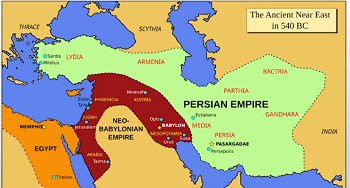
At the height of the empire, Persia encompassed the areas of present-day Iran, Egypt, and Turkey as well as parts of Afghanistan and Pakistan. It stretched from the Balkan Peninsula in the west to the Indus River Valley in the east. It stretched south to Egypt and north to the Caspian Sea where the Persian Empire was changed under the leadership of different emperors as they conquered and lost lands. The map shows ancient Persia at its height.
 |
Below is a timeline of Persian history, showing the important events that happened during the life of the Persian Empire.
- 550 BCE - Cyrus the Great establishes the Achaemenid Empire after defeating the Median capital.
- 559 BCE - The Neo-Babylonian Empire falls as Cyrus conquers the capital city of Babylon.
- 530 BCE - Cyrus the Great dies and his son, Cambyses II, become emperor.
- 522 BCE - Cambyses II dies from a wound in his thigh. Darius the Great becomes emperor less than a year later.
- 499-493 BCE - The Ionian Revolt takes place where several areas revolt against Persia.
- 490 BCE - Darius attacks Greece, but is defeated.
- 456 BCE - Darius dies and his son Xerxes I become emperor.
- 480 - 466 BCE - Xerxes attacks Greece and destroys the city of Athens. He is later defeated by the Greeks at Salamis. Several Persian territories begin to revolt. Persia is eventually defeated by Greece and its allies.
- 465 BCE - Xerxes I is assassinated and his son Artaxerxes takes the throne.
- 449 BCE - A peace deal is reached between Athen (Greece), Argos, and Persia
- 424 BCE - Artaxerxes dies at Susa and his son Xerxes II becomes king. That same year, his brother Sogdianus assassinates Xerxes II. Six months later, Sogdianus is killed by his half-brother Darius II, who takes the throne.
- 412 BCE - Darius II becomes ill and dies. His son Artaxerxes II becomes emperor.
- 373 BCE - Artaxerxes II loses control of Egypt when it revolts.
- 358 BCE - Artaxerxes II dies and is succeeded by his son Artaxerxes III.
- 340 BCE - Persia reconquers Egypt.
- 338 BCE - Artaxerxes III is poisoned by a Persian official and his youngest son Artaxerxes IV becomes king.
- 336 BCE - Artaxerxes IV is poisoned by his chief vizier and Darius III, a cousin, takes the throne.
- 334 - 330 BCE - Persia is defeated by Alexander the Great, bringing an end to the Persian Empire.
The Persian Empire was one of the most advanced societies of its time. They were the first to develop regular routes between three different continents - Asia, Africa, and Europe. A vast postal service and communication network was set up to send messages across the large empire. The Persian people created many different art forms that included metalwork, rock carvings, weaving, and architecture and incorporated different styles from the various cultures as they were conquered and added to the empire.
The main religion throughout the empire was Zoroastrianism, which encouraged the worship of one god instead of the many gods worshipped by most of the religions in the area at that time. The kings were devoted to this religion, but many of them, including Cyrus the Great, allowed the people to continue to practice their own religion instead of imposing Zoroastrianism on them.
Cyrus the Great and many of the emperors that followed (though not all of them) were lenient leaders who allowed life to continue as normal for the conquered kingdoms. The conquered ruler was allowed to stay in power as long as he bowed to the emperor's authority and paid taxes. Satraps or governors, were the king's representatives in each province. They worked for the king to collect taxes, raise a military, and participate in any military campaigns.
A social hierarchy existed within the empire. At the top, of course, was the king and his family followed by the priests and nobles. Military commanders came next, with merchants and artisans just below them. At the bottom were the peasants and slaves. The peasants were mostly farmers and laborers. Peasants could own their own land. They farmed or raised animals, worked on the king's projects, and joined the military as soldiers or support personnel when called upon. Slaves were treated more as paid servants, receiving compensation for their work, shelter, and clothing. Darius I even made it a crime for a master to mistreat their slave.
Men and women had equal roles within the empire. They often worked the same jobs and received the same pay. Women were highly respected and served as supervisors, conducted business, owned land, and could serve in the military.
Persians enjoyed sports such as archery, boxing, fencing, horsemanship, hunting, polo, javelin-throwing, swimming, and wrestling. Both boys and girls from all classes of society were encouraged to participate in sports. In their free time, Persians enjoyed board games, banquets, music, mime, dance, and storytelling.
The Persian Empire lasted from approximately 559 B.C.E. to 330 B.C.E. It started as various semi-nomadic tribes in the area that is modern-day Iran. Cyrus the Great joined the tribes and started the Achaemenid Empire in 550 B.C.E. Darius the Great became king soon after Cyrus and was a conqueror. He claimed the Greeks were inciting rebellion in Persian territories, so attacked. He was unsuccessful in defeating Greece, as was his son Xerxes I in later years. The Persian Empire during its prime stretched from the Balkan Peninsula in the west to the Indus River in the east, from Egypt in the south to the Caspian Sea in the north. Several emperors ruled over the Persian Empire until the military genius Alexander the Great brought an end to the empire around 330 BCE.
The Persian Empire was made of several provinces that were led by the conquered kings, as long as they remained loyal to the emperor and paid taxes. Life for conquered nations remained very much the same since many emperors allowed customs and cultures to continue. For example, Zoroastrianism (which focused on worshipping one god) was the religion of the Persian kings, but conquered peoples were allowed to continue their own religious practices. A social hierarchy existed with the emperor at the top and peasants and slaves at the bottom. Peasants were allowed to own their own land, though, and slaves were treated more as hired servants and could not be mistreated by their owners. Men and women had equal roles in society with women being able to work any job, enjoying equal pay, and being highly respected. Persians enjoyed many sports and hobbies in their leisure time.
Video Transcript
Empires
Over the course of centuries, groups of people have developed ways of living together. These groups have evolved from small farming communities to large cities, complete with governments, social groups, activities, and religion. In an ideal world, these cities would live peacefully together, but humanity is not perfect. Some communities have sought to expand for money, power, or both, and through invasion or diplomacy have taken over multiple cities and states, forming what is known as an empire.
In this lesson, we will explore the historical Persian Empire, an empire in Asia Minor from about 559 B.C. to around 331 B.C. ruled by the Achaemenids, and discover the characteristics of the empire and area that it controlled.
Persian Empire
Historically, the term ''Persian'' refers to a group of people that originated in a region of what is today Iran. The word ''Persia'' was first used to describe an ethnic group called the Achaemenids around Lake Urmia in the 9th century BC. In the mid-7th century, these people moved south and established their own independently-controlled territory in what is today southern Iran. The Achaemenids spent the next century vying for regional power as a tributary state of the Median Empire until the rule of Cyrus the Great. A tributary state is one that owes ''tribute,'' usually in the form of money or goods, to a more powerful state in order for protection.
Cyrus the Great
In the mid-6th century, Cyrus defeated the Medians and conquered their empire, making the Achaemenids the premier power in the region. He consolidated his forces with the Medians and captured more territory east and west, taking the famed ancient city of Babylon in 539 B.C.
At Cyrus' death, the Achaemenids ruled vast stretches of the Middle and Near East. Their empire stretched from the Indus River in the east (in modern Pakistan), stretched south and east to the Persian Gulf, and north to the Caspian Sea. It stretched into the Middle East, controlling territory now parts of the modern states of Iraq, Armenia, and even eastern Turkey. His successors continued expanding the Empire, conquering Egypt and as far east as parts of modern Pakistan and India.
 |
Darius I and Xerxes
Under Darius I, the Persians invaded ancient Greece in the early 5th century B.C. Despite having a much larger force, the Persians were defeated by the Athenians at the Battle of Marathon. Darius' son, Xerxes, attempted to avenge his father's defeat with another invasion in 480 B.C., which included the costly victory against the Spartans and Athenians at Thermopylae. The following year, the Persians were defeated on land and sea, and Plataea and Salamis respectively, and the Persian Empire grew no further.
Governance and Decline
The Persian Empire was one of the more advanced empires of its time. Not only did it cover an enormous expanse of land, from the Indus River to Egypt and southern Europe, but it was also well organized. The Achaemenids organized their vast territorial holdings into provinces, each of which were administered by governors appointed by the emperor.
Despite the Achaemenid rulers' ability to hold together vast amounts of land, soon the Persian Empire began a slow decline, especially after Xerxes' failed invasion of Greece. Xerxes himself was assassinated by one of his own overzealous generals in 465 B.C., ushering in a long period of decline characterized by rebellion and internal conflict. Alexander the Great took advantage of this weakened state and invaded Asia Minor in 334 B.C. In less than a decade, Alexander virtually wiped the Persian Empire off the map.
Lesson Summary
The Persian Empire was an enormous, advanced state that began and was based in the modern nation of Iran. The Persians rose to prominence under Cyrus the Great, a ruler of the Achaemenids, an ethnic group that lived near Lake Urmia in the 9th century B.C.. They began as a tributary state, an area that owes ''tribute,'' usually in the form of money or goods, to a more powerful state in order for protection, but defeated their regional rival the Median Empire and conquered Babylon.
Cyrus' successors conquered further east and west, reaching as far as modern India and Egypt. Other rulers like Darius I and his son, Xerxes, were unable to conquer Greece, and soon after their failure, the Persian Empire began to slowly decline due to rebellion and internal dissension. It was defeated and destroyed quickly in the 4th century by the invading army of Alexander the Great.
Register to view this lesson
Are you a student or a teacher?
Unlock Your Education
See for yourself why 30 million people use Study.com
Become a Study.com member and start learning now.
Become a MemberAlready a member? Log In
BackResources created by teachers for teachers
Over 30,000 video lessons
& teaching resources‐all
in one place.


I would definitely recommend Study.com to my colleagues. It’s like a teacher waved a magic wand and did the work for me. I feel like it’s a lifeline.
Jennifer B.
Teacher

Back

Persian Empire People, Map & History Related Study Materials
Explore our library of over 88,000 lessons
Browse by subject