Amelia has been tutoring high school students in ACT and SAT prep for 11+ years and she has helped multiple students earn acceptance to their top choice schools.
Comma & FANBOYS to Separate Independent Clauses | Study.com ACT® English Test Prep
Table of Contents
- Comma & FANBOYS to Separate Independent Clauses
- Comma & FANBOYS to Separate Independent Clauses Example 1
- Comma & FANBOYS to Separate Independent Clauses Example 2
- Lesson Summary
Welcome to our lesson on Comma Rule #2! Comma Rule #2 states that you must use a comma and a FANBOYS conjunction to connect two independent clauses. This is a heavily-tested rule on the ACT.
It's really important to emphasize that you can't just use a comma by itself when connecting two independent clauses. That FANBOYS conjunction is a necessity if you want to use a comma to connect two independent clauses.
Now, many students forget what FANBOYS conjunctions actually are. Let's take a look at those now.
Here are the FANBOYS conjunctions:
for, and, nor, but, or, yet, so
I highly recommend that students write these down in their notes and make sure they have them memorized for test day.
It's also important to remember what an independent clause actually is. An independent clause expresses a complete idea, and it stands alone as a sentence. That's why, when reviewing comma rules, students should be sure that they are familiar with what an independent clause is, as well as a dependent clause.
Ready to apply this rule to a sample question? Let's take a look at our first example.
![]() |
Here is example #1. The first thing that we want to do whenever we see a comma question is to take a look at the answer choices to identify what's changing between them.
When we look at our answer choices, we see a couple of things. I see a comma and a semicolon; I also see several FANBOYS conjunctions: ''and'' and ''so.''
Next, I'm going to make sure that I know the full context; that means reading the full sentence, not just the underlined portion. Let's do that now.
''The color blue is associated with tranquility and psychological resource facilities like counseling centers and rehabilitation organizations often use blue paint in their decor.''
Now, something that is difficult about this question is the type of conjunction that we are using to join these ideas. Notice how ''and,'' ''so,'' and ''therefore'' all have very different connotations.
''And'' suggests that we have similar ideas.
''So'' and ''therefore'' suggest a conclusion of some kind.
We need to make sure that we are applying proper punctuation and we have a sense of the appropriate connection word between these ideas.
When we look on the left-hand side, we see that ''The color blue is associated with tranquility'' is a complete sentence; it's an independent clause.
The same goes for the sentence on the right: ''psychological resource facilities like counseling centers and rehabilitation organizations often use blue paint in their decor.'' So we know that when we have two independent clauses, we need to join them with a comma and a FANBOYS conjunction.
The only answer choice that does this is B, but let's talk about why B is our best choice. It demonstrates appropriate punctuation (a comma and a FANBOYS), but it also reflects the appropriate relationship between the ideas. Basically that because blue is a tranquil color, these organizations use blue colored paint in their decor. ''So'' is a word that shows cause and effect or conclusion. That's why B is our best answer choice.
Now notice that there is a FANBOYS conjunction in C, but there's a semicolon in front of it. That doesn't follow Comma Rule #2, so we can cross that off.
A and D do not have any punctuation separating these two ideas, so we need to cross those off as well.
Great work! Are you ready to apply Comma Rule #2 on your own? Let's dive in!
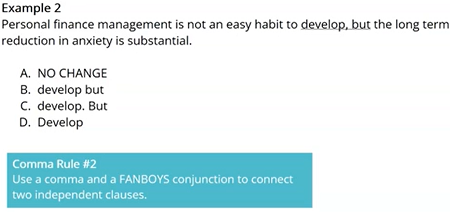
Here is your second example:
![]() |
How'd you do? Let's take a look.
The first thing that we want to do is pay attention to our answer choices. When we do that, we see a lot of different options of punctuation. We see a comma in the ''NO CHANGE'' option, and no punctuation in B, a period in C, and an entirely different option in D where we just have one word. Let's go ahead and read our full context:
''Personal finance management is not an easy habit to develop, but the long term reduction in anxiety is substantial.''
When we look at both sides of the comma here, we notice that we have an independent clause on the left (''Personal finance management is not an easy habit to develop'') and on the right (''the long term reduction in anxiety is substantial'').
![]() |
You'll notice that I did this same thing in the prior example. This is what I like to call the vertical line test. Basically, it means to draw a line between the two sentences to more easily help you determine what types of clauses you are dealing with.
On the left, we have an independent clause and on the right, we also have an independent clause. We know that we can use a comma and a FANBOYS conjunction to connect two independent clauses.
The only option that shows that would be A. We have a comma and the FANBOYS conjunction ''but.''
Now, looking at our other answer choices, we see that they use FANBOYS conjunctions but don't have the appropriate punctuation.
B has no punctuation, and C has a period.
D entirely removes the word ''but'' and just uses the word ''develop,'' but we need that word ''but'' to connect the two ideas, so we can cross that off. Excellent work!
Well done on our lesson on Comma Rule #2. In summary, Comma Rule #2 states that you must use a comma and a FANBOYS conjunction to connect two independent clauses. Remember that FANBOYS conjunctions are as follows:
for, and, nor, but, or, yet, so
You also can use the vertical line test to check for independent clauses. This means drawing a line wherever you see punctuation in the answer choices and assessing whether or not you have an independent clause on either side of that line.
Lastly, eliminate answer choices that don't use a comma and a FANBOYS conjunction to connect two independent clauses. Process of elimination is always your best friend. Great work!
Register to view this lesson
Unlock Your Education
Become a Study.com member and start learning now.
Become a MemberAlready a member? Log In
BackResources created by teachers for teachers
I would definitely recommend Study.com to my colleagues. It’s like a teacher waved a magic wand and did the work for me. I feel like it’s a lifeline.