Science Courses / Course

Soil's Chemical Composition & Environmental Effects

Lesson Transcript
Instructor Nicola McDougal

Nicky has taught a variety of chemistry courses at college level. Nicky has a PhD in Physical Chemistry.

Soil is one of the most important things for life to exist on earth. Its chemical composition and environmental effects are essential to understand if one truly wants to look at its importance. In this lesson, explore what soil is made of, the different types of soils, and some environmental problems with soil.

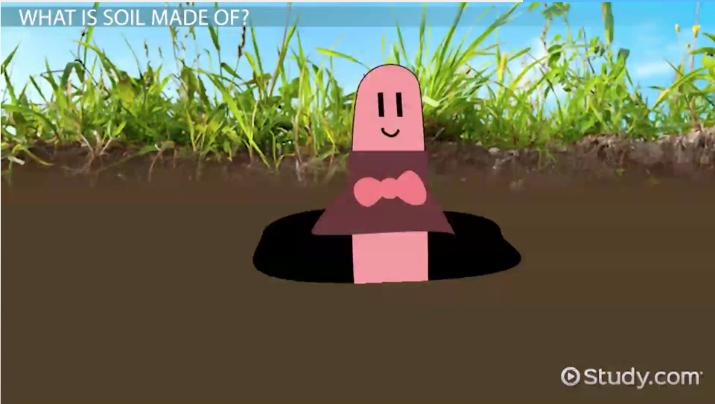
Hi! Meet Ursula. You may recognize that Ursula is a worm. She is an earthworm, and along with other creatures such as ants, woodlice and centipedes, she lives in the soil. Ursula is here to help us learn all about where she lives, what soil is made of and some of the problems her home can have. So, are you ready for our journey? Off we go!

An error occurred trying to load this video.

Try refreshing the page, or contact customer support.

Your next lesson will play in 10 seconds
  • 0:02 What Is Soil Made of?
  • 1:07 Different Types
  • 3:12 Environmental Problems
  • 5:48 Lesson Summary

Hang on, Ursula is trying to tell us something! Okay, Ursula, I haven't forgotten. She also needs to tell us that there are different types of soil. The different types depend on the kind of rock that made it, how much organic material is in it, and its texture. Each type of soil has different properties, and Ursula would like to tell us about different types of soil.

The first soil is called sandy soil. Sand is made of a chemical called silicon dioxide, or more commonly called quartz, and sandy soil is formed from big particles. Sandy soil is light and easy to dig, and many gardeners love it. But the big particle size means that water can pass through easily, and plants need regular watering.

Ursula has already told us that plants grow best in silty soil. This is because silty soil contains a good amount of available chemicals such as nitrogen (N), potassium (K) and phosphorus (P). Plants need these chemicals to grow. These chemicals are essential nutrients for plants. One important chemical property that affects how plants get these nutrients is soil pH. Soils with a pH of less than 7 are acidic; those with a pH of more than 7 are alkaline, or basic; and those with a pH that equals 7 are neutral. The words basic and alkaline mean pretty much the same thing. Soil pH is very important because these nutrients are only available at certain pH values. Nitrogen, for example, is available to plants at a pH greater than 5, and phosphorus is only available between pH 6 and 7.

It is for this reason that most plants do really well in neutral or slightly acidic soils. Hopefully you can see why chalky soils are so infertile. They are highly alkaline, so some of the essential nutrients are no longer available to the plants.

In this lesson, you have learned that soil is made up of weathered rock and organic materials such as dead animals and decomposing plants. It is essential for plants and animals and forms a thin layer on the Earth. The different types of soil depend on the rocks it is made from, the amount of organic material, and the texture of the soil. One type is sandy soil, which has a large particle size and does not retain water well. Silty soil is similar to sandy soil but with smaller particles and is considered the most fertile of soils, loved by gardeners everywhere. Clay soil is very heavy to work with and does not drain well. And finally, chalky soil is very infertile and does not retain water. Soil pH is an important chemical property that determines the availability of nutrients to plants. Most plants grow best in pH values between about 5.5 and 7.0. A significant polluter of soil is mining. Soils around previously mined areas often are contaminated by toxic metals. For this reason, food grown on contaminated soil should not be eaten.

soiltype

Getting to the end of this lesson with understanding of the above topics will enable you to:

Register to view this lesson

Are you a student or a teacher?

Unlock Your Education

See for yourself why 30 million people use Study.com

Become a Study.com member and start learning now.

Become a Member  Back

Resources created by teachers for teachers

Over 30,000 video lessons & teaching resources‐all in one place.
Video lessons
Quizzes & Worksheets
Classroom Integration
Lesson Plans

I would definitely recommend Study.com to my colleagues. It’s like a teacher waved a magic wand and did the work for me. I feel like it’s a lifeline.

Jennifer B.
Teacher
Jennifer B.
Create an account to start this course today
Used by over 30 million students worldwide
Create an account