
Learn about America as a world power. Examine when and how the USA became a superpower and discover the United States' influences around the world today.
United States as a World Power | History & Significance
Table of Contents
- United States of America as a World Power
- When did the USA Become a Superpower?
- How Did America Become a Superpower?
- Significance of America as a World Power
- Lesson Summary
Frequently Asked Questions
Is the US considered a world power?
The U.S. is a world power and is the strongest of them. Today, the U.S. has the strongest military and economy. However, other countries increasingly challenge it.
When did America become a world power?
The U.S. became a world power in 1898 when it seized control of the Spanish Empire. This allowed the U.S. to project its power across the planet.
Table of Contents
- United States of America as a World Power
- When did the USA Become a Superpower?
- How Did America Become a Superpower?
- Significance of America as a World Power
- Lesson Summary
Today, the United States of America is a world power: a country that holds significant influence over a large part of the planet. This influence comes in many forms; the United States holds economic, political, military, and cultural influence across the planet. Because of this influence, many have called the United States a superpower, a country with a dominant position over most other countries.
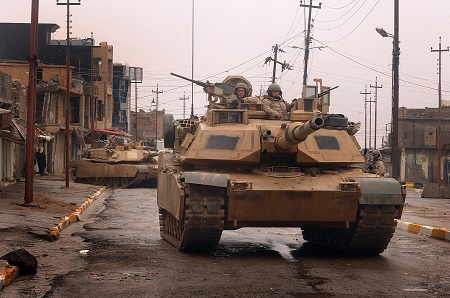
The United States is a world power and a superpower for many reasons. For one, the United States has the best-equipped and best-funded military on Earth. Unlike other countries, the U.S. can project its military power across the world through its large air force and navy. The U.S. spends more money on this than a few countries with the next best militaries combined, and the U.S. operates nearly half of the world's aircraft carriers. Economically, the United States has the greatest GDP (gross domestic product), and the U.S. dollar is the world's reserve currency. American culture is consumed worldwide, and English today is the world's lingua franca, largely due to American influence.
 |

Your next lesson will play in
10 seconds
The United States was first referred to as a superpower in 1944. After the destruction caused by the Second World War, the United States, Great Britain, and the Soviet Union were the world's strongest remaining countries. While the British Empire collapsed shortly after World War Two, the United States and USSR were locked in decades of competition across the planet known as the Cold War. In 1991, the USSR collapsed, leaving the U.S. the sole superpower.
However, it took the United States a long time to rise to this status. While the U.S. gained independence from Britain in 1783 following its Revolutionary War, it took the U.S. decades of expansion and economic development before it became a world power in 1898. That year, the U.S. fought the Spanish-American War and seized control of Spain's far-flung colonial empire. As a result, the Age of American Imperialism and the American Century began in the 20th century.
In 1783, the United States was a fragile country whose newly won independence was a war away from being lost. However, the American's conviction in Manifest Destiny would drive American leaders to expand the country. Manifest Destiny was the belief that God ordained the U.S. to control the whole continent and maximize its power.
Fledgling Power: 1783 and 1898
From its independence to 1898, the United States was a fledgling power. It was mainly concerned with expanding its border westward across the American continent. A fundamental aspect of this expansion was settler-colonialism, wherein Americans displaced or killed Native Americans, settled on their lands, and controlled them as part of America.
Throughout the second half of the 1800s, the U.S. went through the Industrial Revolution. The American economy switched from an economy primarily oriented to agriculture to one based on produced and manufactured goods and tools. This switch allowed the U.S. to make the equipment necessary to become a superpower.
- The Northwest Indian War (1786 to 1795): The U.S. waged war against the indigenous Northwest Confederacy, displacing Native Americans for white settlers in the modern-day Midwest.
- First Barbary War (1801 to 1805): First Barbary War (1801 to 1805): The U.S. and its allies launched an expedition to North Africa, destroying pirates who harassed American trade vessels.
- The Louisiana Purchase (1803): The U.S. purchased the vast and profitable Louisiana territory from France, increasing its size tremendously
- Tecumseh's War (1810 to 1813): The U.S. defeated Tecumseh, the leader of a Native American confederacy in modern-day Indiana; this opened the land to American settlers.
- Mexican-American War (1846 to 1848): After annexing Texas, the U.S. beat Mexico in war and annexed a vast swathe of land stretching to the Pacific Ocean; the status of slavery in these new lands would escalate domestic political conflicts.
- Perry Expedition (1853): A U.S. expedition to Japan forced the isolated country to open up to American trade.
- Sioux Wars (1854 to 1891): In a series of conflicts, the U.S. forced the Sioux tribes into reservations and opened up the west to American settlement.
- American Civil War (1861 to 1865): The U.S. fought a civil war over the status of slavery, resulting in the victory of northern states and the abolition of slavery.
- Spanish-American War (1898): The U.S. fought a victorious war against the crumbling Spanish Empire and made Puerto Rico and the distant islands of Guam and the Philippines colonies; Cuba was made a colony of the U.S. in all but name.
World Power: 1898 to 1945
After the United States seized the Spanish Empire, it now had a colonial empire through which it could project its power abroad. In the first half of the 1900s, the United States would focus on Asia and the Caribbean as new avenues to expand its political power. The World Wars, in which the U.S. cemented its alliance with Britain and France, also occurred during this period. Like Britain, the United States viewed itself in this period as a force for good in the world. Through armed interventions, the U.S. believed it could spread democracy and capitalism. At this point, the U.S. had the largest economy in the world and was the largest industrial producer.
- Philippine-American War (1899 to 1913): The U.S. imposed its colonial rule on the rebellious Philippines through war
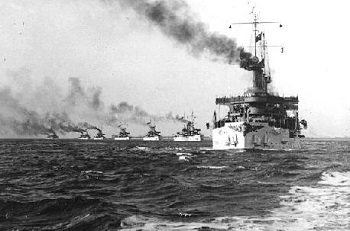
- The Great White Fleet (1907 to 1909): A fleet of U.S. ships traveled around the globe as part of a diplomatic mission and a show of American power.
- The Banana Wars (1899 to 1934): The U.S. occupied many Central American countries to impose regimes friendly to American economic interests.
- World War One (1917 to 1918): The U.S. joined World War One on the side of Britain and France, helping to defeat Germany. After the war, the U.S. helped negotiate the creation of the League of Nations, a diplomatic organization. However, the U.S. ultimately decided not to join itself as it did not wish to be subjected to international rule or pulled into another war.
- World War Two (1941 to 1945): After Japan launched a preemptive attack on the U.S., the U.S. joined Britain, France, and the USSR against Germany, Japan, and Italy. Throughout the war, the U.S. invested a tremendous amount in its army, attained the right to use British airbases across the world, committed itself to be a bulwark for democracy and capitalism across the world, and used nuclear weapons against Japan.
The Cold War: 1945 to 1991
After World War Two, the United States was unquestionably a superpower. It crafted a network of bases across the planet to allow itself to project its power worldwide. However, the Soviet Union, which wished to spread communism, would quickly challenge American power.
The United States stationed large amounts of soldiers in Europe and Japan to challenge the spread of communism; under Domino Theory, the U.S. believed that if one country fell to communism, its neighbors would soon after. The U.S. and its allies opened the world to capitalist international trade through financial institutions like the World Bank and the International Monetary Fund.
- Korean War (1950 to 1953): The U.S. and its allies intervened on behalf of capitalist South Korea against communist North Korea and China. While the war ends in a stalemate, South Korea becomes a firm U.S. ally.
- Cuban Revolution (1959): Cuba fell to a communist revolution. The U.S. attempted to reimpose its rule over Cuba but failed.
- Vietnam War (1965 to 1973): Like in Korea, the U.S. intervened on behalf of capitalist South Vietnam against communist North Vietnam. After a protracted conflict, the U.S. was forced to withdraw, and Vietnam became wholly communist.
- U.S. Intervention in Lebanon (1982 to 1984): The U.S. and its allies intervened in Lebanon in an attempt to end that country's civil war but ultimately withdrew without accomplishing their goals.
- Gulf War (1990 to 1991): The U.S. and its allies invaded Iraq to kick the country out of Kuwait, securing the U.S.'s access to a large percentage of the world's oil.
The Sole Superpower: 1991 to Today?
In 1991, the beleaguered and indebted Soviet Union collapsed into several constituent entities after years of fruitless reform. The United States consistently ran up against the USSR and its allies during the Cold War. Frequently, the U.S. failed to impose its power on countries thanks to communists' tough resistance, as was the case in Vietnam and Cuba. Now without the USSR as a powerful rival, the U.S. could stretch its arms like never before, as was the case in the Gulf War.
- Yugoslav Wars (1992 to 1995): With communist Yugoslavia collapsing, the U.S. and its allies intervened to prevent genocide. As a result, borders are established between the post-Yugoslav countries.
- Kosovo War (1998 to 1999): The U.S. bombs Yugoslavia and secures the independence of Kosovo from that country
- The U.S. Invasion of Afghanistan (2001 to 2021): After the September 11 Attacks, the U.S. invaded Afghanistan and fought a protracted war against the Taliban in an attempt to create a secure and democratic country. But upon the U.S.'s evacuation in 2021, the Taliban immediately returned to power.
- The U.S. Invasion of Iraq (2003 to today): Citing the threat of Iraq producing weapons of mass destruction, the U.S. invaded Iraq, toppled dictator Saddam Hussein, and began a several-decades-long occupation. During this period, the U.S. fought against the Islamic extremist organization ISIS and a partial democracy formed in Iraq. Today, the U.S. presence in Iraq is relatively small yet is ongoing.
The status of the United States as a world power and the world's superpower is the central fact of international relations. The United States and its allies built the international institutions through which the world operates. Not only that, but the U.S. can express its particular will through its powerful military or economic pressure. Because the U.S. dollar is the currency through which international trade is carried, the U.S. significantly influences the entire world's economy. Furthermore, American cultural influence has meant that American movies, films, television shows, and books have a worldwide audience. Because English is the lingua franca, Americans have an advantage regarding trade or business across the planet.
However, American power is far from limitless. Despite occupying Afghanistan for twenty years, the country today has returned to the Taliban. Countries like Russia, China, India, and Brazil are growing in strength and may soon balance the United States's power across the planet. China, for example, is forecasted to surpass the U.S. economically in the coming decades. Meanwhile, the Russian invasion of Ukraine demonstrates that other powerful countries can conduct wars to impose their wills. Many international relations scholars contend that the world is returning to a period where there is not just one superpower.
The United States is currently a world power, as it is a country that holds significant influence over a large part of the planet. In the case of the United States, its influence is so great that some people have called the country a superpower: a country with a dominant position over most other countries. The U.S. struggled for many decades to achieve this status. In the Mexican American War (1846-1848), the U.S. conquered the northern half of Mexico. In the Spanish-American War of 1898, the U.S. seized control of the Philippines, Guam, Puerto Rico, and Cuba. After these acts of imperialism, when one country extends its authority over another, the U.S. became a world power. Then the Great White Fleet sailed around the world, demonstrating the power of the United States Navy during 1907-1909. After winning World War Two, the U.S. became a world power, although the USSR challenged its status until 1991.
Because the United States became and remained a world power in the 20th century, it is known as the American Century. Today, the U.S. is the strongest country in the world. Its military is the strongest, its economy is the strongest, and American culture is known to most. However, American power is not limitless and faces increasing competition from resurgent countries such as Russia and China.
Video Transcript
Humble Beginnings
April 19th, 1775, near Lexington and Concord, Massachusetts: a shot rings out. It becomes known as the ''Shot Heard 'Round the World'' because it ignites a world war. In American history, this world war is known as the American Revolution, or more accurately, the Revolutionary War. This small act sets in motion events that will lead to the emergence of the United States as a world power.
When the thirteen British colonies broke away from Great Britain and became the United States of America, they had everything needed to become a world power. They had vast natural resources, an industrious and hard-working population, and a government established on principles of liberty and equality. That said, it is important to understand that the United States emerging as a world power was a process; it didn't happen overnight. It took place over the course of decades throughout the late 19th century.
 |
Not all historians chart the growth of the United States in the same way. Because of this, not everyone agrees on when exactly the U.S. became a world power. Furthermore, the term ''world power'' is somewhat subjective, depending on how that term is defined. After all, what exactly does it mean to be a ''world power''? Does it depend on the size of a country's military? Economy? Global expansion? Achievements? It's a complex issue that we will try to address briefly.
U.S. Development
So from the beginning, the United States was the major power in the Western Hemisphere. After the War of 1812, British involvement in the Western Hemisphere began to decline. The American infrastructure grew by leaps and bounds during the first half of the 19th century, thanks to the American Industrial Revolution. As a result of the Mexican-American War (1846-1848), Mexico was forced to give to the U.S. what is now the American Southwest. Then there was that messy Civil War, even after which the U.S. showed little interest in global expansion. The American army was only one-twentieth the size of France's or Great Britain's. Hardly a global power.
However, by the late 19th century, interest in global expansion began to increase. An assertive foreign policy stance began to characterize the U.S. In 1898, the U.S. annexed Hawaii. That same year, the Spanish-American War broke out, with the United States emerging victorious over Spain. As a result, the U.S. gained control over Cuba, Puerto Rico, Guam, and the Philippines. The late 19th century can be considered the Age of American Imperialism. Imperialism is the act of extending a county's authority upon other nations or regions. Basically, it's a nicer way of saying ''take over,'' as in ''we're going to take over your country.''
 |
America was largely isolationist prior to the late 19th century. The Age of American Imperialism marked a turning point, in which the U.S. took a more interventionist approach toward foreign policy. Theodore Roosevelt was instrumental in this change, both in his role as Assistant Secretary of the Navy and as President. As President, he commissioned the Great White Fleet, a collection of American warships, to circumnavigate the globe between 1907 and 1909. This act was symbolic because it was a way for the U.S. to tell the world: ''Hey, look how mighty we are!''
 |
So, it's safe to say that around the turn of the 20th century, the U.S. emerged as a world power. Other factors besides imperialism affected this transition. By the early 20th century, the United States had become the world's dominant economic, industrial, and agricultural power. After the United States came to the aid of Britain and France during World War I, American might only continued to soar. In fact, historians often use the term American Century to describe American dominance throughout the 20th century. After World War II, the Soviet Union and the United States emerged as the world's two superpowers. Of course, this rivalry went on for nearly a half-century, until the Soviet Union collapsed in 1991, leaving the United States as the world's only superpower.
Lesson Summary
In sum, America's transformation into a world power resulted from a variety of factors. Some of the most important include: American Imperialism during the late 19th century, increased involvement in global affairs, the booming of American industry, and the general economic strength of the American economy. Remember, the Americans' rise to world power status was a process; it didn't happen overnight.
Now let's review our key terms. The Mexican-American War (1846-1848) resulted in Mexico giving away to the U.S. what is now the American Southwest. As a result of the 1898 Spanish-American War, the U.S. gained control over Cuba, Puerto Rico, Guam, and the Philippines. Imperialism is the act of extending a county's authority upon other nations or regions. The Great White Fleet was a fleet of American warships commissioned by President Roosevelt to circumnavigate the globe between 1907 and 1909. Historians often use the term American Century to describe American dominance throughout the 20th century.
Register to view this lesson
Are you a student or a teacher?
Unlock Your Education
See for yourself why 30 million people use Study.com
Become a Study.com member and start learning now.
Become a MemberAlready a member? Log In
BackResources created by teachers for teachers
Over 30,000 video lessons
& teaching resources‐all
in one place.


I would definitely recommend Study.com to my colleagues. It’s like a teacher waved a magic wand and did the work for me. I feel like it’s a lifeline.
Jennifer B.
Teacher

Back

United States as a World Power | History & Significance Related Study Materials
Explore our library of over 88,000 lessons
Browse by subject