
Learn the difference between the three types of parasitic helminths: nematodes, cestodes, and trematodes. Discover how they reproduce and how someone becomes infected.
Helminths | Definition, Transmission & Examples
Table of Contents
Show
Frequently Asked Questions
What is the more common name for a cestode?
The more common name for a cestode is a tapeworm. These are long, flat, ribbon-like, and often multisegmented flatworms, though some have single segments.
Where on earth are helminths most common?
Parasitic worms are most common in rural or developing areas such as Ethiopia and Honduras, areas which tend to have contaminated water and poor sanitation. China also has a high prevalence of parasitic infection.
What are the 3 types of helminths?
The three types of helminths are flukes, tapeworms, and roundworms. These organisms are large, multicellular, free-living, or parasitic worms. They are able to infect via fecal-oral, vector, or entry through the skin.
Table of Contents
ShowParasitic worms are worms classified as a parasite. Parasites are organisms that live and feed on a living host at the expense of the host. The parasites utilize the nutrients and safe environment inside the host to grow and reproduce. Parasitic worms are most common in rural or developing areas such as Ethiopia and Honduras that tend to have contaminated water and poor sanitation. China also has a high prevalence of parasitic infection. Helminth are large, multicellular, free-living or parasitic worms. Common symptoms of infection with helminths include confusion, bloody stool, and nausea.

Your next lesson will play in
10 seconds
Protozoa and helminths are two classes of parasites. Although there are some similarities, helminth worms are different from protozoa.
What is a protozoan?
A protozoan is a microscopic, single-celled, free-living, or parasitic in-nature organism. Protozoa can infect via oral-fecal, vector, or entry through the skin.
What is a helminth?
A helminth is a large, multicellular, free-living, or parasitic in-nature organism. Helminth infection occurs via oral-fecal, vector, or entry through the skin. When people hear about parasitic worms, they generally picture a tapeworm. However, only one variety of helminth fall under this category. Household helminth examples include flukes, tapeworms, and roundworms.
Nematodes
Nematodes, also called roundworms, are any worm in the phylum Nematoda. With over 15,000 known species of roundworms, they are among the most abundant animals on Earth. Even though they are referred to as roundworms, nematodes are not closely related to true worms.
Nematodes have long, round, smooth, unsegmented bodies with an anterior mouth and digestive tract. Adult nematodes have well-developed reproductive, nervous, and excretory systems but do not have discrete circulatory or respiratory systems. Most nematodes are bisexual meaning there are distinct male nematodes and female nematodes, each with representative reproductive organs.
Nematodes can be parasites infecting both plants and animals, but not all roundworms are parasitic. Some roundworms are free-living in soil, fresh, and marine environments. Nematodes range in size but most are shorter than 1 millimeter. The largest nematode, Placentonema gigantissima, is found in the placenta of sperm whales and is 9 meters long. They move similar to snakes or eels.
 |
Examples of nematodes include:
- Ascarids
- Filariasis
- Whipworms
- Adenophorea
- Enoplea
 |
Cestodes
Cestodes, commonly referred to as tapeworms, are long, flat, ribbon-like, multi-segmented flatworms. Some have a single, long segment, while others are multi-segmented. Cestodes are divided into a head called a scolex that contains nerves functioning like a brain, neck, and segments. The scolex contains hooks or suckers allowing the parasite to attach to the gut wall of the host. Cestodes do not have a mouth, digestive tract, or circulatory system.
 |
Cestodes have a distinct three-part life cycle: egg, immature stage, and adult stage. They are hermaphroditic, meaning they have both male and female sex organs. Each segment of a cestode has two sets of male and female reproductive organs. These segments become full of eggs, detach, and pass in the feces. The immature cestode enters the tissue of an intermediate host and is enclosed in a cyst until the young tapeworm develops to its infective stage. Cestodes can grow up to 60 feet in humans.
Examples include:
- Taenia saginata
- Taenia solium
- Diphyllobothrium latum
- Hymenolepis nana
Trematodes
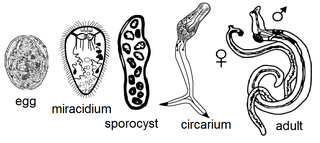
Trematodes, commonly known as flukes, are parasitic flatworms. They range in size from 1 millimeter to several centimeters. Most of these parasitic worms have flat, leaf-shaped symmetrical bodies with oral and ventral suckers allowing them to attach and move. Trematodes can be external parasites, internal parasites attaching to internal organs, or semi-external parasites attaching to the lining of the mouth or gills. They have a digestive system composed of a pharynx, esophagus, and intestine. Trematodes do not have an anus so all digested food is regurgitated after digestion. Trematodes do not have a circulatory system. Most trematodes are hermaphroditic and use muscles to glide or creep.
 |
Examples include:
- Schistosoma haematobium
- S. mansoni
- S. japonicum
Helminths have different modes of transmission, or ways they are transmitted from host to host. Modes of transmission include fecal-oral, transdermal, vector-borne, and predator-prey.
Fecal-Oral
Most infections by helminth result from accidental ingestion. Fecal-oral transmission occurs when eggs or larvae are passed in the fecal matter of a host and ingested by another organism. For example, in areas with unsanitary and contaminated water, eggs from hosts carrying tapeworms may be passed in fecal matter and enter the water system. As the contaminated water is ingested by another person, eggs enter the body and continue the lifecycle in the new host. Whipworms (Trichuris) utilize this mode of transmission.
Transdermal
Infection can also occur by soil-transmitted helminths. Transdermal transmission occurs when an infective form of the helminth in soil penetrates the skin of organisms. After penetration, the helminth moves to tissues where it can develop and produce eggs. The eggs are then passed from the host through feces. Hookworms are a type of helminth that utilize transdermal transmission.
Vector-Borne
Another way a person can be infected by a helminth involves a person being bit by an insect that is infected with helminths. This is referred to as vector-borne transmission. A vector is an organism that is able to carry a parasite from one host to another. The most common vectors of parasites include mosquitoes, snails, and flies. Onchocerca microfilariae is a helminth ingested by blackflies (vector). When the fly bites its host, the parasite is transmitted. Eggs from the parasitic Schistosoma helminth infect snails. The snails become a host where the parasite grows and reproduces to later be transmitted to other organisms.
Predator-Prey
Predator-prey transmission utilizes two distinct hosts. Helminth transmission occurs as the predator consumes infected prey. Once the prey becomes infected, the helminth reproduces and releases the infective stage of the parasite via feces. Organisms in the environment that come in contact with the infective stage become hosts.
Parasitic worms are worms classified as a parasite. Parasites are organisms that live and feed on a living host at the expense of the host. They are most commonly found in rural or developing areas such as Ethiopia and Honduras that tend to have contaminated water and poor sanitation. China also has a high prevalence of parasitic infection. Helminth are large, multicellular, free-living, or parasitic worms. There are three types of helminth infection: fecal-oral, vector, and entry through the skin. Common symptoms of infection with helminths include confusion, bloody stool, and nausea. Nematodes, also called roundworms, are any worm in the phylum Nematoda. These helminths have long, round, smooth, unsegmented bodies with an anterior mouth and digestive tract. Cestodes, commonly referred to as tapeworms, are long, flat, ribbon-like, multi-segmented flatworms divided into a head called a scolex that contains nerves functioning like a brain, neck, and segments. Cestodes are hermaphroditic, having both male and female sex organs. Trematodes, commonly known as flukes, are parasitic flatworms. Most trematodes are also hermaphroditic.
Helminths have different modes of transmission or ways they are transmitted from host to host. Fecal-oral transmission occurs when eggs or larvae are passed in the fecal matter of a host and ingested by another organism. Transdermal transmission occurs when an infective form of the helminth in soil penetrates the skin of organisms. Another way a person can be infected by a helminth involves a person being bit by an insect that is infected with helminths. This is referred to as vector-borne transmission. A vector is defined as an organism that is able to carry a parasite from one host to another. Some examples of vectors are mosquitoes, snails, and flies. In predator-prey transmission the parasite utilizes two distinct hosts. Transmission begins with infected prey. As the predator consumes infected prey it becomes infected. The helminth reproduces and releases the infective stage of the parasite via feces.
Video Transcript
Worm Infection
Juan is a 12-year-old boy who lives in a farming town located in the Central American county of Honduras. The town that Juan lives in is quite poor and has a very primitive sewer system that is not very sanitary. Although Juan is only 12, he is very helpful around his family's farm, which grows sugarcane.
Recently, Juan has been feeling very nauseous and tired. At first Juan and his family just thought it was a common stomach bug, but then Juan noticed blood in his stools. Worried about their son, Juan's parents immediately took him to the nearest hospital to get checked out. After running several tests on Juan, a doctor informed the family that Juan had been infected with intestinal helminths.
What are Helminths?
Helminths are parasitic worms that can infect the tissues and intestines of a person. Symptoms of helminth infections include nausea, vomiting, abdominal pains, confusion, and gastrointestinal bleeding. Helminths are found throughout the world but are most commonly found in Central and South America, Africa, and East Asia. These worms can infect a person in several different ways.
- With fecal-oral transmission, the worm lives in the intestines of an infected person and lays eggs that end up in the feces of the person. The person's feces then contaminates soil or water, and a person ingests this contaminated soil or water. This type of transmission is common in poor areas that do not have proper sewer systems and sanitation practices, such as Juan's town.
- Transdermal transmission means that larvae in the soil or water actively infect a person by crawling through their skin and traveling into their intestines.
- The term vector-borne transmission refers to when worms infect another animal (vector) such as the blackfly. The blackfly then bites a person, causing the worm to infect the person as well.
- Predator-prey transmission begins when worms infect an animal that is killed and eaten, causing the worms to infect the person as well.
It's important to not confuse helminths with other parasitic organisms, such as protozoa. Helminths differ from protozoa in a couple different ways. The biggest difference between them has to do with their structure and size. Protozoa are single-celled, microscopic organisms, while helminths are made up of many cells and can be seen with the naked eye. Another important difference between these two parasitic organisms is that protozoa are able to reproduce and multiply while living inside a human body, while adult helminths are unable to do so.
There are three main types of helminths: nematodes, cestodes, and trematodes.
Nematodes
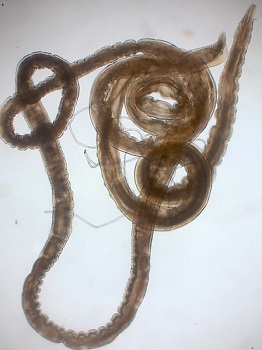
Nematodes (also known as roundworms) have a long, thin, tubular body, which make them look very similar to an earthworm. These worms have a complete digestive tract that includes a mouth, esophagus, intestines, and anus. Nematodes have both male and female worms, with the males usually being smaller than the females. Specific examples of roundworms include Ascaris, Enterobius, hookworms, Trichinella, and Trichuris (also known as whipworms).
 |
Cestodes
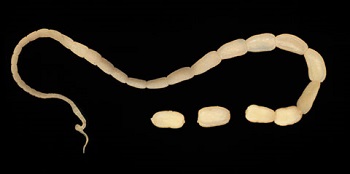
Cestodes (also known as tapeworms) have a long, flat, segmented body. The top segment of the cestode is called a scolex (head) that contains nerves that function as the brain. These worms do not have a complete digestive tract, and they absorb nutrients through the outer covering of their body. All cestodes are hermaphrodites, meaning each worm has both male and female reproductive organs. An example of a specific type of tapeworm is Taenia.
 |
Trematodes
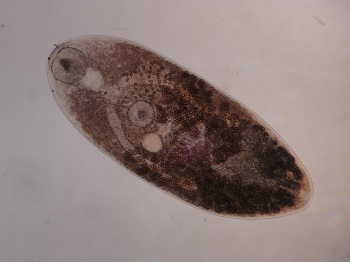
Trematodes (also known as flukes) have flat, wide bodies that are shaped very similar to a leaf. These worms can attach to hosts by using their suckers that are located on their mouths and ventral (stomach) region. Most trematodes are hermaphrodites; however, some types of trematodes have separate male and female worms. An example of a specific type of fluke is Schistosoma.
 |
Lesson Summary
Helminths are parasitic worms that can infect the tissues and intestines of a person. These worms can infect a person in the following ways:
- Fecal-oral – The worm lives in the intestines of an infected person and lays eggs that end up in the feces of the person. The person's feces then contaminates soil or water, and a person ingests this contaminated soil or water.
- Transdermal – Larvae in the soil or water actively infect a person by crawling through their skin.
- Vector-borne – The worms infect another animal (vector) such as a blackfly. The blackfly then bites a person, causing the worm to infect the person as well.
- Predator-prey – The worms infect an animal. A person kills and eats this animal, causing the worms to infect the person as well.
There are three main types of helminths, which include the following:
- Nematodes (also known as roundworms) have a long, thin, tubular body and a complete digestive tract. Nematodes have both male and female worms, with the males usually being smaller than the females.
- Cestodes (also known as tapeworms) have a long, flat, segmented body that includes a scolex (head). These worms absorb nutrients through the outer covering of their body and are hermaphrodites, meaning each worm has both male and female reproductive organs.
- Trematodes (also known as flukes) have flat, wide bodies that contain suckers on the mouth and stomach. Most trematodes are hermaphrodites; however, some types of trematodes have separate male and female worms.
Medical Disclaimer: The information on this site is for your information only and is not a substitute for professional medical advice.
Register to view this lesson
Are you a student or a teacher?
Unlock Your Education
See for yourself why 30 million people use Study.com
Become a Study.com member and start learning now.
Become a MemberAlready a member? Log In
BackResources created by teachers for teachers
Over 30,000 video lessons
& teaching resources‐all
in one place.


I would definitely recommend Study.com to my colleagues. It’s like a teacher waved a magic wand and did the work for me. I feel like it’s a lifeline.
Jennifer B.
Teacher

Back

Helminths | Definition, Transmission & Examples Related Study Materials
Explore our library of over 88,000 lessons
Browse by subject