Science Courses / Course

Rotational Inertia: Physics Lab

Lesson Transcript
Instructor David Wood

David has taught Honors Physics, AP Physics, IB Physics and general science courses. He has a Masters in Education, and a Bachelors in Physics.

In physics, the rotational inertia of an object varies based on its mass. Explore the rotational inertia of a flywheel with this step-by-step lab, and learn how to analyze the acquired data.

Rotational inertia, also known as moment of inertia, is the rotational equivalent of mass; a quantity that resists changes in the rotation of an object. Rotational motion is similar to linear motion. In linear motion, more massive objects resist changes in their velocity; in rotational motion, objects with more rotational inertia resist changes in their angular velocity. An object with more mass will have more rotational inertia, but the way the mass is distributed around the rotation point also has an effect on rotational inertia. If your mass is a long way away from the point of rotation, the object has more rotational inertia than if it is close by.

Today we're going to investigate rotational inertia and try to calculate a value of rotational inertia for a flywheel.

An error occurred trying to load this video.

Try refreshing the page, or contact customer support.

Your next lesson will play in 10 seconds
  • 0:01 What Is Rotational Inertia?
  • 0:50 Physics Lab Steps
  • 3:10 Data Analysis
  • 4:51 Lesson Summary

For this physics lab, you will need:

  • A flywheel
  • An axle for the flywheel
  • A mount for the axle that will allow it to rotate
  • A weight hanger
  • Slotted weights
  • A stop watch
  • A meter ruler
  • String
  • Duct tape
  • A protractor

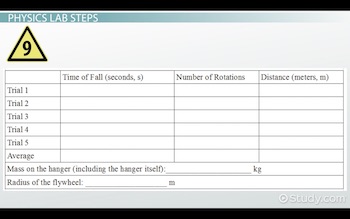
Step 1: Assemble the equipment. The flywheel should be on the axle and the axle attached to its mount, allowing it to freely rotate. Put a piece of duct tape on the side of the flywheel so that you can more accurately see how it is spinning.

Step 2: Tie one end of a long piece of string to a stationary support near the axle, then wind the string around the axle until there is little free string remaining.

Step 3: Attach some weights to the weight hanger, and tie the other end of the string to the top of the hanger. The weight should be hanging not far below the axle.

Step 4: Measure the height of the hanging mass above the ground.

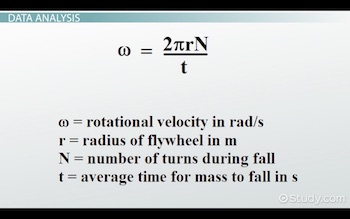
Now that you have your data, it's time to analyze it. In this motion, the gravitational potential energy of the mass is changed into kinetic energy. But because the mass is also turning the flywheel, some of the gravitational potential energy is instead turned into rotational energy. Therefore, we can say the gravitational potential energy in the mass at the start is equal to the kinetic energy in the mass right before it hits the ground plus the rotational energy in the flywheel right before it hits the ground.

Rotational inertia, also known as moment of inertia, is the rotational equivalent of mass; a quantity that resists changes in the rotation of an object. Just as with linear motion, more massive objects resist changes in their velocity. In rotational motion, objects with more rotational inertia resist changes in their angular velocity. An object with more mass will have more rotational inertia, but the way the mass is distributed around the rotation point also has an effect on rotational inertia. If your mass is a long way away from the point of rotation, the object has more rotational inertia than if it is close by.

Using these concepts and an energy equation, we were able to investigate rotational inertia, calculating it for a flywheel.

After you have finished with this lesson, you'll be able to:

Register to view this lesson

Are you a student or a teacher?

Unlock Your Education

See for yourself why 30 million people use Study.com

Become a Study.com member and start learning now.

Become a Member  Back

Resources created by teachers for teachers

Over 30,000 video lessons & teaching resources‐all in one place.
Video lessons
Quizzes & Worksheets
Classroom Integration
Lesson Plans

I would definitely recommend Study.com to my colleagues. It’s like a teacher waved a magic wand and did the work for me. I feel like it’s a lifeline.

Jennifer B.
Teacher
Jennifer B.
Create an account to start this course today
Used by over 30 million students worldwide
Create an account