Copyright
Science Courses / Course

Parathyroid Gland: Calcium Metabolism, Osteoclasts & PTH

Lesson Transcript
Instructor Rebecca Gillaspy

Dr. Gillaspy has taught health science at University of Phoenix and Ashford University and has a degree from Palmer College of Chiropractic.

Parathyroid glands are endocrine glands on the posterior surface of the thyroid gland. Parathyroid glands play a vital role in regulating the minerals calcium and phosphorous in the body. Learn about the structure of parathyroid glands, and the role these glands play in regulating calcium, phosphorus, osteoblasts and osteoclasts in the body.

The thyroid gland is an endocrine gland that sits at the base of your neck. When we flip the thyroid gland over and take a look at its back side, we see that the posterior surface of the thyroid gland contains tiny masses of glandular tissue that serve an entirely different function from that of the thyroid. In this lesson, we will learn about these small endocrine glands, referred to as the parathyroid glands, and the role they play in balancing calcium levels within the body.

The parathyroid glands are located on the posterior surface of the thyroid gland.
Parathyroid Glands

An error occurred trying to load this video.

Try refreshing the page, or contact customer support.

Your next lesson will play in 10 seconds
  • 0:04 Parathyroid Gland
  • 1:28 Parathyroid Hormone (PTH)
  • 3:15 Osteoclasts and Osteoblasts
  • 3:53 Calcium Balance
  • 5:37 Lesson Summary

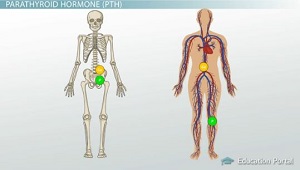
A hormone that comes from the parathyroid glands is conveniently called a parathyroid hormone (PTH). So, we see that parathyroid hormone is defined as a hormone produced by the parathyroid glands that regulates the amount of calcium and phosphorus in the body.

Calcium is an important ion that has a wide variety of effects on the body. We usually think of calcium when we think of bone formation, but it's also important for proper muscle contraction and proper cell membrane permeability.

Phosphorus, like calcium, is needed for bone formation. Among other things, it combines with lipids to form a major structural component of all cell membranes, which we know as phospholipids.

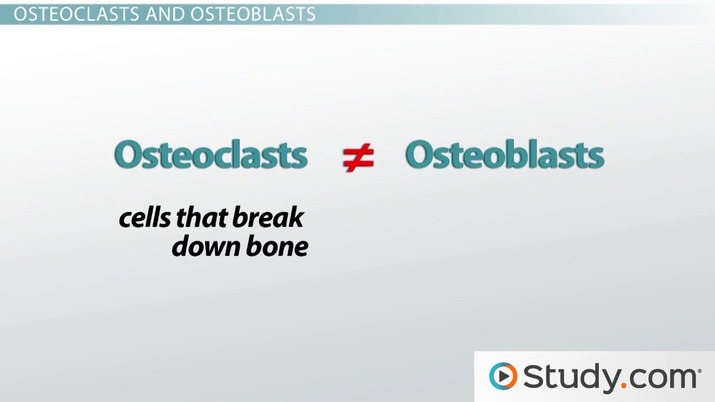
Osteoclasts are cells that break down bone. Osteoblasts do the opposite action, and therefore, we see that osteoblasts are cells that make bone. You can keep these straight by thinking of osteoclasts as chewing bone as it breaks it down and osteoblasts as building bones.

So, when we put everything together, we see that a decrease in blood calcium levels triggers the release of parathyroid hormone, which stimulates osteoclasts to break down bone. This frees calcium to enter the blood, restoring the level to normal.

One thing that's very apparent when learning about the endocrine system is that the release of a hormone is often dependent on maintaining homeostasis - and this is the case with parathyroid hormone. We see that the secretion of parathyroid hormone happens when blood calcium levels drop too low. So, you might be wondering: what happens if blood calcium levels get too high?

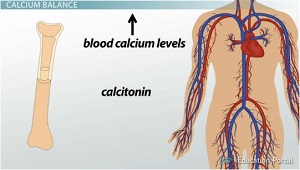
This gives us an opportunity to reintroduce a hormone we previously learned about called calcitonin. Calcitonin is a hormone secreted by the thyroid gland that lowers blood calcium levels.

In other words, parathyroid hormone puts calcium in the blood, and calcitonin clears it out of the blood. It's almost as if these two hormones, parathyroid hormone and calcitonin, are constantly locked in a tug-of-war match.

Let's review. Parathyroid hormone (PTH) is a hormone produced by the parathyroid glands that regulates the amount of calcium and phosphorus in the body.

Secretion of parathyroid hormone is stimulated by low blood calcium levels and inhibited by high blood calcium levels. Therefore, when blood calcium levels are too low, parathyroid hormone is released, which stimulates the breakdown of bone. This frees calcium to enter the blood, restoring the level to normal.

Following this lesson, you should have the ability to:

Register to view this lesson

Are you a student or a teacher?

Unlock Your Education

See for yourself why 30 million people use Study.com

Become a Study.com member and start learning now.

Become a Member  Back

Resources created by teachers for teachers

Over 30,000 video lessons & teaching resources‐all in one place.
Video lessons
Quizzes & Worksheets
Classroom Integration
Lesson Plans

I would definitely recommend Study.com to my colleagues. It’s like a teacher waved a magic wand and did the work for me. I feel like it’s a lifeline.

Jennifer B.
Teacher
Jennifer B.
Create an account to start this course today
Used by over 30 million students worldwide
Create an account