
Learn about the acetanilide formula and its structure. Understand the properties of acetanilide such as density, melting point, molar mass, and its applications.
Acetanilide Structure, Formula & Properties
Table of Contents
- What is Acetanilide?
- Acetanilide Structure
- Properties of Acetanilide
- Applications of Acetanilide
- Lesson Summary
Frequently Asked Questions
What is IUPAC name of acetanilide?
The IUPAC name of acetanilide is N-phenylacetamide. Acetamide has the formula CH3CONH2. The >CONH2 is the amide functional group. The nitrogen present forms a single bond with a benzene ring in the place of one of the two hydrogen atoms it has bonded with.
What are the structures of acetanilide?
Acetanilide has the acetamide molecule bonded to the benzene ring through the nitrogen atom of the amide group. Acetanilide shows two resonance structures that differ in the way atoms bond with each other.
What is the functional group of acetanilide?
The functional group present in acetanilide is the amide group, >CONH-. The nitrogen atom has two hydrogen atoms bonded to it in an amide. In acetanilide, one of the two hydrogen atoms gives way to a bond with a benzene ring.
Is acetanilide an acid or base?
Acetanilide is a weak base with a pH value near 8. It is a weak base because of the resonance structures it shows. The nitrogen atom of the amide group does not act as a proton acceptor or a nucleophile.
Table of Contents
- What is Acetanilide?
- Acetanilide Structure
- Properties of Acetanilide
- Applications of Acetanilide
- Lesson Summary
Acetanilide is an organic compound. Acetanil, acetanilid, acetamidobenzene, and N-acetylaminobenzen are the common names. It goes by the trade name Antifebrin. However, its IUPAC name is N-phenylacetamide.
Acetanilide Formula
The compound acetanilide's formula is {eq}CH_{3}CONHC_{6}H_{5} {/eq}. The compound has four different elements in its composition. There are eight carbon atoms, nine hydrogen atoms, one nitrogen atom, and one oxygen atom in the acetanilide structure.

Your next lesson will play in
10 seconds
Organic compounds have functional groups that determine their chemical behavior. Acetanilide has the amide functional group. The functional group has the representation
{eq}> CONH_{2} {/eq}
Acetanilide is a derivative of anilne. It consists of a benzene ring and a side chain. Its structure is:
 |
The functional group is the amide group. The functional group is highlighted in blue in the image below. {eq}R_{1} {/eq} in this case, is the phenyl group.
 |
Resonance Structures of Acetanilide
Chemists depict compounds with Lewis structures. The Lewis structures show the bonds between the atoms. The depictions can tell scientists at a glance what properties the compound might have. Sometimes, the Lewis structure of a compound fails to fully explain its chemical behavior. The phenomenon of resonance causes this disparity. A polyatomic molecule may have two or more contributing structures and the electrons in the bonds keep oscillating between them. These contributing structures are resonance structures. Resonance structures give more stability to the molecule or ion concerned and explain the behavior of certain compounds.
Acetanilide shows resonance structures.
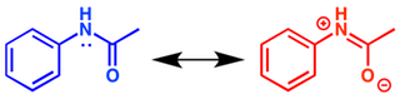 |
The first structure is the common representation of the acetanilide structure. The nitrogen in the amide group has a lone pair of electrons. It is a nucleophile. It can accept hydrogen ions or donate a lone pair of electrons to electrophiles. The compound exhibits basic chemical nature.
In the second structure, the electron shift has taken place. The nitrogen atom no longer has a lone pair of electrons, rather it has developed a positive charge. The oxygen atom has a negative charge and there is a double bond between the nitrogen and the carbon atom of the amide group.
Because of the shift in the electrons, nitrogen cannot act as a nucleophile or a hydrogen ion acceptor, nor can it donate lone pair of electrons to other structures. The nitrogen atom in this resonance structure has lost its property to act as a base. Chemically, the second structure shows it is less basic than the first structure.
Acetanilide has the following properties:
- Its appearance is in the form of white leaflets or flakes.
 |
- Acetanilide's molar mass is 135.17 g/mol.
- The density of acetanilide is 1.219 g/cc
- Its melting point range is {eq}113 {/eq} to {eq}115^{o}C {/eq}
- Acetanilide is slightly soluble in water. Less than 5 g of the compound dissolves in one liter of water. It is more soluble in organic solvents.
- The boiling point of acetanilide is {eq}304^{o}C {/eq}
- Acetanilide has been in use for treating fever and pain since the late 19th century, but it causes negative side effects; it interferes with the oxygen-carrying capacity of hemoglobin in the body. Since then, only the compounds produced from acetanilide are in use in the pharmaceutical industry.
- Acetanilide finds use as an additive that prevents the decomposition of hydrogen peroxide. It acts as a negative catalyst in the decomposition of hydrogen peroxide.
- It has an application as an accelerator in the rubber industry. An accelerator is a chemical added to rubber during vulcanization. The chemical added speeds up the vulcanization at a lower temperature.
- Varnishes like cellulose ester have acetanilide as an additive.
- Polymers have acetanilide as a plasticizer. Plasticizers are the compounds added to enhance the flow of the polymer during its production. The plasticizer does not change the chemical structure and properties of the polymer.
- In the pharmaceutical industry, acetanilide is the base for producing acetaminophen, a pain-reducing drug. Researchers discovered that acetanilide changed into acetaminophen in the body and that compound has the analgesic effect.
- Sulfanilamide, a pharmaceutical drug, is a topical antibiotic for curing bacterial infections. It belongs to a family of pharmaceutical compounds known as sufa drugs.
- Cellulose-based fabrics get a bright red color when treated with the dye Para Red. The dye is a derivative of aniline. It is an azo dye. The starting materials for making Para Red are p-nitroaniline and p-naphthol.
Acetanilide is a compound derived from anile and acetamide. The acetanilide structure has four elements and the acetanilide formula is {eq}C_{6}H_{5}NHCOCH_{3} {/eq}
The functional group of acetanilide is the amide group. The compound has a molar mass of 135.17 g/mol, and a density of 1.219 g/cc. Its appearance is in the form of white leaflet crystals. It shows a slight solubility in water but has a higher solubility in organic solvents. The melting point range of acetanilide is between 113 to 115 degrees Celsius. Acetanilide is a weak base because of the resonance structures it shows. The compound is a starting material for many pharmaceutical drugs like sulfanilamide, a topical antibacterial, antifungal medicine. Aniline compounds form a part of the azo dyes, of which Para Red is an important one.
Video Transcript
Acetanilide
When you have a headache or muscle soreness what do you typically use to help make you feel better? Do you reach for Aleve, aspirin, or maybe Tylenol? There certainly are a lot of choices out there for over-the-counter pain management and most likely you have a particular option that works best for you and your needs.
Did you know that there's a pain medication that used to be quite common but is no longer in use? As it so happens, it's the main topic of our lesson today.
It's called acetanilide and although it used to be a commonly prescribed medication for light pain management, it quickly lost its allure among medical professionals after some serious toxicity concerns began to arise. Today, we're going to be talking about acetanilide in terms of its chemical formula, resonance structures, and some of its important derivatives. Let's get started!
Structure & Chemical Formula
Acetanilide is an organic chemical compound (meaning it's composed of carbon and hydrogen mostly) that is classified as an amide in terms of its functional group. This means that it has the carbonyl group (carbon-oxygen double bond) bonded directly to a nitrogen atom. It also contains an aromatic ring, which is a ring composed of six carbon atoms and an alternating double-single-double-single bonding pattern all around the ring.
 |
Acetanilide only contains four types of atoms, which include carbon, hydrogen, nitrogen, and oxygen. It's chemical formula tends to be written as C6 H5 NHCOCH3. The reason it's written that way is to help signify the different portions of the molecule. For instance, the C6 H5 portion of the chemical formula represents the aromatic ring, and the NHCOCH3 piece represents the amide functional group.
A lot of times, it's helpful to break molecules up into parts in order to simplify them. It's kind of like taking what looks like a complex math problem. Although you may think it's impossible to solve, once you break it down into simpler portions it begins to make more sense and is not so intimidating.
Resonance Structures
It turns out that acetanilide's structure can be represented by either of two structures, which are related to each other by resonance. Resonance structures are different representations of the same molecule, due to the arrangement of bonds and electrons. The first structure of acetanilide is exactly like the one we saw previously, but notice how the second is different.
 |
In the second resonance structure, notice that the lone pair of electrons that was on the nitrogen atom are gone, and there is a negative charge on the oxygen atom. Also, there is now a double bond between nitrogen and the carbon atom of the carbonyl group. This is a very nice example of how resonance works. We haven't changed anything about the molecule's identity, just the way the bonds are distributed between the atoms.
This is also a good illustration that helps to explain why the nitrogen atom of acetanilide cannot act as a base (in other words, a hydrogen ion acceptor) nor as a nucleophile (an electron pair donor). It's because the lone pair of electrons is tied up in resonance. Imagine if someone tied up your right arm and you happened to be right handed. You wouldn't be able to write or throw, correct? It's the same kind of idea when we 'tie up' the electrons on the nitrogen atom through resonance, they can't be used anymore!
Derivatives
Acetanilide itself isn't used any longer as a pain reliever due to its toxic side effects. But that doesn't mean that the compound became completely obsolete altogether. Acetanilide finds use as a starting material in the synthesis of another compound known as para red, which is a very bright red-colored chemical dye used by the textile industry. Para red is considered a derivative of acetanilide, simply because it's 'derived' from the compound as a building block.
Another important derivative of acetanilide is a molecule called sulfanilamide. Sulfanilamide can be prepared from acetanilide very easily, even by students in introductory organic chemistry laboratory courses, and is known for its antibacterial properties. Sulfanilamide belongs to a class of pharmaceuticals called sulfa drugs, which are extremely important for their wide range of medicinal applications.
Lesson Summary
Acetanilide is an organic chemical compound that's classified as an amide in terms of its functional group, and additionally contains an aromatic ring. Acetanilide only contains four types of atoms, which include carbon, hydrogen, nitrogen, and oxygen. It's chemical formula is usually written as C6 H5 NHCOCH3.
Acetanilide's structure can be represented by either of two structures, which are related to each other by resonance. Resonance structures are different representations of the same molecule in which they differ from one another in the way the bonds and electrons are arranged. The resonance structures of acetanilide help explain the fact that the nitrogen atom is neither capable of acting as a base nor as a nucleophile.
Important derivatives of acetanilide include:
- Para red: a bright red-colored chemical dye used by the textile industry.
- Sulfanilamide: a sulfa drug derived from acetanilide known for its antibacterial properties.
Register to view this lesson
Are you a student or a teacher?
Unlock Your Education
See for yourself why 30 million people use Study.com
Become a Study.com member and start learning now.
Become a MemberAlready a member? Log In
BackResources created by teachers for teachers
Over 30,000 video lessons
& teaching resources‐all
in one place.


I would definitely recommend Study.com to my colleagues. It’s like a teacher waved a magic wand and did the work for me. I feel like it’s a lifeline.
Jennifer B.
Teacher

Back

Acetanilide Structure, Formula & Properties Related Study Materials
Explore our library of over 88,000 lessons
Browse by subject